Valuation · EV/EBITDA model
Is Zoetis (ZTS) stock undervalued?
On November 7, 2026, with the shares at $79.40, a quick EV/EBITDA model by Brief Equity valued Zoetis at about $102 for 2028. That is about 29% above the price, after a year in which Zoetis cut its revenue outlook and its dermatology sales fell 16% in each of the second and third quarters. Zoetis looks somewhat undervalued on that model, as long as its loss of dermatology market share settles and its new products add revenue in 2028.
By The Brief Equity Team · Model dated · Published
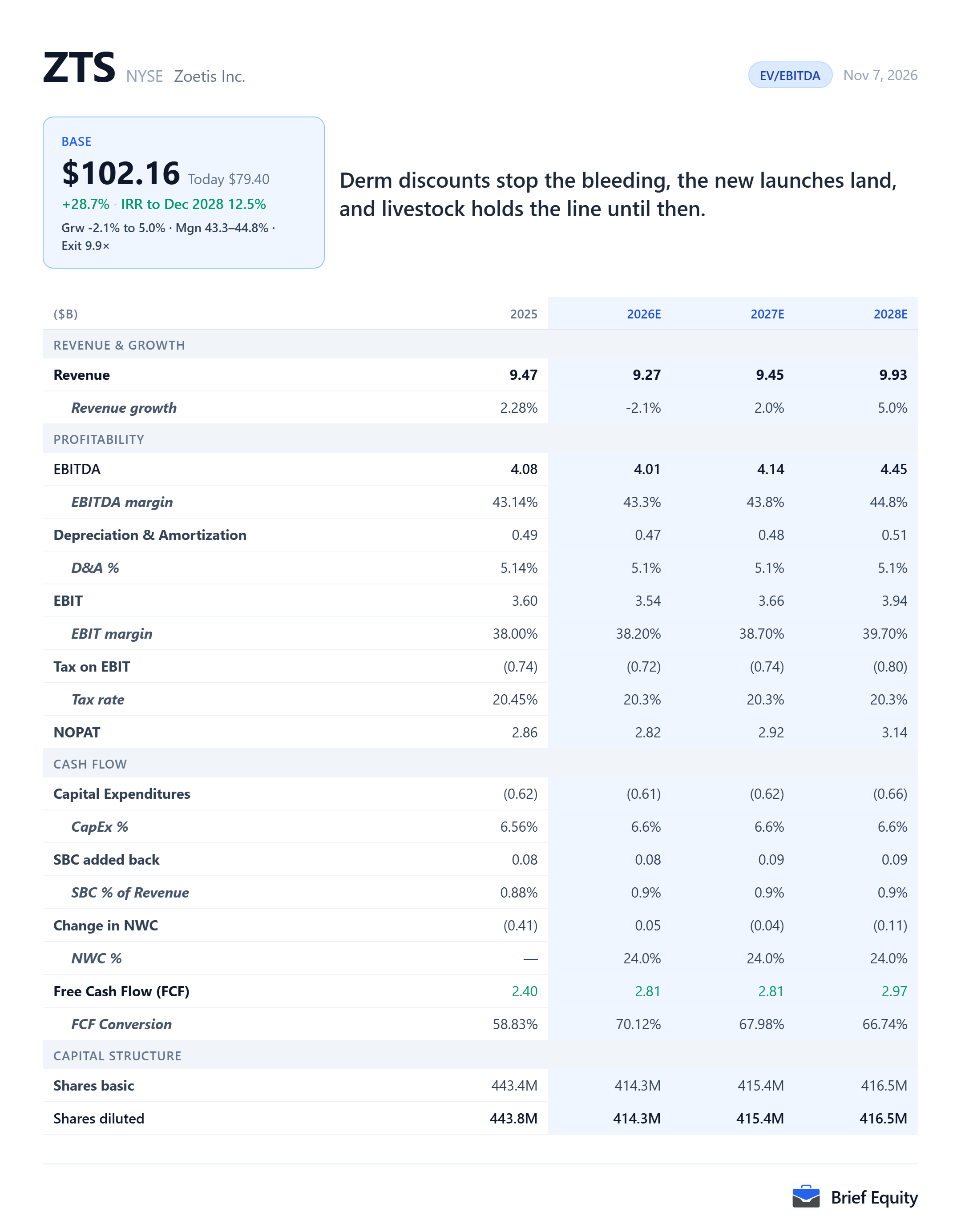
The model's assumptions for Zoetis
Zoetis's fiscal year is the calendar year, and the last year it has reported in full is 2025. The model runs three years, to 2028, and values the company on a multiple of its 2028 EBITDA. Every figure below is the model's own except the analysts' revenue, which is the consensus the model was built beside.
| 2026 | 2027 | 2028 | |
|---|---|---|---|
| Revenue, model | 9.27 | 9.45 | 9.93 |
| Revenue growth, model | -2.1% | 2.0% | 5.0% |
| EBITDA, model | 4.01 | 4.14 | 4.45 |
| EBITDA margin, model | 43.3% | 43.8% | 44.8% |
| Revenue, analysts' consensus | 9.27 | 9.34 | 9.67 |
Why Zoetis looks undervalued
Zoetis has had a difficult 2026. Its key dermatology products fell 16% in both the second and third quarters, its prices declined, and its full-year revenue outlook moved from $9.680 billion to $9.960 billion in May to $9.220 billion to $9.320 billion in November. The view here is that most of that damage has already happened.
Zoetis is defending its dermatology franchise with discounts, and its chief executive said the loss of dermatology market share slowed to 4 points in the third quarter, from about 7 points in the second. She described what the company is watching for:
“When we see two quarters where those shares pretty much stayed, we'll have a sense that those shares have stabilized, and we can then really focus more on gaining share and growing the market overall.”
Kristin Peck, Zoetis third-quarter 2026 earnings call, November 5, 2026
Zoetis says market share has historically settled 12 to 18 months after a competitor launches. Its new products, including long-acting Cytopoint, Simparica Duo and Lenivia in the United States, are expected to add little revenue in 2027, with their effect building into 2028.
“While we expect limited revenue contribution from these launches in 2027, their impact should build later in the year and into 2028.”
Jay Saccaro, Zoetis third-quarter 2026 earnings call, November 5, 2026
In the third quarter of 2026, Zoetis's livestock revenue grew 7% while U.S. companion animal revenue fell 8%. Zoetis also repurchased 17.7 million shares in the first nine months of 2026, at an average of $74.77 a share in the third quarter.
For Zoetis, the Brief Equity model takes revenue down 2.1% in 2026, then up 2.0% in 2027 and 5.0% in 2028, somewhat above the analysts' consensus. Its EBITDA margin rises from 43.3% to 44.8% as cost savings arrive. At 9.9 times 2028 EBITDA, close to where the shares trade now, that values Zoetis at about $102 a share in 2028, about 29% above the price of $79.40.
The main condition for this view is that Zoetis's loss of dermatology market share actually settles. Elanco, a competitor, reported on November 6, 2026 that its U.S. share of JAK itch treatments had grown 7 points from a year earlier.
What has to be true, and what would break it
The view that Zoetis looks undervalued at $79.40 rests on its dermatology market share settling and on its new products adding revenue by 2028.
What has to be true
- Zoetis's loss of U.S. dermatology market share settles within the 12 to 18 months the company says is typical after a competitor launches.
- The products Zoetis launches in 2027 add revenue in 2028, taking growth to about 5% that year.
- The EBITDA margin rises to about 44.8% by 2028 as cost savings arrive.
- The market pays about 9.9 times EBITDA for Zoetis in 2028.
What would break it
- Competitors keep gaining dermatology market share from Zoetis through 2027.
- Zoetis has to keep discounting to hold its share.
- The market pays a lower multiple of EBITDA for Zoetis than 9.9 times.
The parts of Zoetis's business
Zoetis reports two segments, the United States and International, and splits each into companion animal and livestock, with a small contract manufacturing and human health line beside them.
| Share of revenue | |
|---|---|
| U.S. companion animal | 44.6% |
| International companion animal | 25.0% |
| International livestock | 19.9% |
| U.S. livestock | 9.3% |
| Contract manufacturing and human health | 1.2% |
Zoetis beside its peers
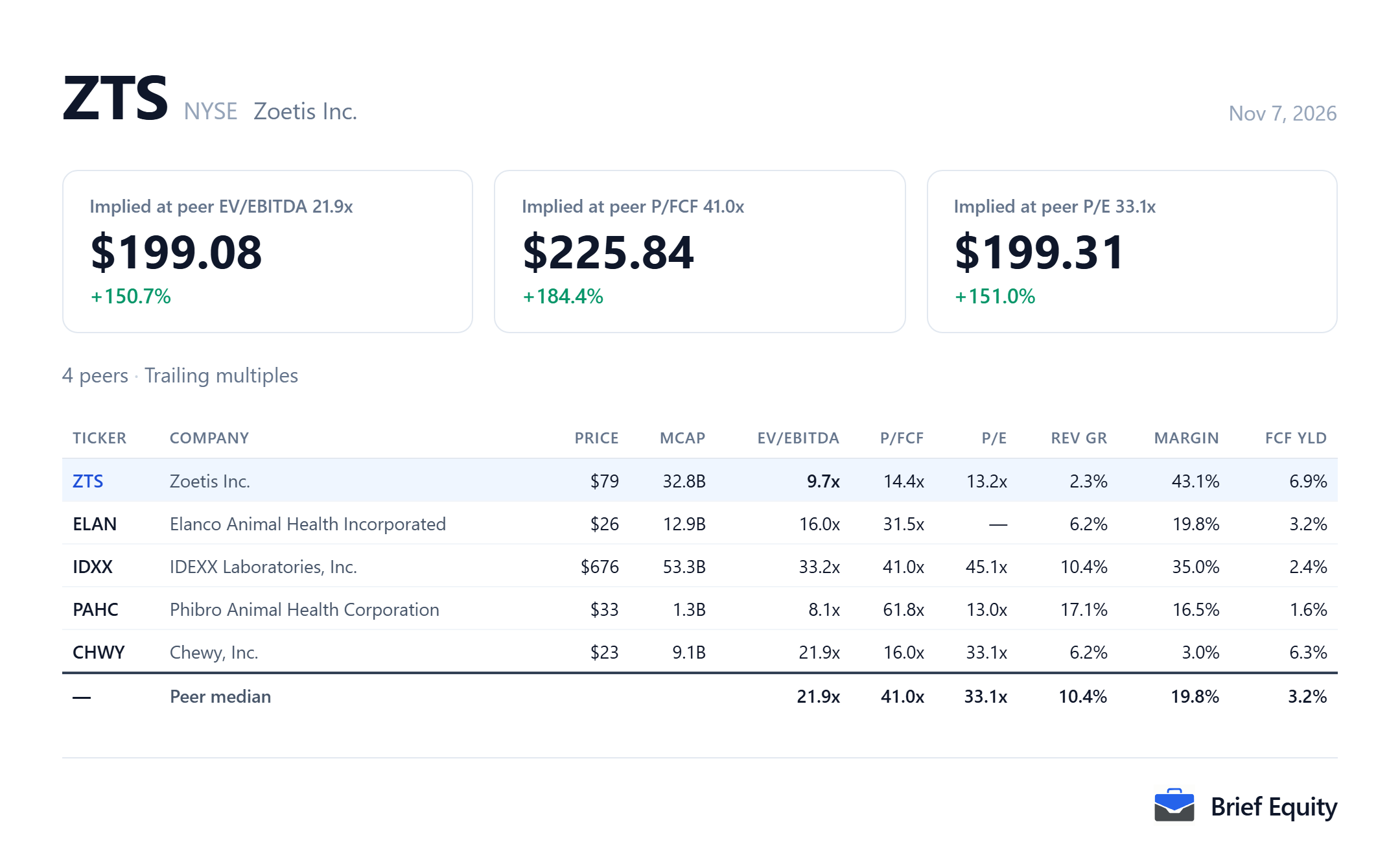
Zoetis is compared here with four U.S.-listed companies chosen for this post: its direct animal health rival, a pet diagnostics company, a livestock animal health company and an online pet retailer and pharmacy.
- ELAN: Animal health for pets and livestock, the direct rival
- IDXX: Pet diagnostics and veterinary clinic demand
- PAHC: Livestock animal health
- CHWY: Pet owner spending and the online pet pharmacy
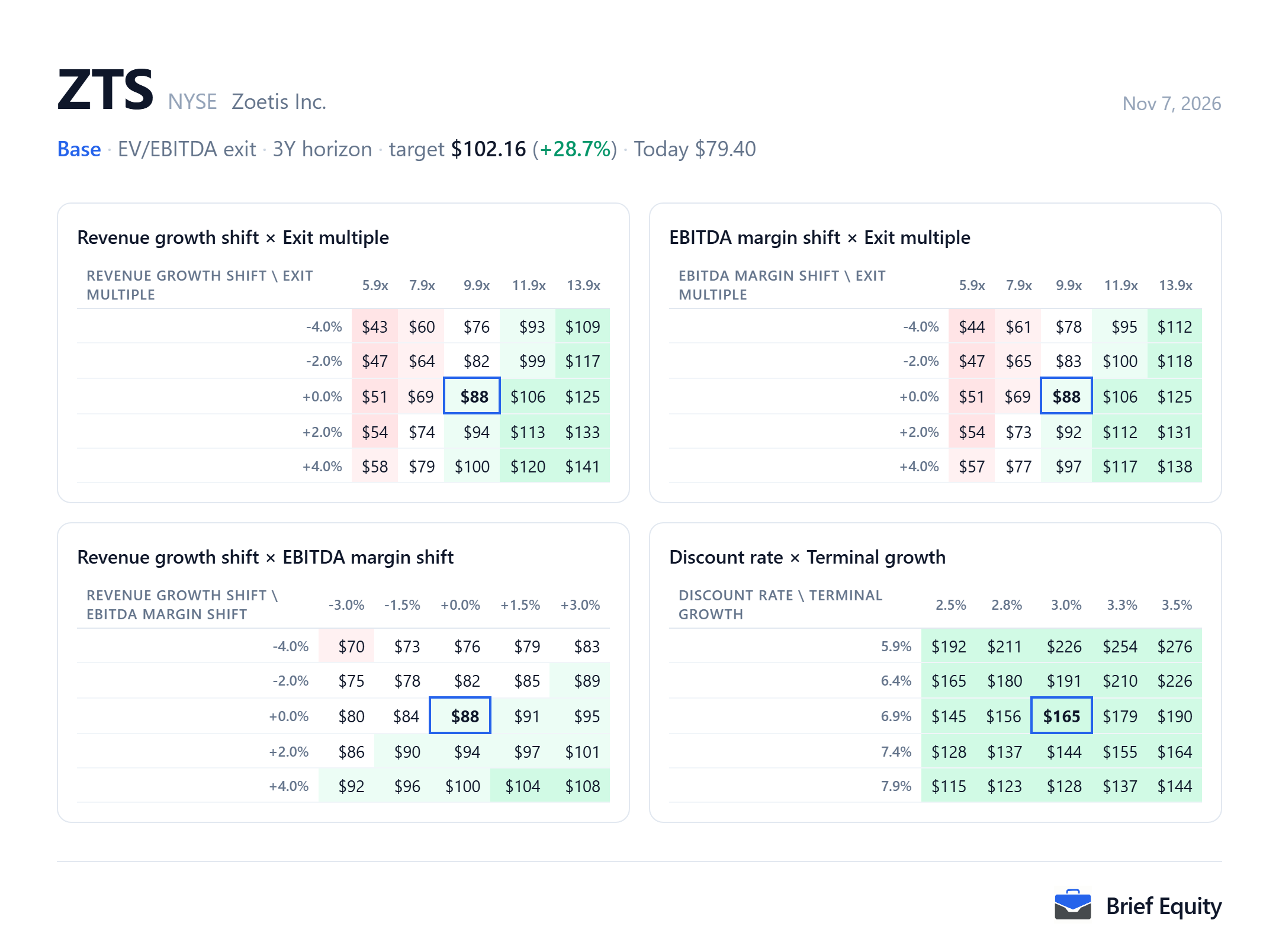
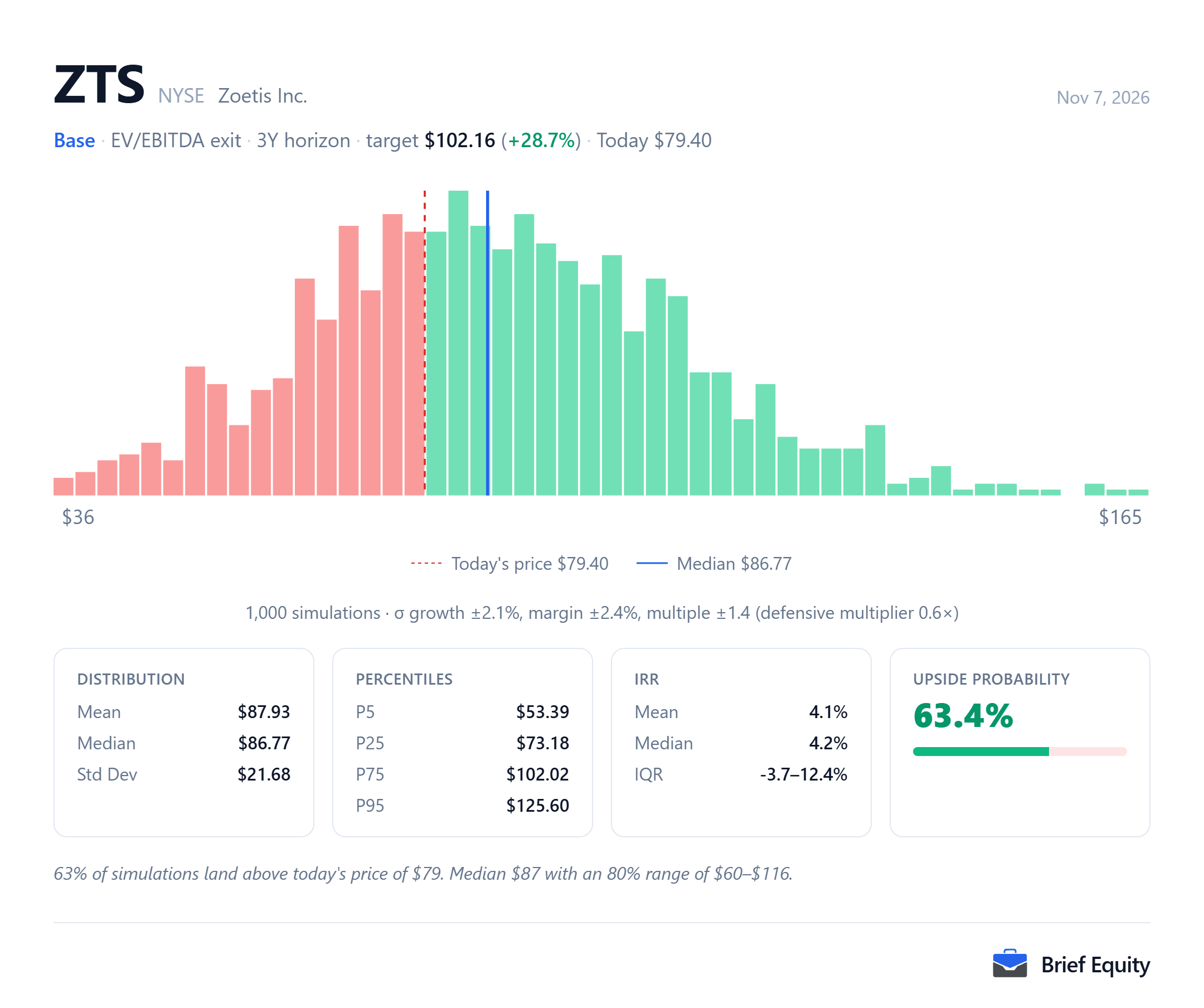
How the estimate moves with its assumptions
The two Zoetis cards below test the estimate: the sensitivity grids move two assumptions at a time, and the Monte Carlo card reruns the model many times with growth, margin and the exit multiple drawn at random.
Questions about Zoetis
These questions about Zoetis (ZTS) are answered from the documents listed under Sources.
- What revenue does Zoetis expect for 2026?
- On November 5, 2026, Zoetis narrowed its full-year 2026 revenue guidance to $9.220 billion to $9.320 billion, an organic operational decline of 1% to 2%.
- When will Zoetis give guidance for 2027?
- On its call of November 5, 2026, Zoetis said it was too early to give specific guidance for 2027. Its chief financial officer said the company would also share an update on the financial metrics it guides to on its fourth-quarter call.
- What convertible notes does Zoetis have outstanding?
- As of September 30, 2026, Zoetis had $2.0 billion of 0.250% convertible senior notes due June 15, 2029, with an initial conversion price of about $148.20 a share.
Sources
The quotations and facts about Zoetis (ZTS) on this page rest on the documents below.
- Zoetis annual report on Form 10-K for 2025, February 12, 2026
- Zoetis quarterly report on Form 10-Q for the third quarter of 2026, November 5, 2026
- Zoetis third-quarter 2026 results release, November 5, 2026
- Zoetis third-quarter 2026 earnings call, November 5, 2026
- Zoetis first-quarter 2026 results release, May 7, 2026
- Elanco third-quarter 2026 results release, November 6, 2026
About this page
Brief Equity and its team hold no position in Zoetis (ZTS) as of November 7, 2026.
This page is research, not investment advice. It describes one model and the assumptions behind it, and market data is delayed. Read how these models are built and our editorial policy.
Related guides: How to read a 10-K (SEC filing), How to research a stock before you buy, Where to read earnings transcripts and filings in one place.