Valuation · EV/EBITDA model
Is Twilio (TWLO) stock overvalued?
On October 31, 2026, with the shares at $205.03, a quick EV/EBITDA model by Brief Equity valued Twilio at about $249 for 2028. Twilio looks overvalued at that price unless AI voice grows enough to make up for slower growth in Messaging, which was 56.8% of its 2025 revenue, because the model reaches $249 only with an exit multiple of 65.2 times EBITDA.
By The Brief Equity Team · Model dated · Published
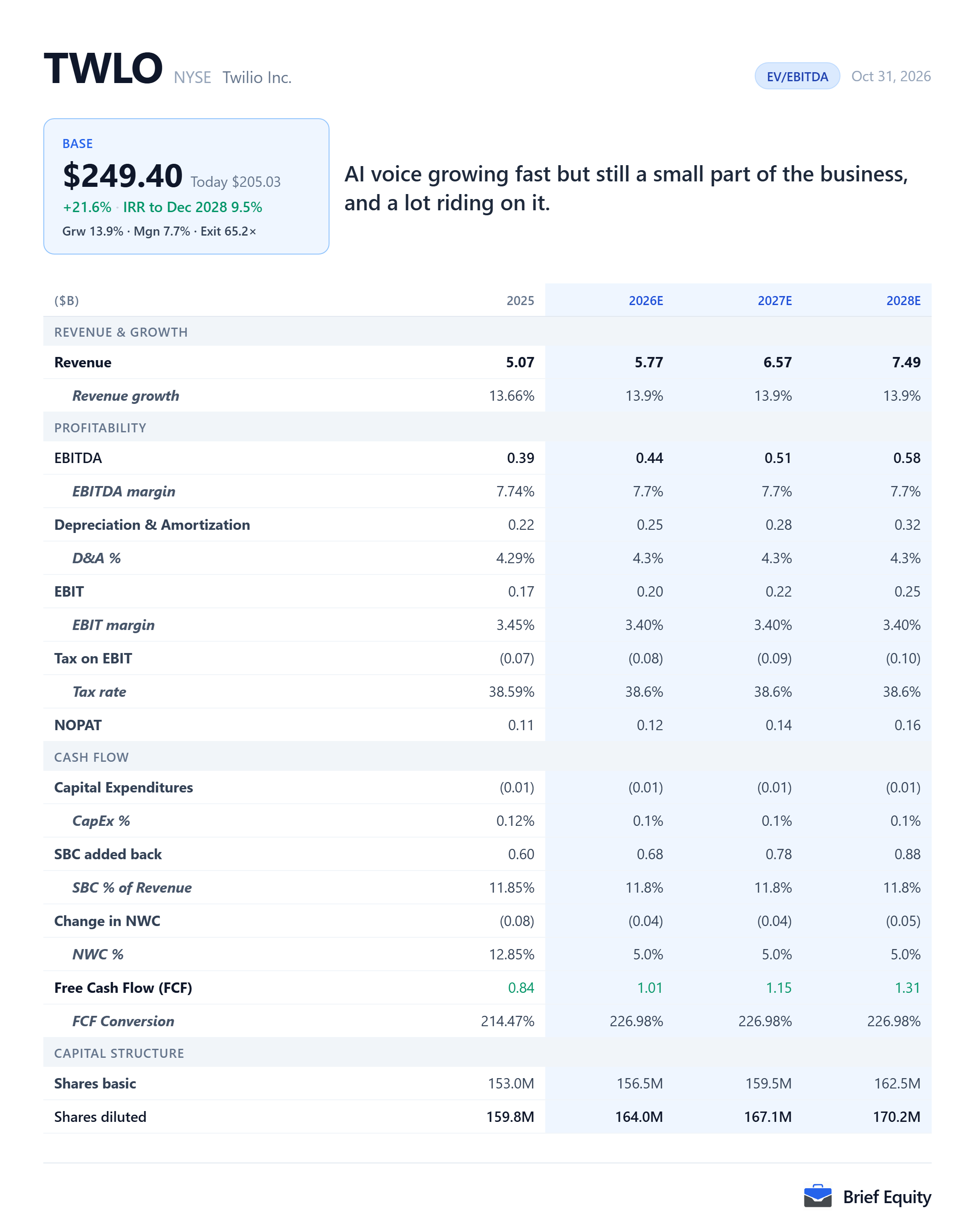
The model's assumptions for Twilio
Twilio's fiscal year is the calendar year. The model runs three years, to 2028, and every row below is the model's own except the analyst consensus revenue.
| 2027 | 2028 | |
|---|---|---|
| Revenue, model | 6.57 | 7.49 |
| Revenue growth, model | 13.9% | 13.9% |
| EBITDA, model | 0.51 | 0.58 |
| EBITDA margin, model | 7.7% | 7.7% |
| Revenue, analyst consensus | 6.77 | 7.48 |
Why Twilio looks overvalued
Twilio's shares closed at $205.03 on October 30, 2026, down 15.24% on the day. At that price, Twilio still looks overvalued unless AI voice grows enough to make up for slower growth in Messaging.
Twilio's voice business is growing. Voice revenue grew more than 20% in the third quarter of 2026, voice revenue from self-serve customers grew more than 50%, and one AI customer that spent in the low six figures a quarter with Twilio in the first quarter of 2025 has passed a $6 million annual run rate. Twilio's chief executive, Khozema Shipchandler, said on the October 29, 2026 call that AI voice is still a small share of the voice minutes available.
“But as I mentioned in my answer to the prior question, it's still 1% penetration in terms of the total available voice minutes out there.”
Khozema Shipchandler, Chief Executive Officer, Twilio third-quarter 2026 earnings call, October 29, 2026
Voice was 12.1% of Twilio's 2025 revenue. Messaging was 56.8% of Twilio's 2025 revenue and 72.7% of that year's revenue growth, and its organic growth slowed from 18% in the second quarter of 2026 to 17% in the third.
The model grows Twilio's revenue 13.9% a year through 2028, in line with analyst consensus of 13.9% a year from 2025 to 2028, and holds the EBITDA margin, measured after stock-based compensation, at 7.7%. With an exit multiple of 65.2 times EBITDA in 2028, the model values Twilio at about $249 a share for 2028, about 22% above the share price.
What has to be true, and what would break it
Twilio looks overvalued on this model as long as AI voice stays a small part of its business.
What has to be true
- AI voice stays near the 1% of available voice minutes Twilio's chief executive described in October 2026.
- Messaging, 56.8% of Twilio's 2025 revenue, keeps slowing after its organic growth fell from 18% to 17% in the third quarter of 2026.
What would break it
- The financial services, health care and insurance customers that Twilio's chief executive said drive the biggest voice volumes adopt AI voice at scale.
- Voice keeps growing more than 20% a year and becomes a much larger share of Twilio's revenue.
The parts of Twilio's business
Twilio reports one segment and splits its revenue into five product groups in its annual report. Messaging was 56.8% of Twilio's 2025 revenue and 72.7% of that year's revenue growth.
| Share of revenue | Share of revenue growth | |
|---|---|---|
| Messaging | 56.8% | 72.7% |
| Voice | 12.1% | 11.9% |
| 10.3% | 5.8% | |
| Segment | 6.0% | 0.9% |
| Other | 14.7% | 8.7% |
Twilio beside its peers
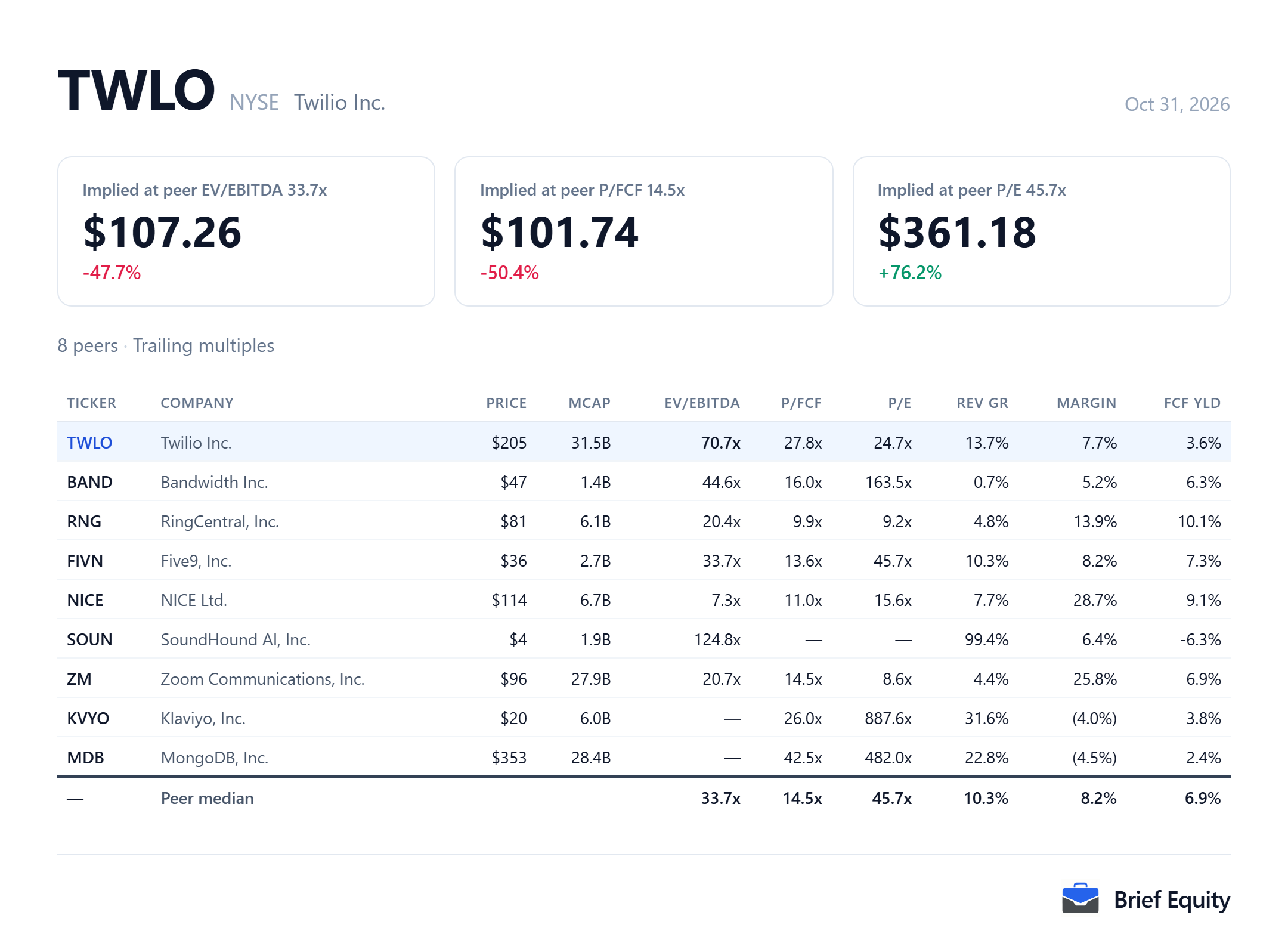
Twilio is compared here with eight US-listed companies, chosen to cover its voice and messaging network, contact-center voice, voice AI and its email and marketing products.
- BAND: Voice and messaging network, the closest match to Twilio
- RNG: Business phone systems
- FIVN: Contact-center voice and AI agents
- NICE: Customer-service software and AI
- SOUN: Voice AI
- ZM: Communications software at a similar size
- KVYO: Marketing texts and email, beside Messaging and Email
- MDB: Usage-priced developer software at a similar size
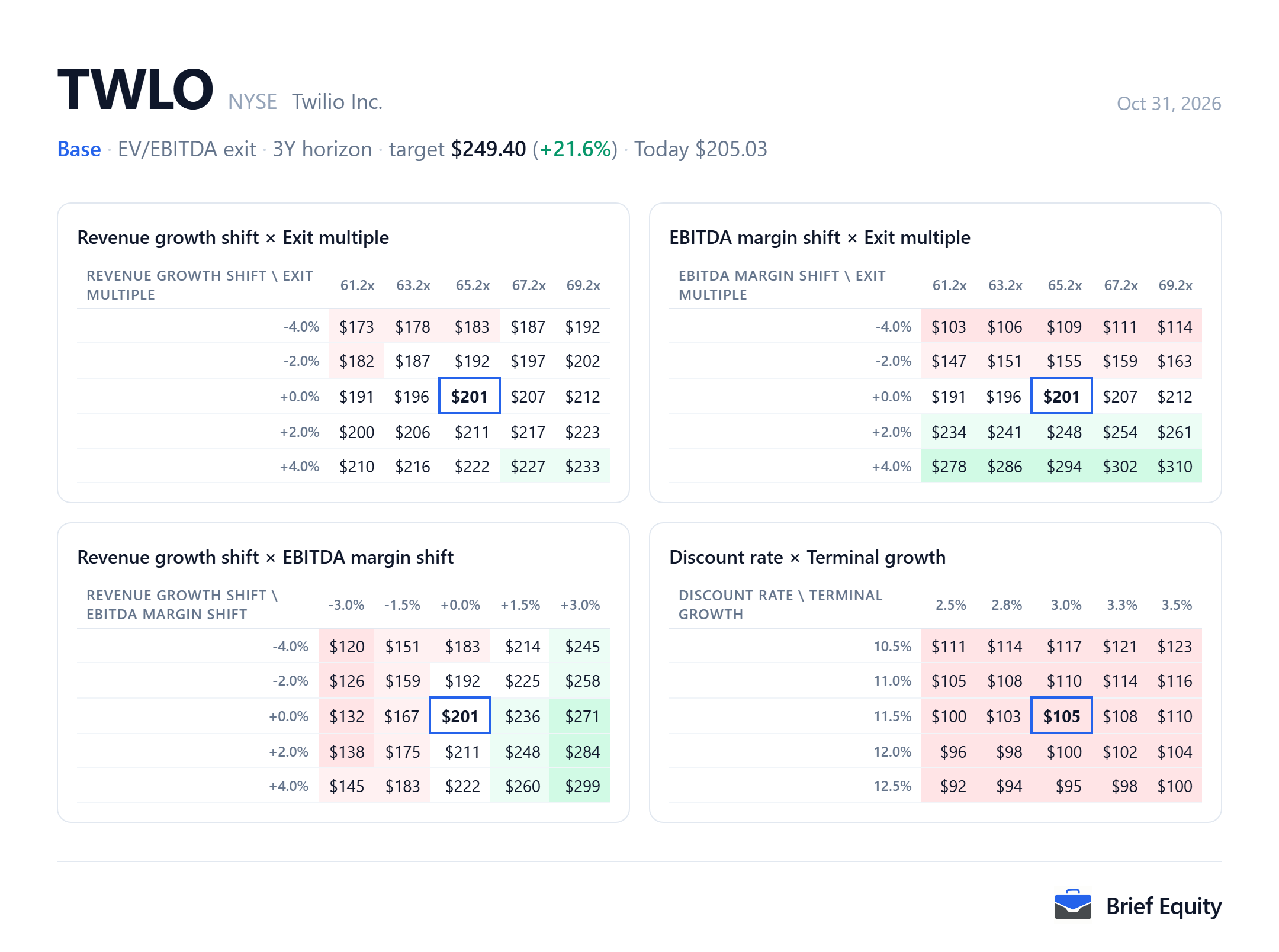
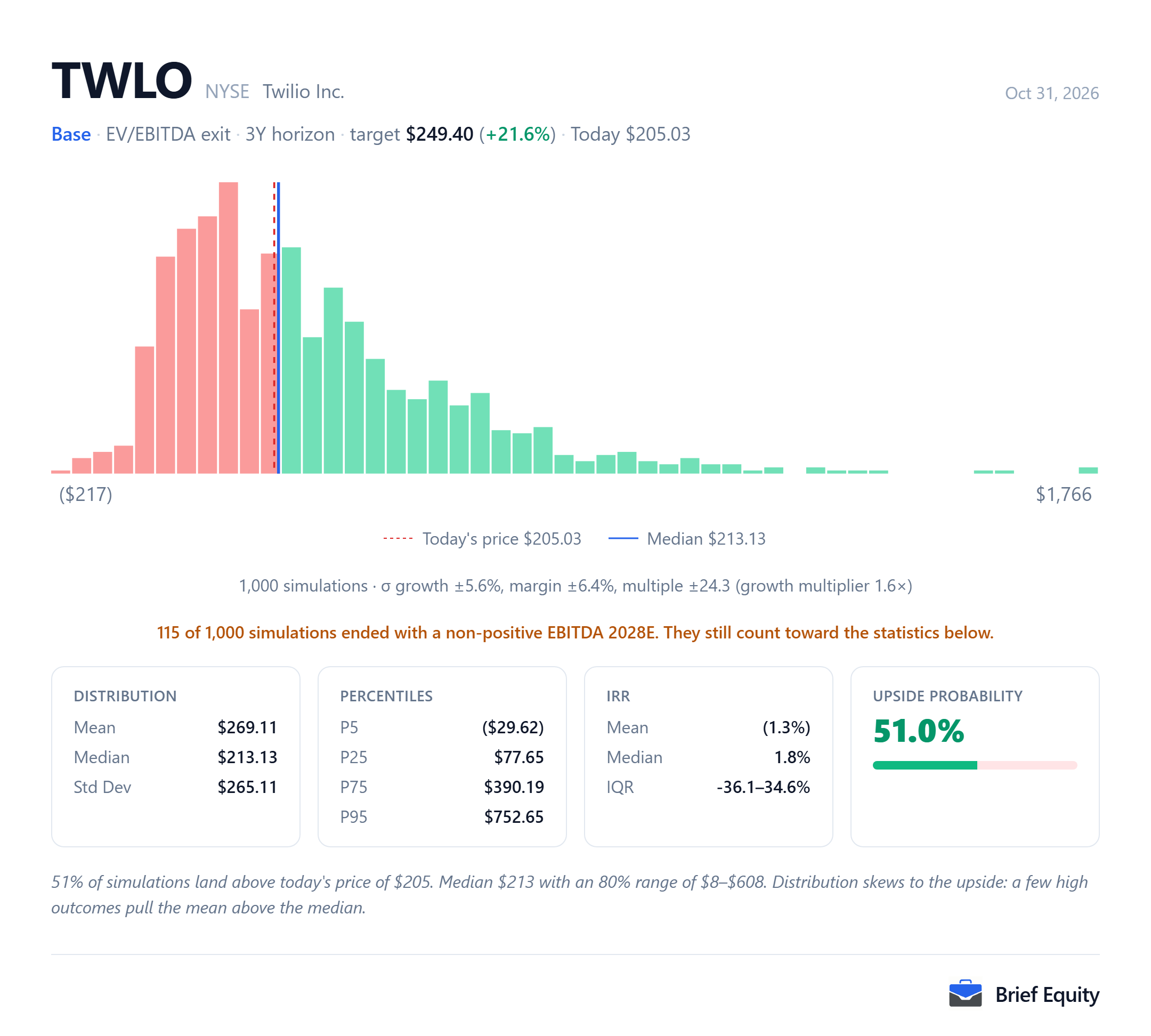
How the estimate moves with its assumptions
The two Twilio cards below test the estimate: the sensitivity grids move two assumptions at a time, and the Monte Carlo card reruns the model many times with growth, margin and the exit multiple drawn at random.
Questions about Twilio
These questions about Twilio (TWLO) are answered from the documents listed under Sources.
- What revenue growth does Twilio expect for 2027?
- On its October 29, 2026 call, Twilio said it expects 2027 organic revenue growth of at least 10%, above the 7% to 8% annual framework from its 2025 Investor Day.
- How much stock has Twilio bought back?
- As of September 30, 2026, Twilio had completed approximately $1.3 billion of repurchases under its $2.0 billion program and had approximately $700 million left, with the program set to expire on December 31, 2027.
- How much do US carrier fees add to Twilio's 2026 revenue guidance?
- Twilio's full-year 2026 revenue guidance, given on October 29, 2026, assumes approximately $245 million of incremental pass-through revenue from US carrier fees, which have no impact on its gross profit.
Sources
The quotations and facts about Twilio (TWLO) on this page rest on the documents below.
- Twilio third-quarter 2026 results release, October 29, 2026
- Twilio third-quarter 2026 earnings call, October 29, 2026
- Twilio annual report for 2025 (Form 10-K), February 24, 2026
- Twilio share price at the close on October 30, 2026, October 30, 2026
About this page
Brief Equity and its team hold no position in Twilio (TWLO) as of October 31, 2026.
This page is research, not investment advice. It describes one model and the assumptions behind it, and market data is delayed. Read how these models are built and our editorial policy.
Related guides: How to value a stock yourself (without Excel), How to write an investment thesis.