Valuation · EV/EBITDA model
Is Spotify (SPOT) stock overvalued?
Brief Equity's quick EV/EBITDA model of Spotify, dated October 27, 2026, puts the shares at about $467 for 2028, against a price of $557.13 that day. On those assumptions Spotify looks expensive, with the model's value about 16% below the price. The view rests on most of Spotify's growth from here coming from price increases rather than from new subscribers, while its EBITDA margin holds at 15%.
By The Brief Equity Team · Model dated · Published
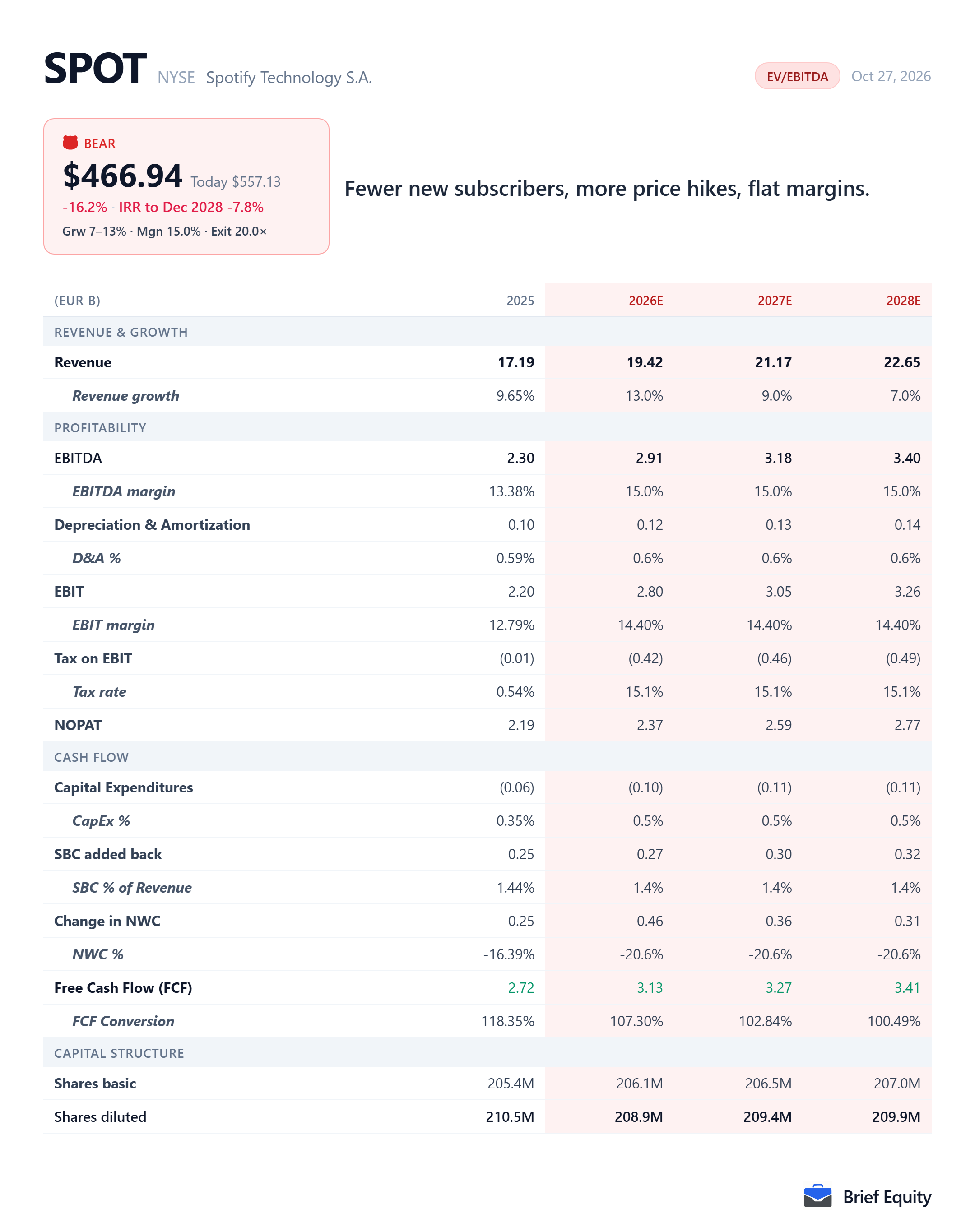
The model's assumptions for Spotify
Spotify's fiscal year is the calendar year and it reports in euros, so the tables below are in euros, while the share price and the model's value are in US dollars on its New York listing. The model runs three years, to 2028, and the second table sets the model's revenue beside analyst consensus revenue for the same years.
Reports in EUR. Price and per-share values in USD at 1.1153.
| 2026 | 2027 | 2028 | |
|---|---|---|---|
| Revenue, model | 19.42 | 21.17 | 22.65 |
| Revenue growth, model | 13.0% | 9.0% | 7.0% |
| EBITDA, model | 2.91 | 3.18 | 3.40 |
| EBITDA margin, model | 15.0% | 15.0% | 15.0% |
| 2026 | 2027 | 2028 | |
|---|---|---|---|
| Revenue, model | 19.42 | 21.17 | 22.65 |
| Revenue, analyst consensus | 19.57 | 22.47 | 25.53 |
Why Spotify looks overvalued
Spotify looks expensive at $557.13 if most of its growth from here comes from price increases rather than from new subscribers.
Price increases are doing much more of Spotify's growth than they were. In 2025 Premium average revenue per user fell 1% in euros, and Premium revenue grew mainly because the number of subscribers rose. In the nine months to September 30, 2026, price increases added €0.44 to Premium average revenue per user, while changes in product and market mix took €0.15 off it, and in the third quarter Premium average revenue per user rose 7.5% in constant currency against subscriber growth of 9%.
“For the nine months ended September 30, 2026 and 2025, Premium ARPU was €4.86 and €4.61, respectively, which represented an increase of 5%. This increase of €0.25 is primarily attributable to price increases, resulting in a €0.44 increase in Premium ARPU. This increase was partially offset by changes in product and market mix, decreasing Premium ARPU by €0.15, and unfavorable movements in foreign exchange rates, decreasing Premium ARPU by €0.04.”
Spotify interim condensed consolidated financial statements and operating review for the third quarter of 2026 (Form 6-K), October 22, 2026
Spotify's subscriber growth has slowed, from 11% in 2024 to 10% in 2025 and 9% in the year to September 30, 2026.
Spotify's operating margin has not moved with its pricing. In the third quarter of 2026 its gross margin was a record for a third quarter, but operating expenses rose about 26% against revenue growth of 16%, both as reported, and the operating margin was 13.5%, against 13.6% a year earlier.
Spotify's music royalties for its subscription plans are generally the greater of a percentage of revenue and an amount per user. Asked on the third-quarter call about its agreements with Universal Music Group and Warner Music Group, Spotify's co-chief executive said the agreements run on a two-year cycle and that another renewal is coming up.
“But I can say this is a reoccurring two-year rhythm that we've more or less had forever in Spotify's lifetime. And to your point, now we're coming up on another one.”
Alex Norström, Co-Chief Executive Officer, Spotify third-quarter 2026 earnings call, October 22, 2026
Spotify's revenue in the model grows 13% in 2026, 9% in 2027 and 7% in 2028, with the EBITDA margin held at 15%. At 20 times 2028 EBITDA, the shares come to about $467 in 2028, about 16% below the price. Analyst consensus has revenue growing 14.1% a year from 2025 to 2028, and Spotify's own target for 2030 is revenue growth in the mid-teens a year with an operating margin above 20%.
What has to be true, and what would break it
Spotify looks expensive on this model only while a few things hold, and the view fails if they stop holding.
What has to be true
- Spotify's subscriber growth keeps slowing, and more of its revenue growth comes from price increases than from new subscribers.
- Spotify's operating margin stays near the 13.5% it reported for the third quarter of 2026.
What would break it
- Spotify's subscriber growth stops slowing and stays the larger part of its revenue growth.
- Spotify's operating margin climbs toward its 2030 target of above 20%.
The parts of Spotify's business
Spotify reports two segments, Premium and Ad-Supported, and in 2025 Premium accounted for all of the year's revenue growth, because Ad-Supported revenue fell slightly.
| Share of revenue | Share of revenue growth | |
|---|---|---|
| Premium | 89.3% | 101.2% |
| Ad-Supported | 10.7% |
Spotify beside its peers
Spotify is compared here with six companies chosen to cover its subscription business, the record labels it pays, and apps that turn free users into paying ones.
- NFLX: Subscription streaming that grows by raising prices, against Spotify's Premium business
- SIRI: Paid audio subscriptions, against Spotify's Premium business
- WMG: A record label on the other side of Spotify's royalty payments
- UMG.AS: A record label on the other side of Spotify's royalty payments
- MTCH: A free app that converts users to paid plans and leans on pricing, against Spotify's free tier
- DUOL: A free app that converts users to paid plans, against Spotify's free tier
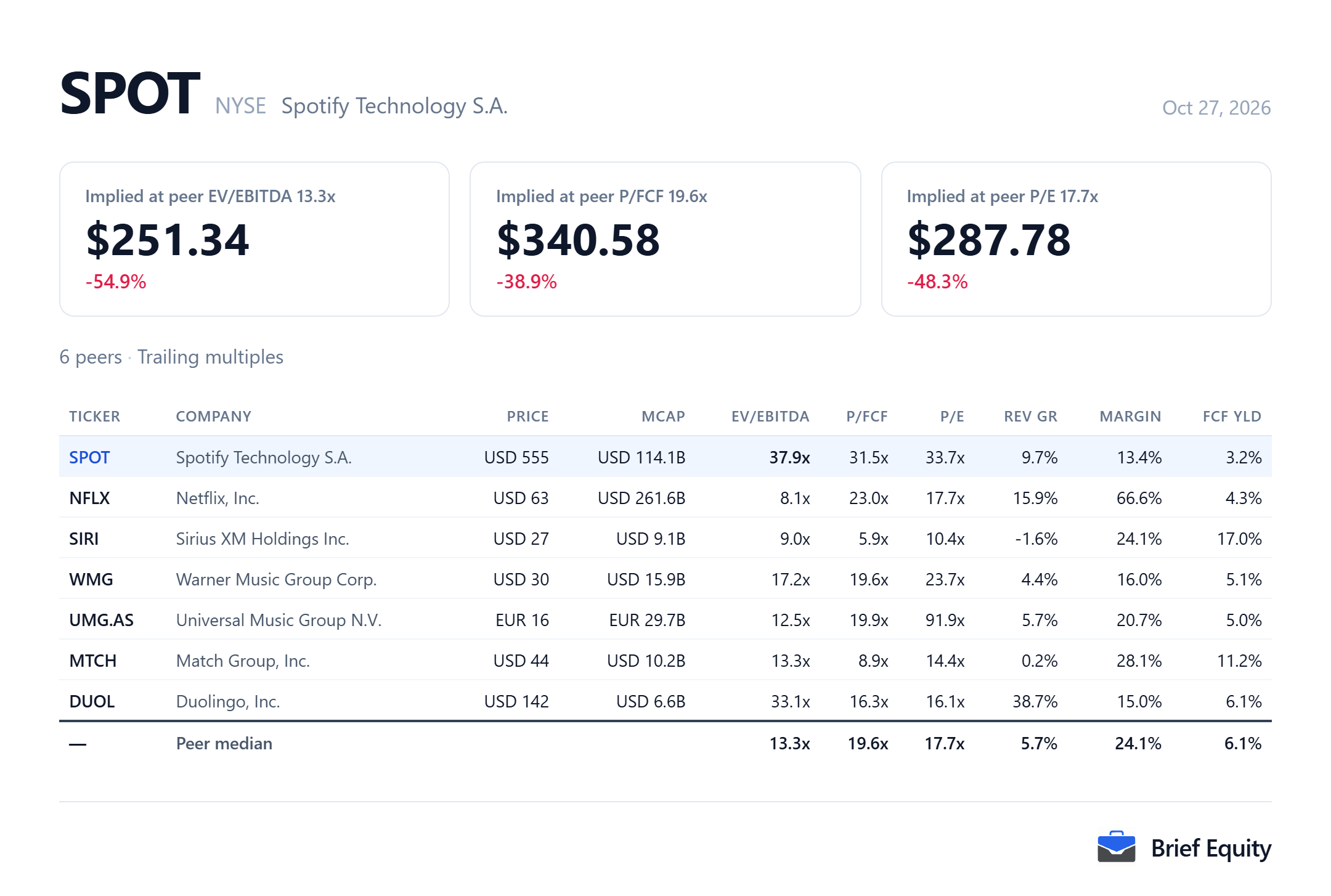
How the estimate moves with its assumptions
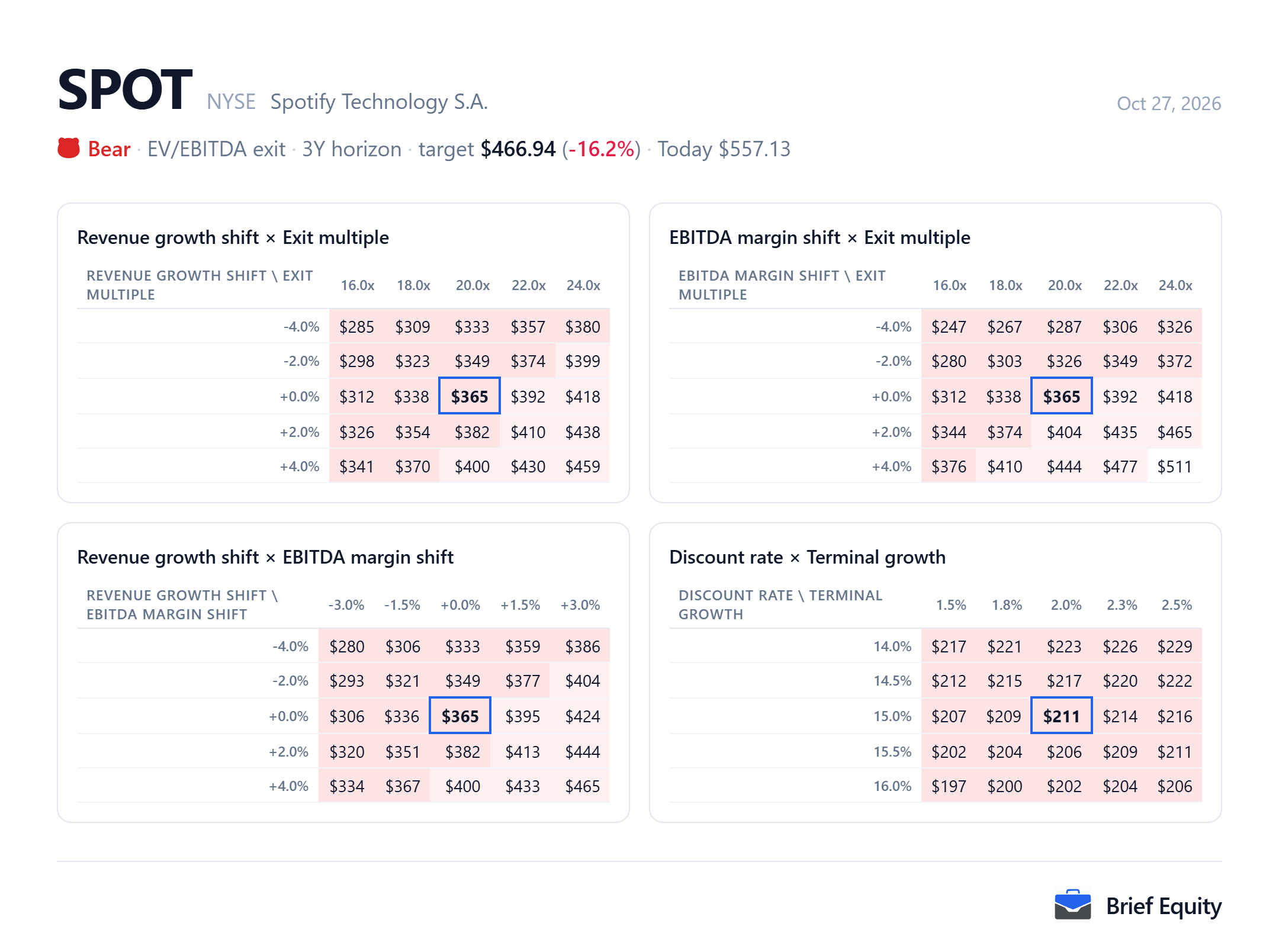
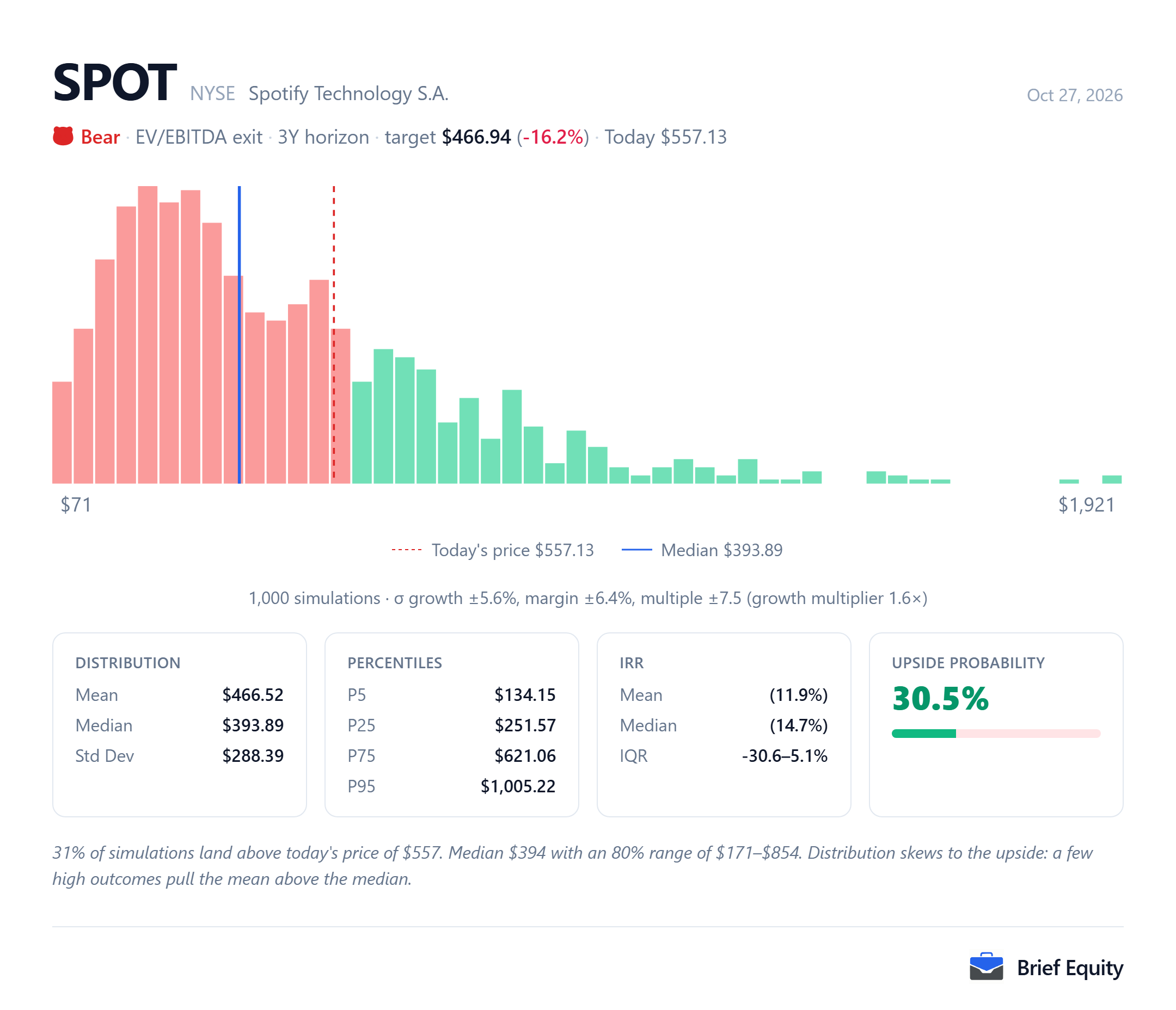
The two pictures below show how far the Spotify estimate moves when its assumptions change: one moves two assumptions at a time, and the other runs the model many times with growth, margin and the exit multiple drawn at random.
Questions about Spotify
These questions about Spotify (SPOT) are answered from the documents listed under Sources.
- How many paying subscribers does Spotify have?
- Spotify had 306 million Premium subscribers on September 30, 2026, against 281 million a year earlier.
- Does Spotify have any debt?
- As of September 30, 2026, Spotify said it had no outstanding indebtedness other than lease liabilities, after its exchangeable notes matured on March 15, 2026.
- Who controls the votes at Spotify?
- At December 31, 2025, Spotify's founders Daniel Ek and Martin Lorentzon together held 69.3% of the voting power.
- How much of Spotify's revenue comes from advertising?
- In the third quarter of 2026, Ad-Supported revenue made up 10% of Spotify's total revenue.
Sources
The quotations and facts about Spotify (SPOT) on this page rest on the documents below.
- Spotify third-quarter 2026 shareholder update, October 22, 2026
- Spotify interim condensed consolidated financial statements and operating review for the third quarter of 2026 (Form 6-K), October 22, 2026
- Spotify third-quarter 2026 earnings call, October 22, 2026
- Spotify annual report (Form 20-F) for 2025, February 10, 2026
- Spotify second-quarter 2026 earnings call, August 4, 2026
About this page
Brief Equity and its team hold no position in Spotify (SPOT) as of October 27, 2026.
This page is research, not investment advice. It describes one model and the assumptions behind it, and market data is delayed. Read how these models are built and our editorial policy.
Related guides: EV/EBITDA explained, How to value a stock yourself (without Excel), What is an analyst price target.