Valuation · DCF model
Is ServiceNow (NOW) stock undervalued?
Brief Equity's quick DCF model of ServiceNow, dated October 31, 2026, values the shares at about $136 today, about 29% above the share price of $105.12, the previous day's close. After its fall in October 2026 ServiceNow looks somewhat cheap, with a lot of risk: the view rests on its organic revenue growth, which it does not report, staying well above the 11.8% a year the share price implies.
By The Brief Equity Team · Model dated · Published
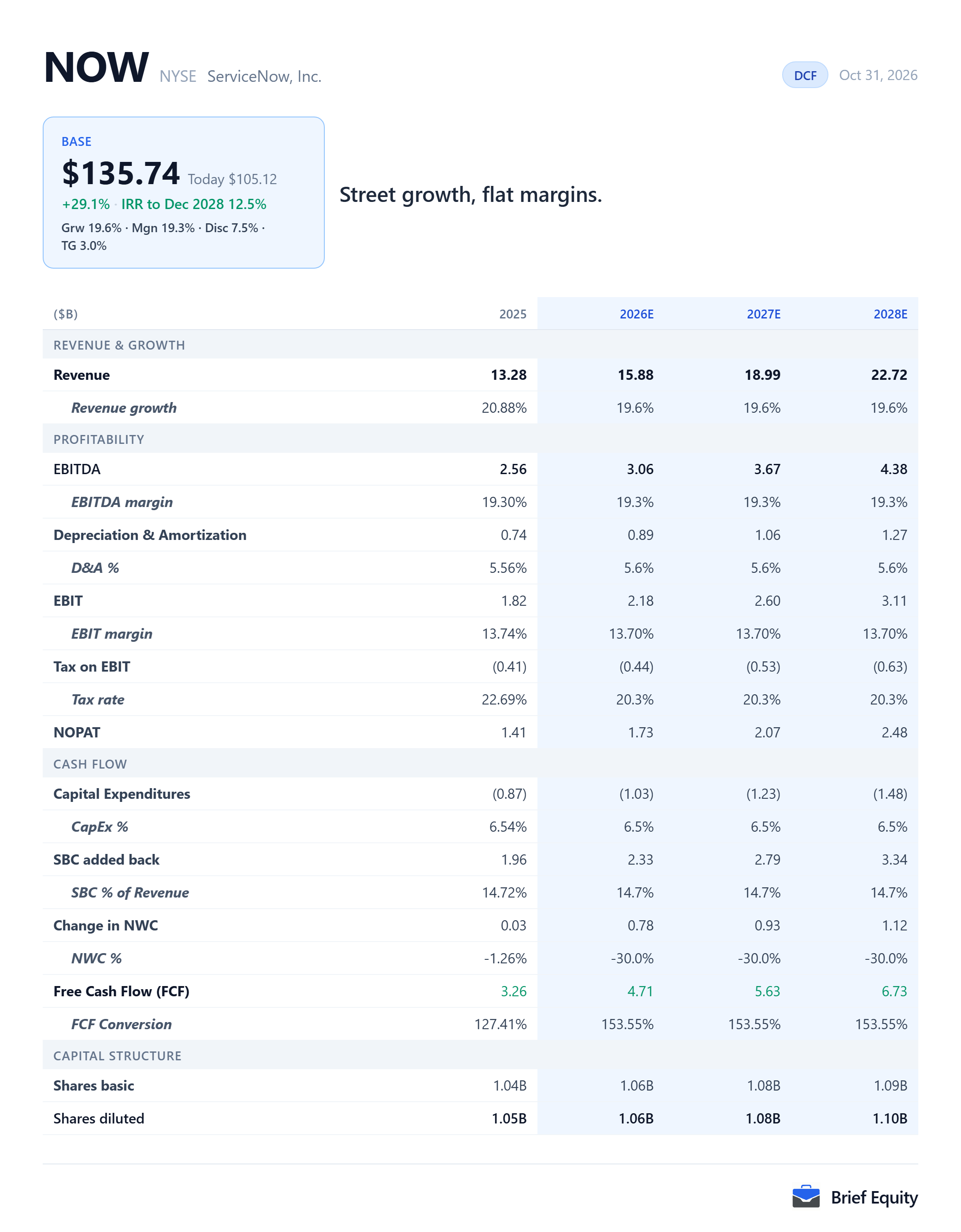
The model's assumptions for ServiceNow
ServiceNow's fiscal year is the calendar year and it reports in US dollars. The model runs three years, to 2028, with revenue growing at the analyst consensus rate compounded from 2025 to 2028 and the EBITDA margin held at its 2025 level, which is measured after stock-based compensation. The second table sets the model's revenue beside analyst consensus revenue for the same years.
| 2026 | 2027 | 2028 | |
|---|---|---|---|
| Revenue, model | 15.88 | 18.99 | 22.72 |
| Revenue growth, model | 19.6% | 19.6% | 19.6% |
| EBITDA, model | 3.06 | 3.67 | 4.38 |
| EBITDA margin, model | 19.3% | 19.3% | 19.3% |
| Free cash flow, model | 4.71 | 5.63 | 6.73 |
| 2026 | 2027 | 2028 | |
|---|---|---|---|
| Revenue, model | 15.88 | 18.99 | 22.72 |
| Revenue, analyst consensus | 16.23 | 19.24 | 22.71 |
Why ServiceNow looks undervalued
ServiceNow's shares look somewhat cheap at $105.12, their close on October 30, 2026, though the view carries a lot of risk.
ServiceNow's share price fell 26.9% on October 29, 2026, the day after it reported its third-quarter results. In those results it guided growth in current remaining performance obligations, the contracted revenue it expects to recognize over the next twelve months, to 18.5% in constant currency for the fourth quarter, down from 21% in the third quarter.
“We expect cRPO growth of 18.5% on a constant currency basis. This reflects a higher mix of on-prem deals and excludes a rising balance of T4C backlog, both of which contribute to revenue but not cRPO.”
Gina Mastantuono, Chief Financial Officer, ServiceNow third-quarter 2026 earnings call, October 28, 2026
In the model, ServiceNow's revenue grows at the analyst consensus rate of 19.6% a year through 2028 and its EBITDA margin stays at 19.3%, the 2025 level after stock-based compensation, and the discounted cash flows come to about $136 a share today, about 29% above the price. Holding the rest of the model unchanged, the share price of $105.12 implies revenue growth of 11.8% a year.
ServiceNow's revenue grew 22% in the first nine months of 2026, well above the growth rate the share price implies.
ServiceNow's 2026 revenue includes the businesses it acquired, Moveworks, Veza and Armis, from the dates of acquisition, and the company gives no organic growth figure. The view rests on its organic growth staying well above the 11.8% a year the share price implies.
What has to be true, and what would break it
ServiceNow looks somewhat cheap on this model while a few things hold, and the view fails if they stop holding.
What has to be true
- ServiceNow's revenue growth stays well above 11.8% a year through 2028.
- Its organic revenue growth, which it does not report, also stays well above 11.8% a year.
What would break it
- Revenue growth falls toward 11.8% a year once the 2026 acquisitions sit in both years' figures.
- The slowdown in current remaining performance obligations carries into revenue growth near 11.8% a year in 2027.
The parts of ServiceNow's business
ServiceNow reports one operating segment and splits its revenue between subscriptions and professional services, and the shares below cover the full year 2025.
| Share of revenue | Share of revenue growth | |
|---|---|---|
| Subscription | 97.0% | 97.5% |
| Professional services and other | 3.0% | 2.5% |
ServiceNow beside its peers
ServiceNow is compared here with ten companies chosen to cover enterprise workflow software, IT service management, security and IT operations.
- CRM: Front-office workflow software
- SAP: Enterprise resource planning on subscription
- WDAY: Human resources and finance workflow software
- TEAM: IT service management software
- ADBE: Subscription software at scale
- INTU: Subscription software at scale
- ADSK: Subscription software at scale
- PANW: Security software, where the Armis and Veza acquisitions point
- CRWD: Security software
- DDOG: IT operations software
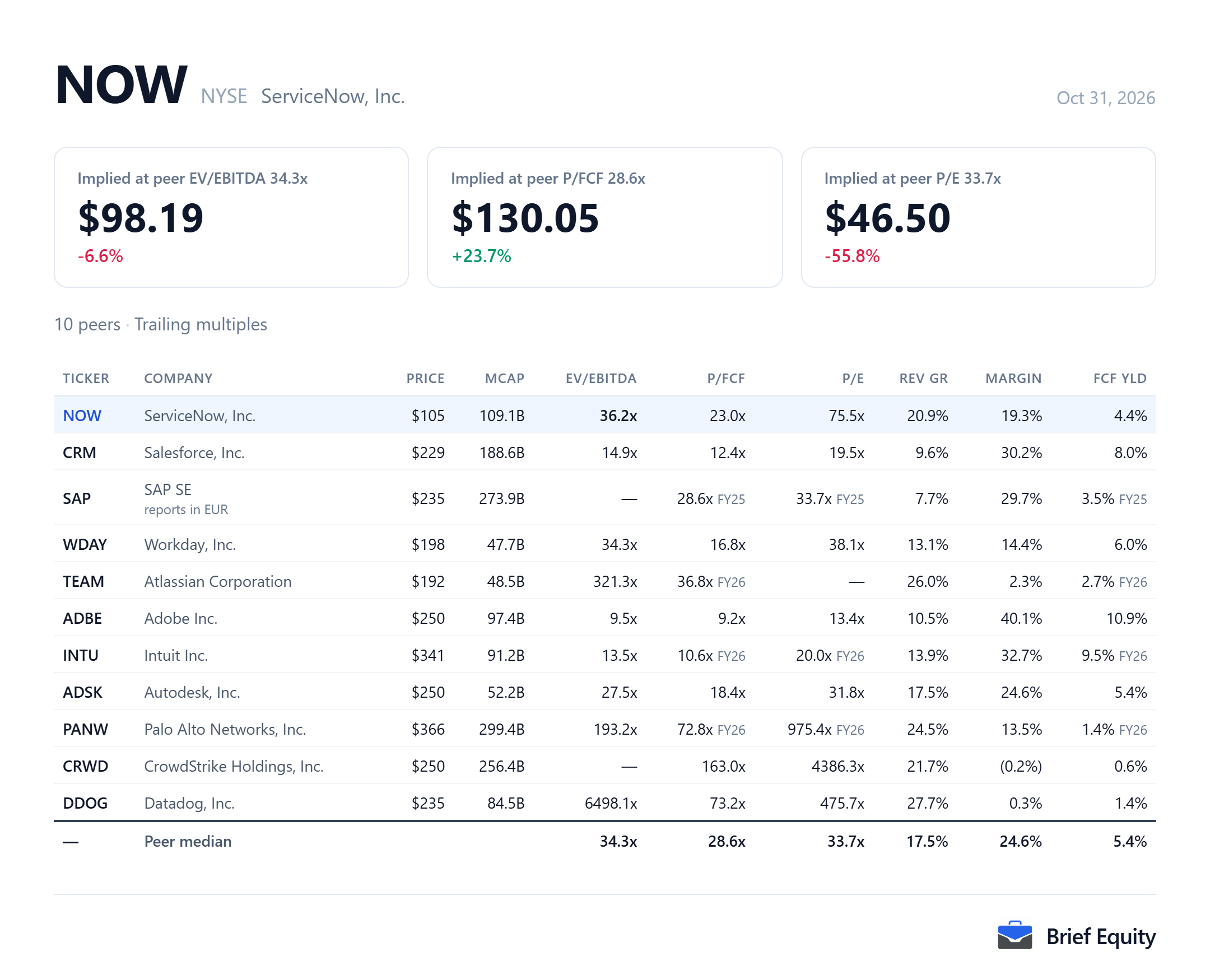
How the estimate moves with its assumptions
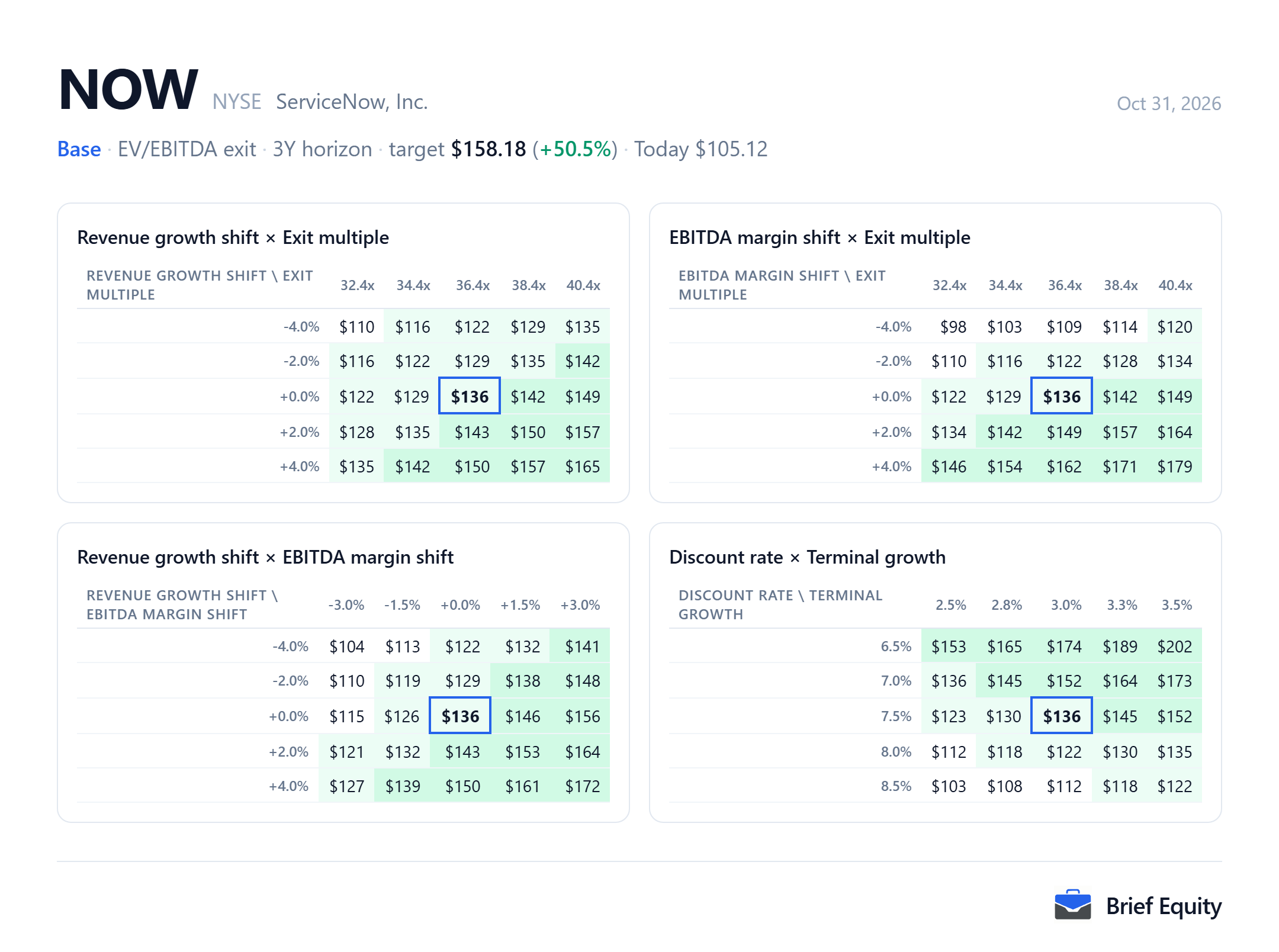
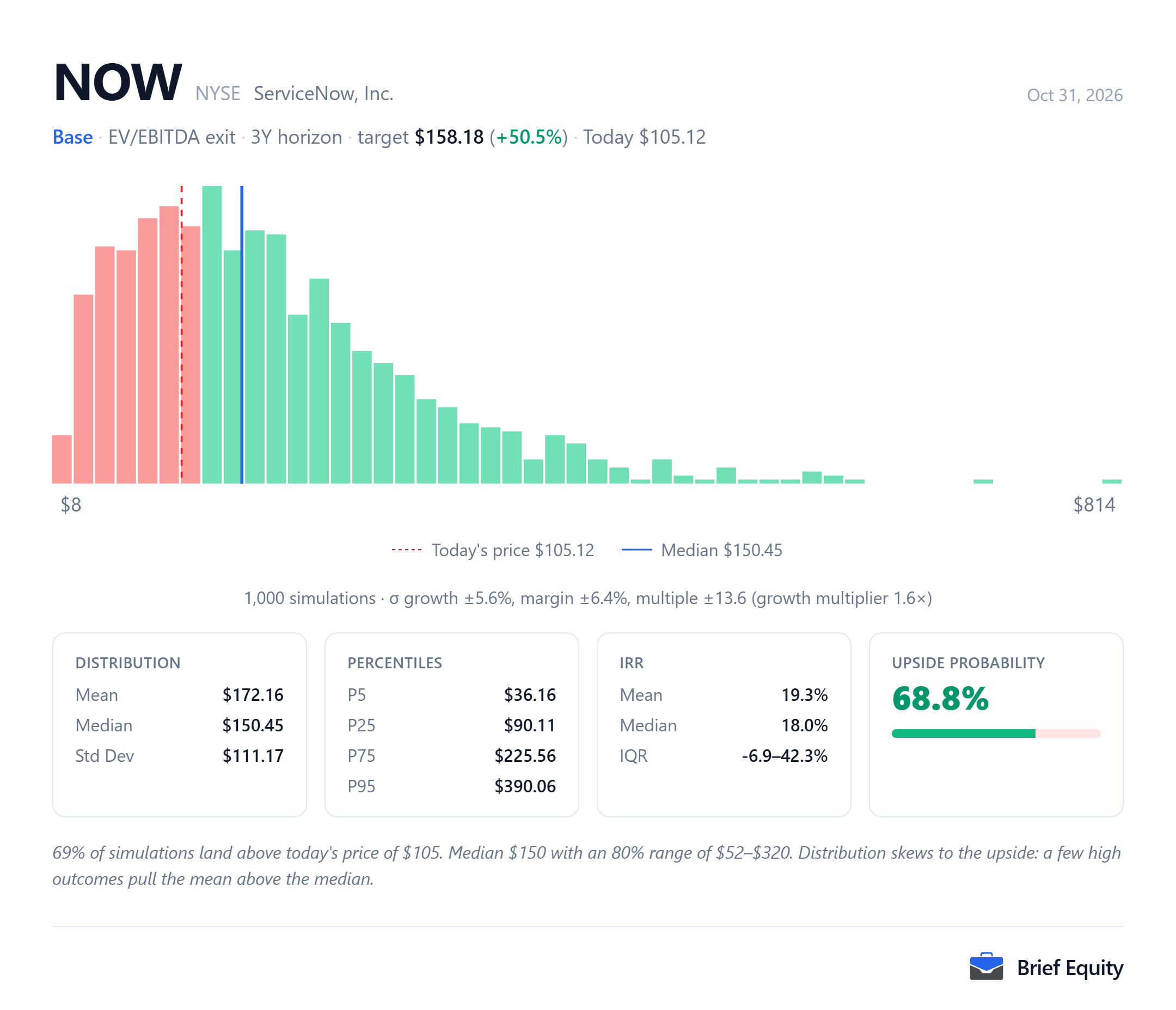
The two pictures below show how far the ServiceNow estimate moves when its assumptions change: one moves two assumptions at a time, and the other runs the model many times with growth, margin and the exit multiple drawn at random.
Questions about ServiceNow
These questions about ServiceNow (NOW) are answered from the documents listed under Sources.
- When did ServiceNow split its stock?
- ServiceNow's board approved a 5-for-1 split of its common stock on December 5, 2025, with an effective date of December 17, 2025.
- How much did ServiceNow pay for Armis?
- ServiceNow acquired Armis on April 20, 2026 for preliminary purchase price consideration of approximately $7.6 billion, settled in cash. It funded part of that with a $4.0 billion term loan, repaid in May 2026 mainly through an issue of notes.
- How much debt does ServiceNow have?
- At September 30, 2026, ServiceNow carried short-term debt of $2,086 million and long-term debt of $5,438 million, against long-term debt of $1,491 million and no short-term debt at December 31, 2025.
Sources
The quotations and facts about ServiceNow (NOW) on this page rest on the documents below.
- ServiceNow third-quarter 2026 results release, October 28, 2026
- ServiceNow quarterly report (Form 10-Q) for the third quarter of 2026, October 28, 2026
- ServiceNow third-quarter 2026 earnings call, October 28, 2026
- ServiceNow's one-day share price fall on October 29, 2026, October 30, 2026
- ServiceNow's closing price and fourth-quarter backlog guide, October 29, 2026, October 30, 2026
About this page
Brief Equity and its team hold no position in ServiceNow (NOW) as of October 31, 2026.
This page is research, not investment advice. It describes one model and the assumptions behind it, and market data is delayed. Read how these models are built and our editorial policy.
Related guides: DCF explained (discounted cash flow), How to build a DCF model (step by step), What is free cash flow.