Valuation · EV/EBITDA model
Is SAP (SAP) stock undervalued?
Brief Equity's quick EV/EBITDA model of SAP, dated October 14, 2026, puts the shares at about $357 for 2028, against a price of $220.49 that day. On those assumptions SAP looks somewhat cheap, with the model's value about 62% above the price. The view rests on one condition: that SAP bills for AI agents on usage on top of its subscriptions, rather than agents cutting the number of users it charges for.
By The Brief Equity Team · Model dated · Published
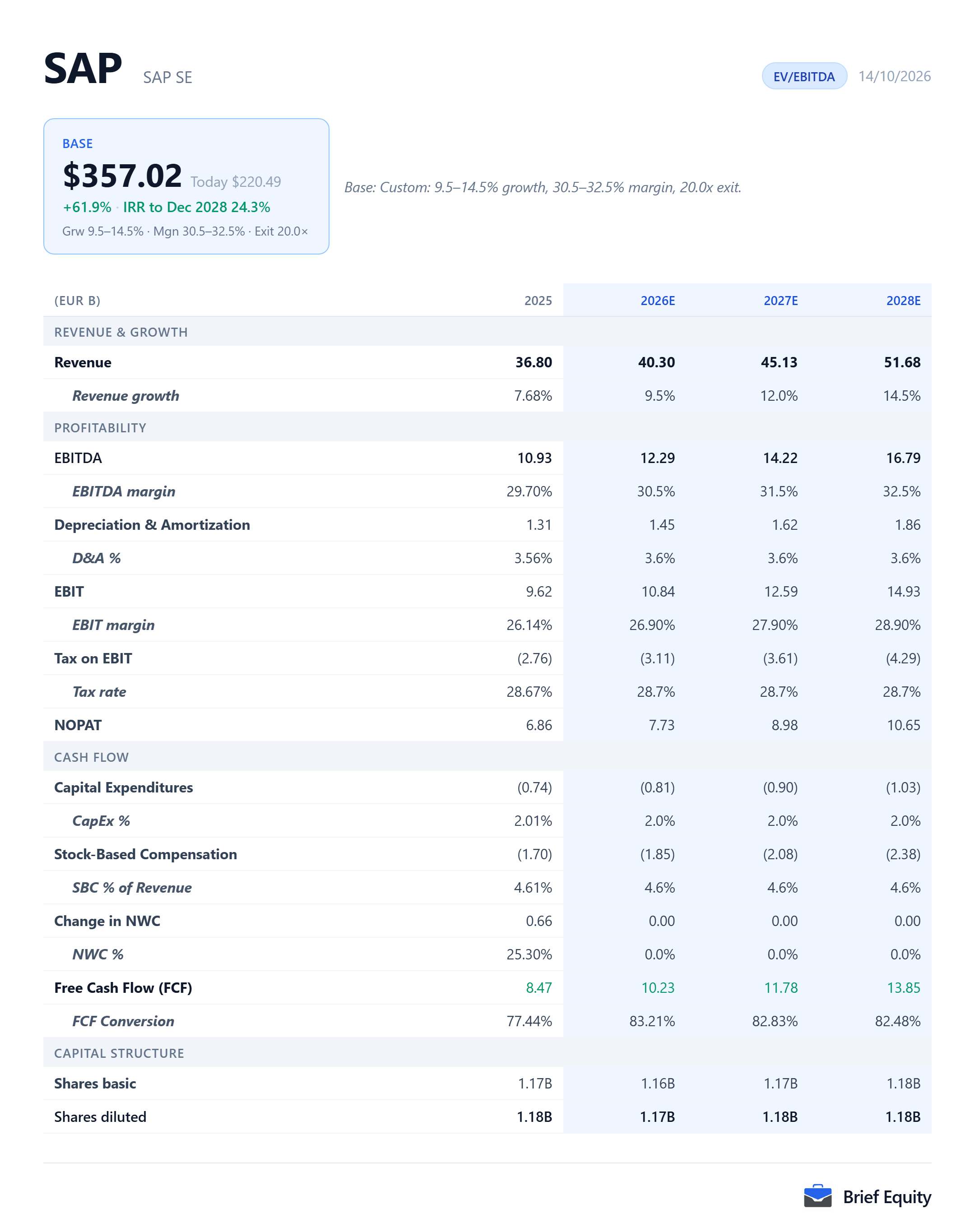
The model's assumptions for SAP
SAP's fiscal year is the calendar year, and it reports in euros, so the tables below are in euros while the share price and the model's value are in US dollars. The model projects three years, to 2028, and analyst consensus revenue for the same years is shown beside the model's revenue.
Reports in EUR. Price and per-share values in USD at 1.1158.
| 2026 | 2027 | 2028 | |
|---|---|---|---|
| Revenue, model | 40.30 | 45.13 | 51.68 |
| Revenue growth, model | 9.5% | 12.0% | 14.5% |
| EBITDA, model | 12.29 | 14.22 | 16.79 |
| EBITDA margin, model | 30.5% | 31.5% | 32.5% |
| 2026 | 2027 | 2028 | |
|---|---|---|---|
| Revenue, model | 40.30 | 45.13 | 51.68 |
| Revenue, analyst consensus | 40.75 | 45.54 | 51.03 |
Why SAP looks undervalued
On this model SAP looks somewhat cheap at $220.49, and its place in AI agents for business software looks underrated.
Software shares fell in the spring of 2026 on worries about seat-based pricing, because subscription software revenue depends largely on how many people hold a license. SAP's chief executive, Christian Klein, addressed this on the company's first-quarter call.
“Also, it is important to highlight that less than 40% of our 2025 cloud revenue was tied to named users.”
Christian Klein, Chief Executive Officer, SAP first-quarter 2026 earnings call, April 23, 2026
On the second-quarter call, Klein said SAP prices its agents on the value they deliver, and that AI lets it change its prices.
“Now with AI, I mean, now we can completely reset the price level.”
Christian Klein, Chief Executive Officer, SAP second-quarter 2026 earnings call, July 23, 2026
The view on SAP therefore depends on agents being billed on usage on top of its subscriptions, rather than reducing the number of users it charges for.
SAP's current cloud backlog was EUR 22.9 billion at the end of the second quarter of 2026, up 26% at constant currencies and faster than in the first quarter, after SAP's share price fell 28% in the first quarter alone. AI and SAP Business Data Cloud were key parts of more than 90% of SAP's 50 largest deals in the second quarter.
SAP counts its AI offerings inside Cloud ERP Suite revenue, which made up 49.2% of its revenue in 2025 and grew 28% that year at actual currencies, while software licenses and support revenue fell 9%.
The model has SAP's revenue growth rising from 9.5% in 2026 to 12% in 2027 and 14.5% in 2028, against analyst consensus of 11.5% a year from 2025 to 2028, and its EBITDA margin rising one point a year, from 30.5% to 32.5%. SAP guides its total operating expenses in 2027 to grow at 80% to 90% of total revenue growth, and Klein said SAP will hire nowhere near as many people in 2026 as it planned at the start of the year. At 20 times EBITDA in 2028, the shares come to about $357, about 62% above the price.
Salesforce, Oracle and Microsoft are each offering AI agents for back-office and ERP work, and SAP does not report a figure for its AI revenue.
What has to be true, and what would break it
SAP looks somewhat cheap on this model only if a few things hold, and the view fails if they do not.
What has to be true
- SAP bills customers for AI agents on usage, on top of their subscriptions, rather than agents reducing the number of users it charges for.
- Customers keep signing cloud contracts with SAP, as the growth in its current cloud backlog showed in the second quarter of 2026.
What would break it
- AI agents from other companies, such as Salesforce, Oracle or Microsoft, take over business work that customers now do in SAP's applications.
- Agents reduce the number of users SAP charges for faster than billing on usage adds revenue.
The parts of SAP's business
SAP reports its revenue by type, and in 2025 Cloud ERP Suite, which includes SAP's AI offerings, grew while software licenses and support and services revenue fell.
| Share of revenue | |
|---|---|
| Cloud ERP Suite | 49.2% |
| Software licenses and software support | 31.3% |
| Services | 11.6% |
| Extension Suite | 7.0% |
| IaaS | 0.9% |
SAP beside its peers
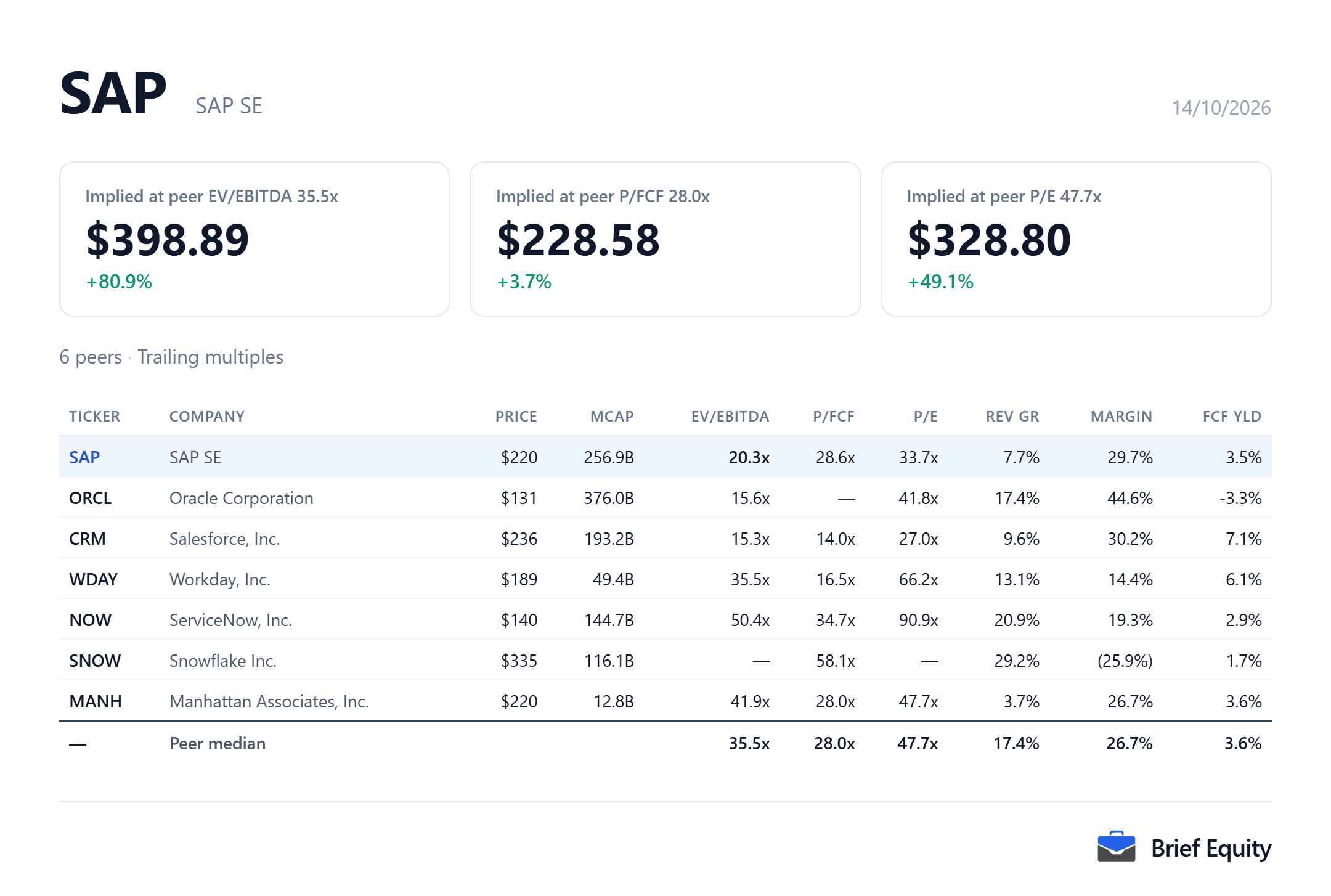
SAP is compared here with six companies, chosen to cover its business applications, its AI agents and its data platform.
- ORCL: Cloud ERP and other business applications
- CRM: Customer relationship applications and AI agents
- WDAY: Human resources and finance applications
- NOW: Workflow software and AI agents
- SNOW: Data platform, against SAP Business Data Cloud
- MANH: Supply chain applications
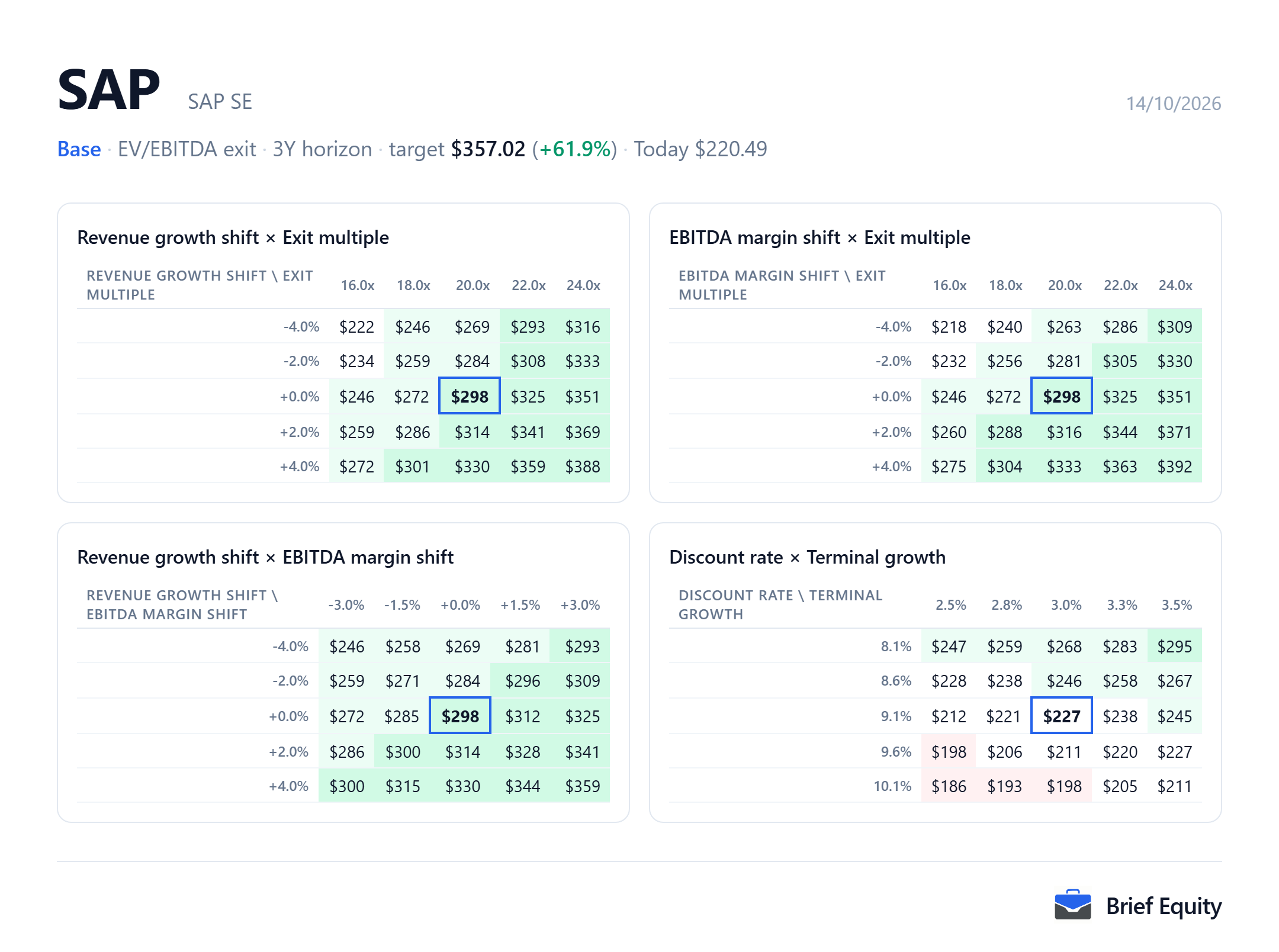
How the estimate moves with its assumptions
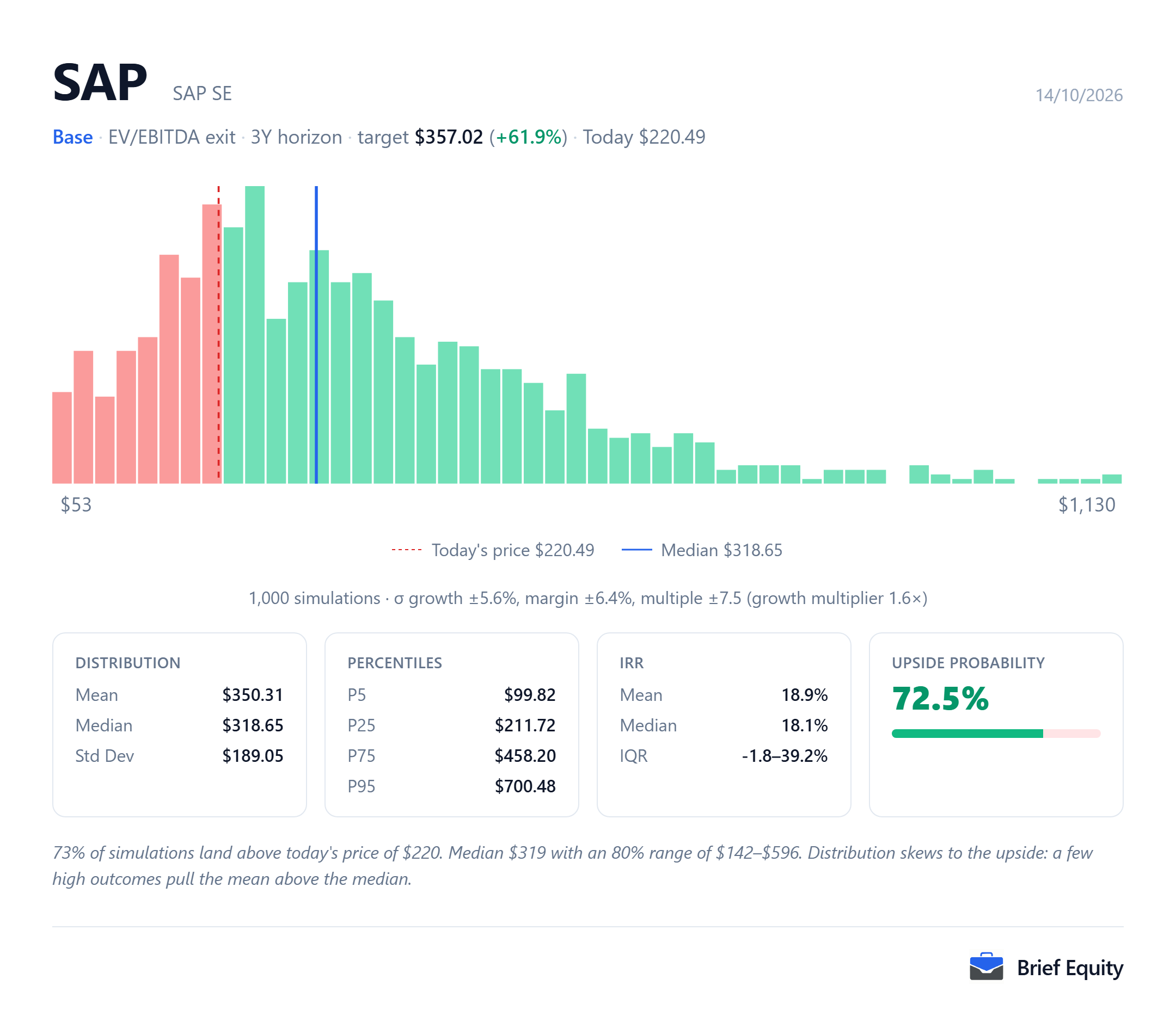
The two pictures below show how far the SAP estimate moves when its assumptions change: the first moves two of them at a time, and the second runs the model many times with growth, margin and the exit multiple drawn at random.
Questions about SAP
These questions about SAP (SAP) are answered from the documents listed under Sources.
- Does SAP have debt?
- At June 30, 2026, SAP's financial debt was EUR 8,550 million against group liquidity of EUR 11,407 million, leaving net liquidity of EUR 2,856 million.
- Does SAP buy back its shares?
- Under a program of up to EUR 10 billion that runs until December 31, 2027, SAP had repurchased 16,280,097 shares by June 30, 2026, at an average price of EUR 161.16, about EUR 2.6 billion.
- How much free cash flow does SAP generate?
- SAP's free cash flow was EUR 8.24 billion in 2025. In July 2026 SAP said it expects approximately EUR 10 billion of free cash flow for 2026, at actual currencies.
- How many AI agents does SAP plan to offer?
- In its half-year report for 2026, SAP said it expects to deploy more than 400 AI agents by the end of 2026.
- Which companies did SAP buy in 2026?
- SAP completed its acquisitions of Reltio on May 7, 2026, Dremio on July 6, 2026 and Prior Labs on July 16, 2026.
Sources
The quotations and facts about SAP (SAP) on this page rest on the documents below.
- SAP annual report (Form 20-F) for 2025, February 26, 2026
- SAP half-year report for the six months ended June 30, 2026, July 23, 2026
- SAP quarterly statement for the second quarter of 2026, July 23, 2026
- SAP quarterly statement for the fourth quarter of 2025, January 29, 2026
- SAP first-quarter 2026 earnings call, April 23, 2026
- SAP second-quarter 2026 earnings call, July 23, 2026
- Software stocks since the spring selloff over seat-based pricing, October 13, 2026
- Salesforce's Dreamforce 2026 announcements, September 28, 2026
- Oracle introduces Fusion Claw agents for its business applications, September 29, 2026
- Microsoft on agentic ERP in Dynamics 365, September 23, 2026
About this page
Brief Equity and its team hold no position in SAP (SAP) as of October 14, 2026.
This page is research, not investment advice. It describes one model and the assumptions behind it, and market data is delayed. Read how these models are built and our editorial policy.
Related guides: How to value a stock yourself (without Excel), How to calculate a stock's intrinsic value (fair value), What is an investment thesis.