Valuation · EV/EBITDA model
Is RTX Corporation (RTX) stock undervalued?
Brief Equity's quick EV/EBITDA model of RTX Corporation, dated October 22, 2026, puts the shares at about $261 for 2028, against a price of $191.60 that day. On those assumptions RTX looks somewhat cheap, with a return of about 36%. The estimate rests on one condition: that Congress funds the missile contracts the Pentagon awarded RTX in 2026.
By The Brief Equity Team · Model dated · Published
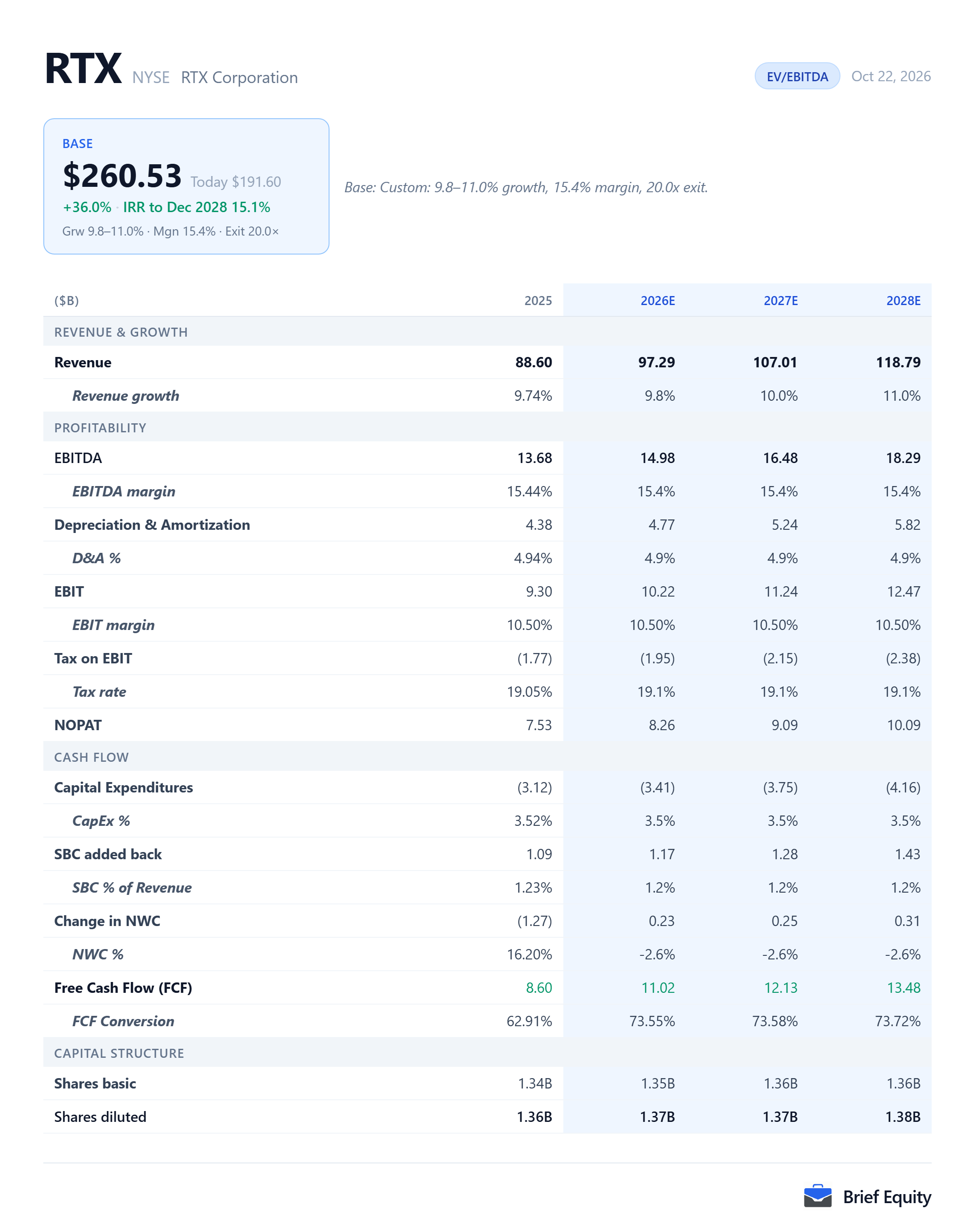
The model's assumptions for RTX Corporation
RTX's fiscal year is the calendar year. The figures below come from a quick model, built on a small set of stated assumptions and projected to 2028. Analyst consensus revenue is shown beside the model's revenue for the same three years.
| 2026 | 2027 | 2028 | |
|---|---|---|---|
| Revenue, model | 97.29 | 107.01 | 118.79 |
| Revenue growth, model | 9.8% | 10.0% | 11.0% |
| EBITDA, model | 14.98 | 16.48 | 18.29 |
| EBITDA margin, model | 15.4% | 15.4% | 15.4% |
| 2026 | 2027 | 2028 | |
|---|---|---|---|
| Revenue, model | 97.29 | 107.01 | 118.79 |
| Revenue, analyst consensus | 97.05 | 104.77 | 112.96 |
Why RTX Corporation looks undervalued
RTX looks somewhat cheap at a share price in the 190s, provided Congress funds the missile contracts the Pentagon awarded the company in 2026.
RTX's shares have fallen from a record high of $226.88 on August 10, 2026. A Yahoo Finance article in September put the decline down to tariff costs and to signs of a possible ceasefire between the United States and Iran. RTX's backlog, meanwhile, reached a record $340 billion at the end of the third quarter, up 36% from a year earlier.
RTX's Raytheon segment booked $52.3 billion of orders in the third quarter of 2026, a book-to-bill ratio of 6.54, and was awarded multi-year production contracts for Tomahawk and AMRAAM missiles in that quarter. The chief executive put the missile contracts at about $70 billion combined, to be carried out over seven to ten years at production rates two to four times today's.
RTX has raised its organic sales growth guidance for 2026 on each of its last two earnings calls: from 5% to 6%, to 8% to 9%, and now to 10% to 11%.
The model of RTX is a quick one. It has revenue growing 9.8% in 2026, within the company's guidance of $97.0 to $97.5 billion of adjusted sales, then 10.0% in 2027 and 11.0% in 2028 as missile production increases, with the EBITDA margin held at 15.4%. Valuing the company at 20 times EBITDA in 2028 gives about $261 a share, about 36% above the price on the model's date. Analysts expect revenue to grow 8.4% a year from 2025 to 2028, and the model's growth over the same period is 10.3% a year.
RTX's missile funding is not yet settled. The federal government is operating under a continuing resolution that runs out on December 11, 2026, and Reuters described the AMRAAM award as provisional, and Congress has not yet funded the full deal.
RTX's chief financial officer expects missile revenue to increase over the next two years and to keep rising until full-rate production is reached.
“And really continuing through 2030 when we get into full rate production for the suite of munitions that we will be providing.”
Neil G. Mitchill Jr., Chief Financial Officer, RTX third-quarter 2026 earnings call, October 20, 2026
RTX's chief executive described the supply chain as the single biggest factor in reaching the higher production rates.
What has to be true, and what would break it
RTX looks somewhat cheap on this model only if a few things hold, and the view fails if they do not.
What has to be true
- Congress funds the missile contracts awarded in 2026 in full.
- Raytheon raises missile production to two to four times today's rates, with suppliers keeping pace.
- Investors pay 20 times EBITDA for the company in 2028.
What would break it
- Defense budgets stop growing and the AMRAAM award is reduced.
- Shortages of parts push the production increase out beyond 2028.
- Investors pay a lower multiple for defense companies as geopolitical tension eases.
The parts of RTX Corporation's business
RTX reports three segments of similar size. The missile contracts sit in Raytheon, while Pratt & Whitney accounted for most of the revenue growth in 2025.
| Share of revenue | Share of revenue growth | |
|---|---|---|
| Pratt & Whitney | 37.1% | 61.7% |
| Collins Aerospace | 31.1% | 21.1% |
| Raytheon | 31.5% | 16.8% |
RTX Corporation beside its peers
RTX is compared here with nine companies, chosen to cover each of its three segments.
- LMT: Missiles and defense systems, for Raytheon
- NOC: Missiles and defense systems, for Raytheon
- GD: Defense, for Raytheon
- LHX: Defense electronics, for Raytheon
- GE: Jet engines, for Pratt & Whitney
- HWM: Engine parts, for Pratt & Whitney
- TDG: Aircraft parts, for Collins Aerospace
- HEI: Aircraft parts, for Collins Aerospace
- WWD: Aircraft controls, for Collins Aerospace
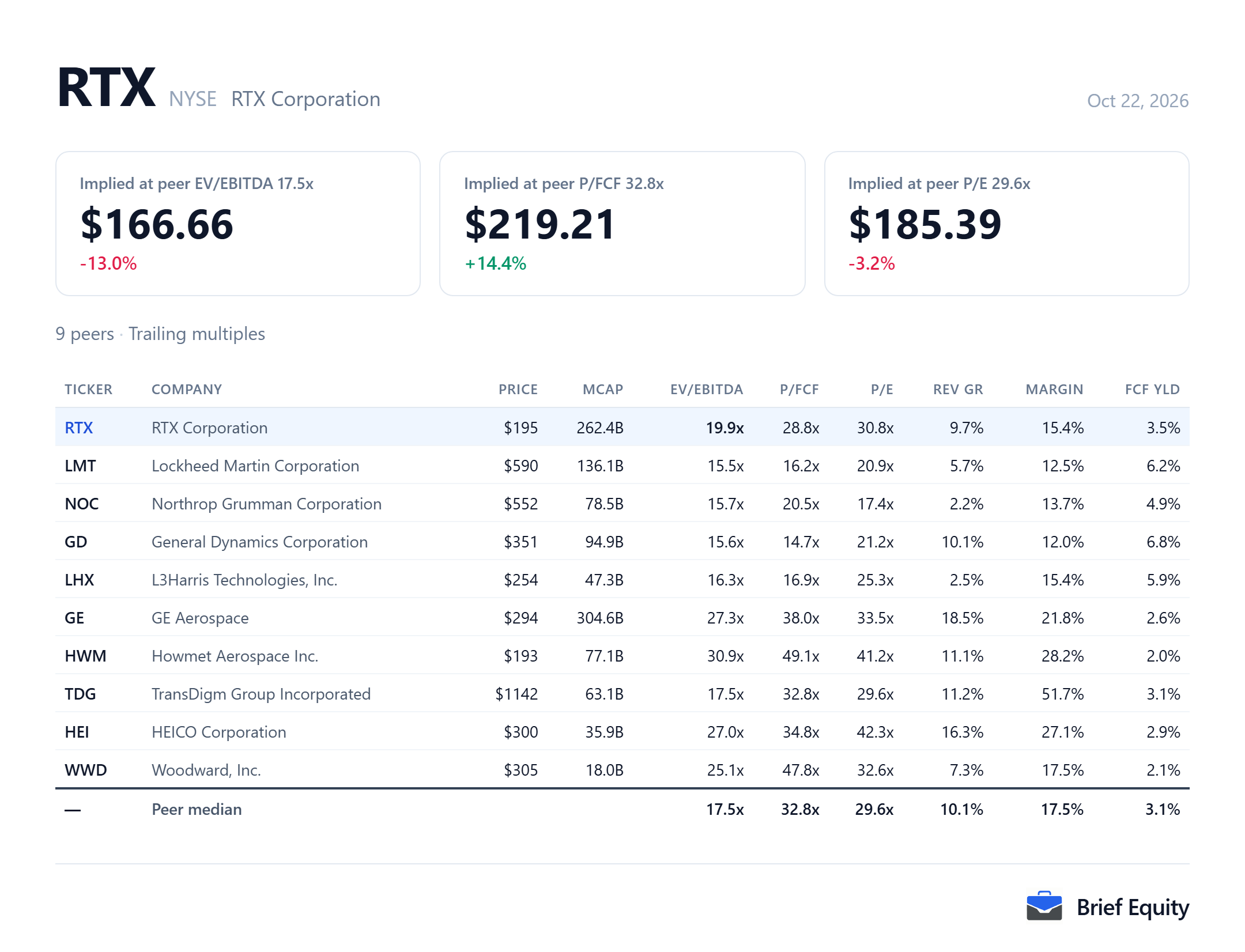
How the estimate moves with its assumptions
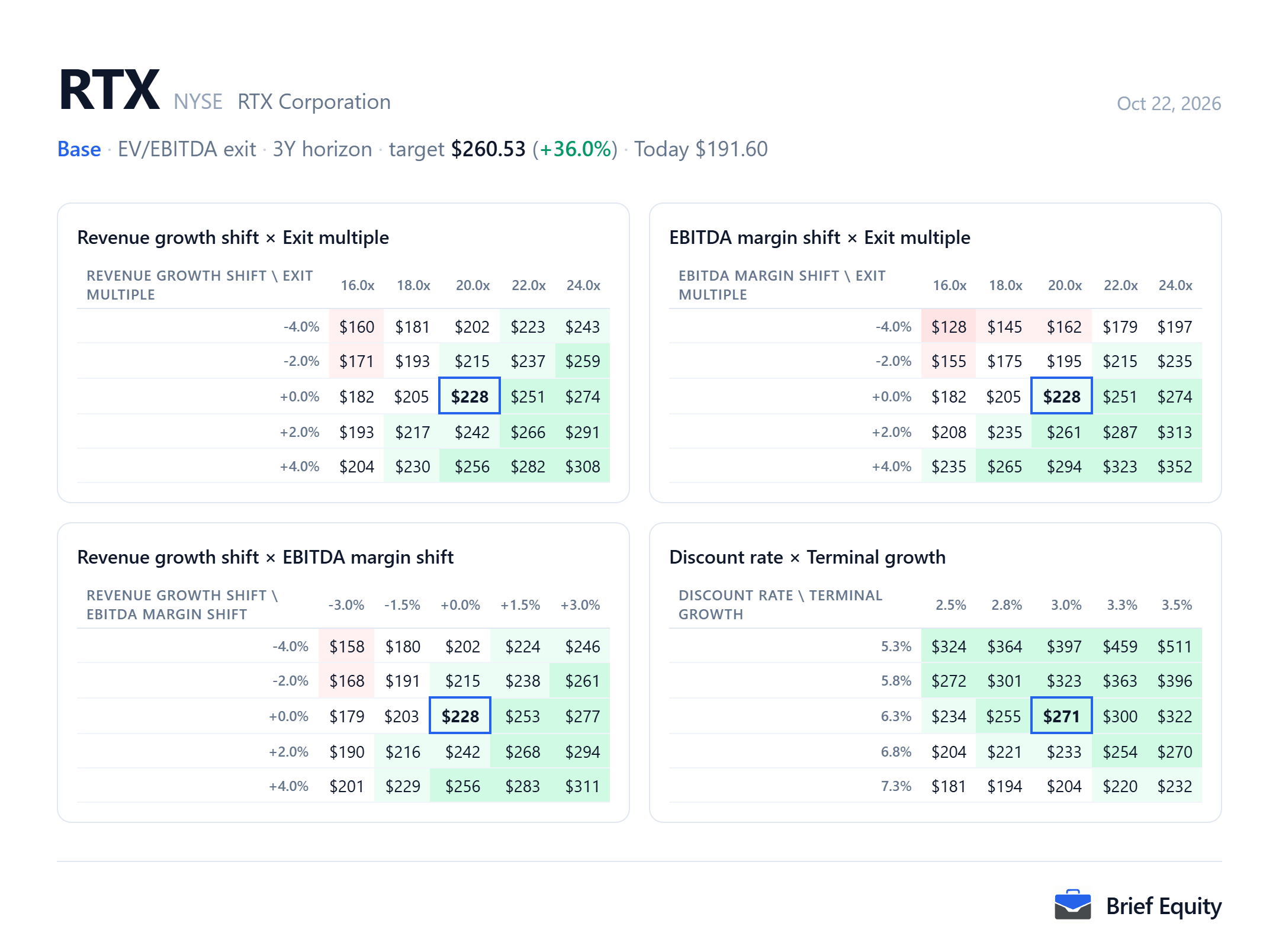
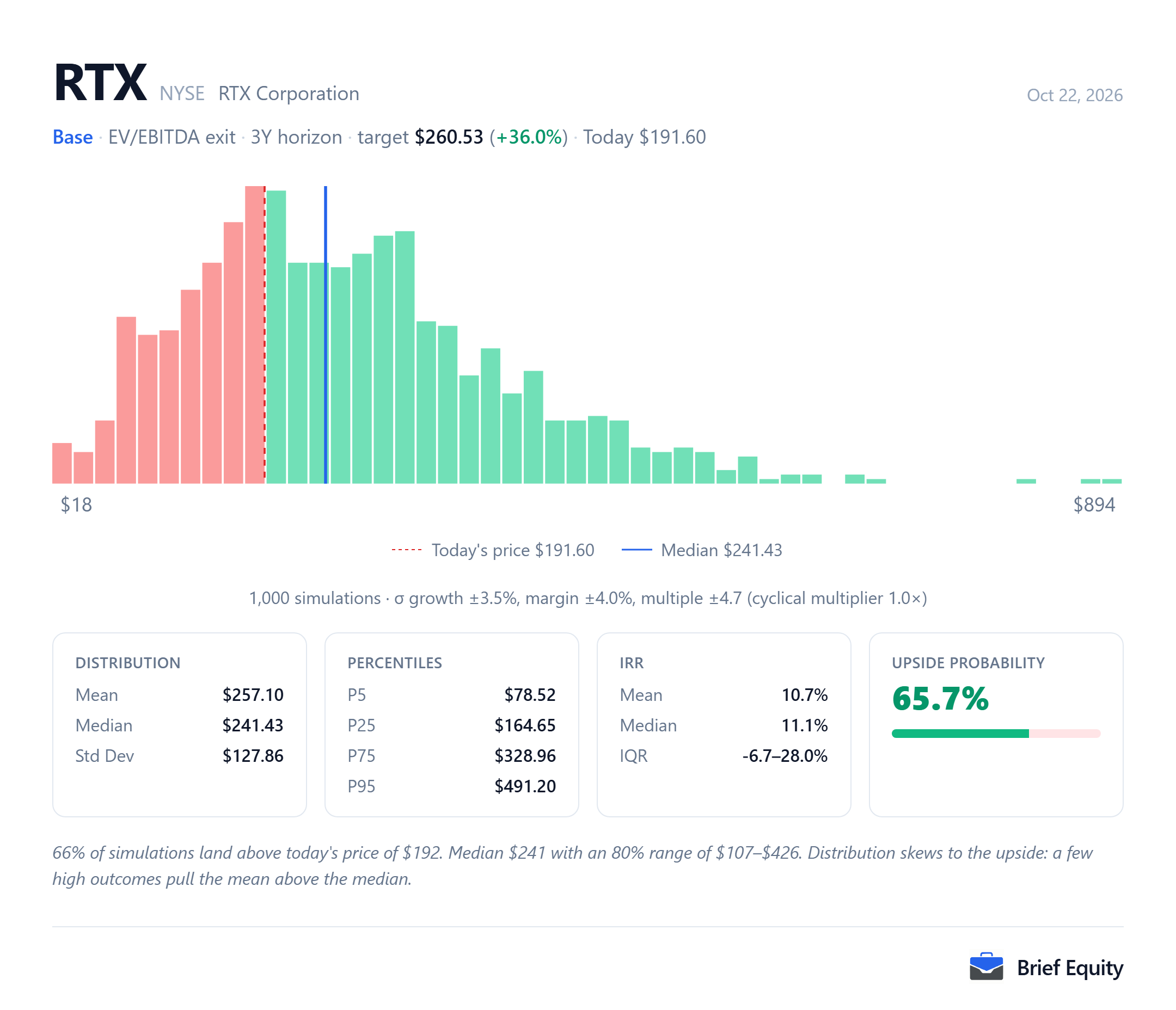
The estimate for RTX depends on its assumptions, and the two pictures below show how far it moves when they change. The first varies two assumptions at a time. The second runs the model many times with growth, margin and the exit multiple varied at random.
Questions about RTX Corporation
These questions about RTX Corporation (RTX) are answered from the documents listed under Sources.
- How large is RTX's backlog?
- RTX reported a backlog of $340 billion at the end of the third quarter of 2026, including $176 billion of commercial and $164 billion of defense.
- What is RTX's sales guidance for 2026?
- In its third-quarter 2026 results RTX guided to adjusted sales of $97.0 to $97.5 billion for 2026, up from $95.0 to $96.0 billion, and organic sales growth of 10 to 11 percent.
- How much debt does RTX have?
- RTX reported total debt of $37,379 million at September 30, 2026, against cash and cash equivalents of $9,173 million.
Sources
The quotations and facts about RTX Corporation (RTX) on this page rest on the documents below.
- RTX annual report (Form 10-K) for 2025, February 6, 2026
- RTX quarterly report (Form 10-Q) for the quarter ended September 30, 2026, October 20, 2026
- RTX third-quarter 2026 earnings release, October 20, 2026
- RTX third-quarter 2026 earnings call, October 20, 2026
- RTX second-quarter 2026 earnings call, July 23, 2026
- RTX shares after third-quarter 2026 results, and the August record high, October 20, 2026
- Why RTX shares fell from their August 2026 high, September 24, 2026
- Pentagon awards Raytheon up to $20.7 billion for AMRAAM production, September 29, 2026
- Continuing resolution funding the federal government to December 11, 2026, September 3, 2026
About this page
Brief Equity and its team hold no position in RTX Corporation (RTX) as of October 22, 2026.
This page is research, not investment advice. It describes one model and the assumptions behind it, and market data is delayed. Read how these models are built and our editorial policy.
Related guides: EV/EBITDA explained, What is enterprise value (EV), How to build a DCF model (step by step).