Valuation · EV/EBITDA model
Is Rolls-Royce (RR.L) stock overvalued?
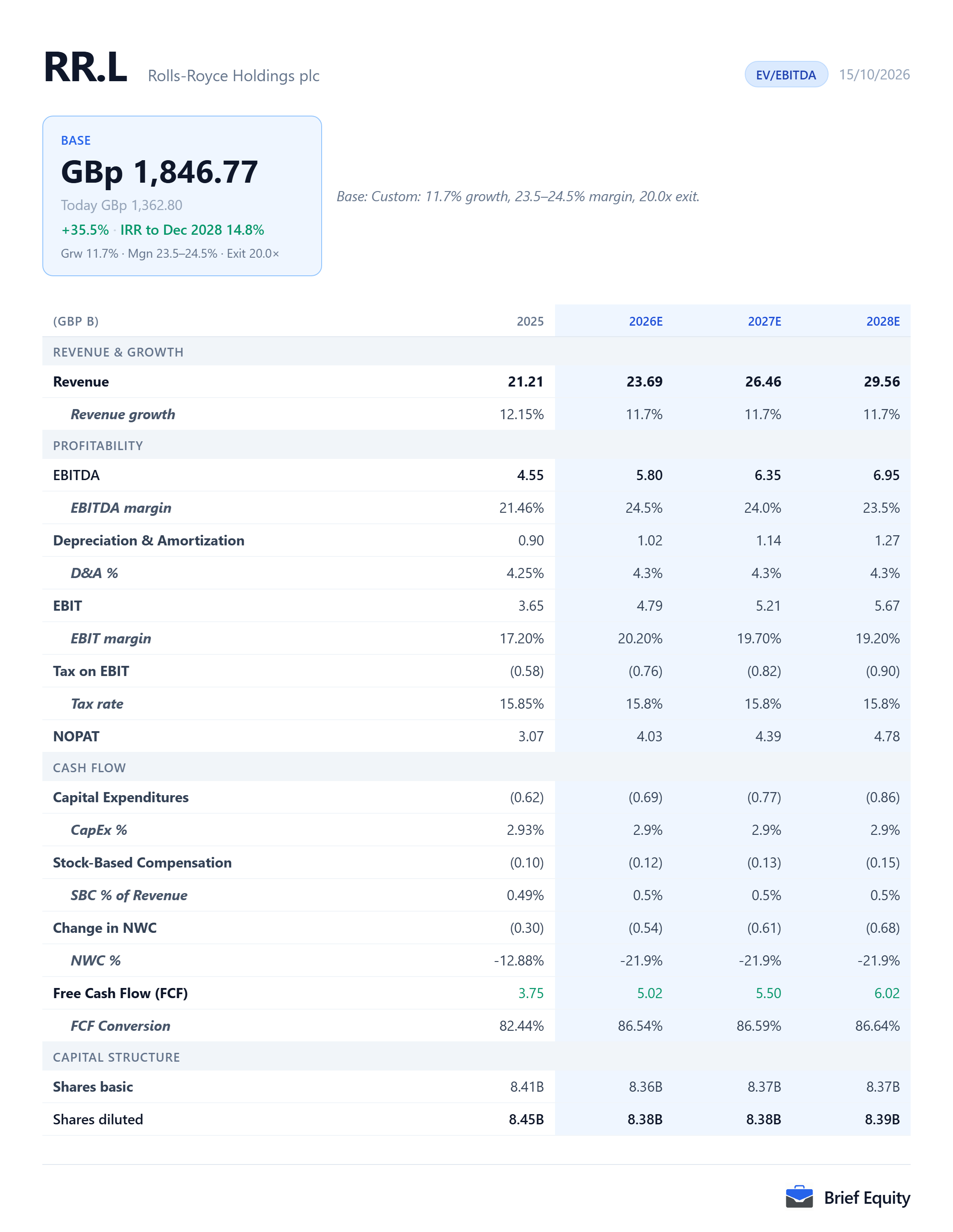
Brief Equity's EV/EBITDA model of Rolls-Royce (RR.L), dated October 15, 2026, puts the shares at 1,847p by 2028, about 36% above the 1,362.80p share price at that date. The stock does not look like much of an opportunity at that price. The model has Rolls-Royce beating its own 2028 profit target, so a larger return would need long-haul flying to run well past what the company plans for 2028.
By The Brief Equity Team · Model dated · Published
The model's assumptions for Rolls-Royce
Rolls-Royce's fiscal year is the calendar year. It reports in pounds while its shares are priced in pence in London, so the table below is in pounds and the value per share is in pence. The figures come from a quick model, built on a small set of stated assumptions and projected over three years. Rolls-Royce reports under IFRS, which carries leases on the balance sheet, so the model's EBITDA is measured before rent.
Reports in GBP. Price and per-share values in pence (GBp).
| 2026 | 2027 | 2028 | |
|---|---|---|---|
| Revenue, model | 23.69 | 26.46 | 29.56 |
| Revenue growth, model | 11.7% | 11.7% | 11.7% |
| EBITDA, model | 5.80 | 6.35 | 6.95 |
| EBITDA margin, model | 24.5% | 24.0% | 23.5% |
| Revenue, analysts' consensus | 23.80 | 26.55 | 29.59 |
Why Rolls-Royce looks overvalued
Rolls-Royce's shares do not look like much of an opportunity at 1,362.80p. In July 2026 the company raised its guidance for 2026 to GBP 4.7 billion to GBP 4.9 billion of underlying operating profit, up from GBP 3.5 billion in 2025, while its target for 2028 is GBP 4.9 billion to GBP 5.2 billion.
Rolls-Royce's chief executive, Tufan Erginbilgic, said on the half-year call that the company may revisit its mid-term targets. Its first half of 2026 also included GBP 497 million of contract catch-ups and provision releases, against GBP 392 million for the whole of 2025, and the company expects a lower contribution from them in the second half of the year.
The model grows Rolls-Royce's revenue 11.7% a year, which puts its 2028 EBIT at GBP 5.67 billion, above the company's 2028 target. At 20 times 2028 EBITDA, it values the shares at 1,847p by 2028, about 36% above the price at the model's date.
Rolls-Royce expects deliveries of its Trent XWB engines to be breakeven or positive by 2028, and the money on those engines is in servicing them, paid by the hour flown. A larger return would need long-haul flying to run well past the 130% to 140% of 2019 levels that the company plans for 2028, from 113% in the first half of 2026.
What has to be true, and what would break it
The estimate for Rolls-Royce holds only if the conditions below are met, and each of them can fail.
What has to be true
- Revenue grows 11.7% a year from 2026 to 2028.
- The EBITDA margin stays between 23.5% and 24.5% over those years.
- The market values Rolls-Royce at 20 times EBITDA at the end of 2028.
What would break it
- Contract catch-ups and provision releases fall away faster than the company expects.
- The market pays a lower multiple of EBITDA if profit growth slows after 2026.
The parts of Rolls-Royce's business
Rolls-Royce reports three main divisions. The table gives each division's share of Rolls-Royce's underlying revenue in 2025, and of the growth in its underlying revenue from 2024.
| Share of revenue | Share of revenue growth | |
|---|---|---|
| Civil Aerospace | 51.8% | 60.7% |
| Power Systems | 24.4% | 28.1% |
| Defence | 23.8% | 11.3% |
Rolls-Royce beside its peers
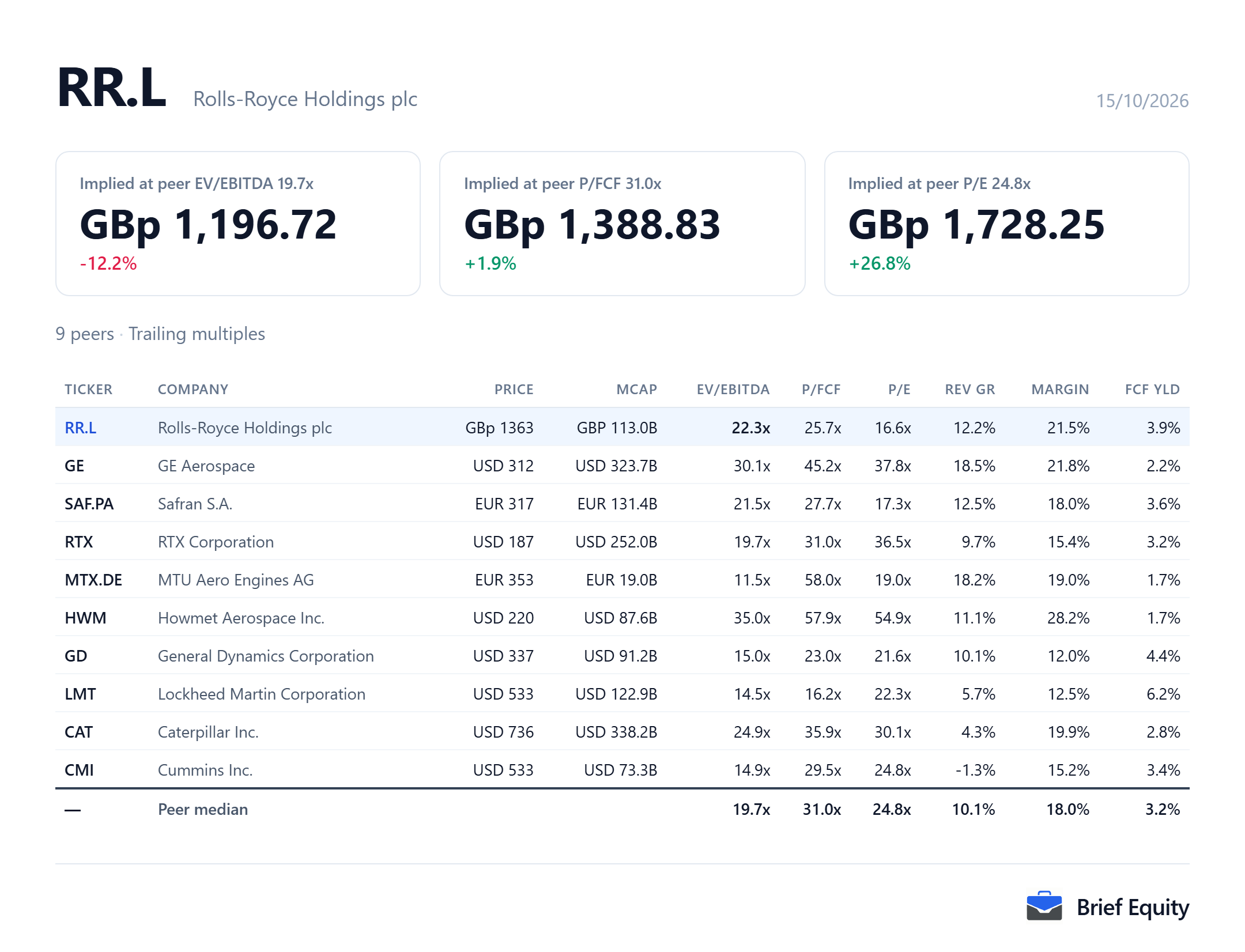
Rolls-Royce is compared with nine companies, chosen so that each of its divisions has at least one peer.
- GE: jet engines and their servicing, against Civil Aerospace
- SAF.PA: jet engines, made with GE through CFM, and their servicing
- RTX: Pratt & Whitney engines, with a defence business alongside
- MTX.DE: engine parts and engine overhaul
- HWM: engine components
- GD: submarines, against Defence
- LMT: combat aircraft, against Defence
- CAT: engines and generators for data centres, against Power Systems
- CMI: engines and generators, against Power Systems
How the estimate moves with its assumptions
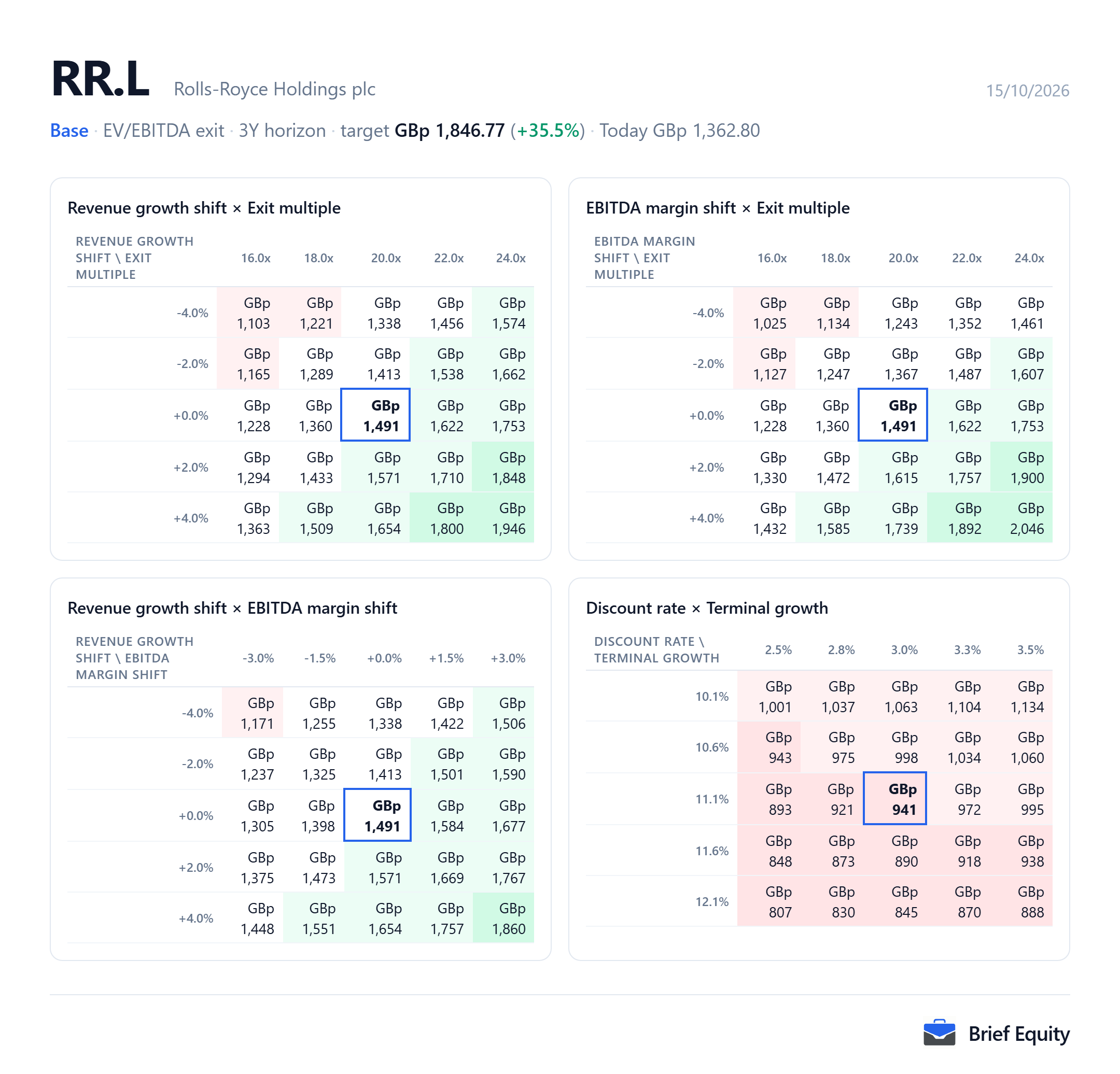
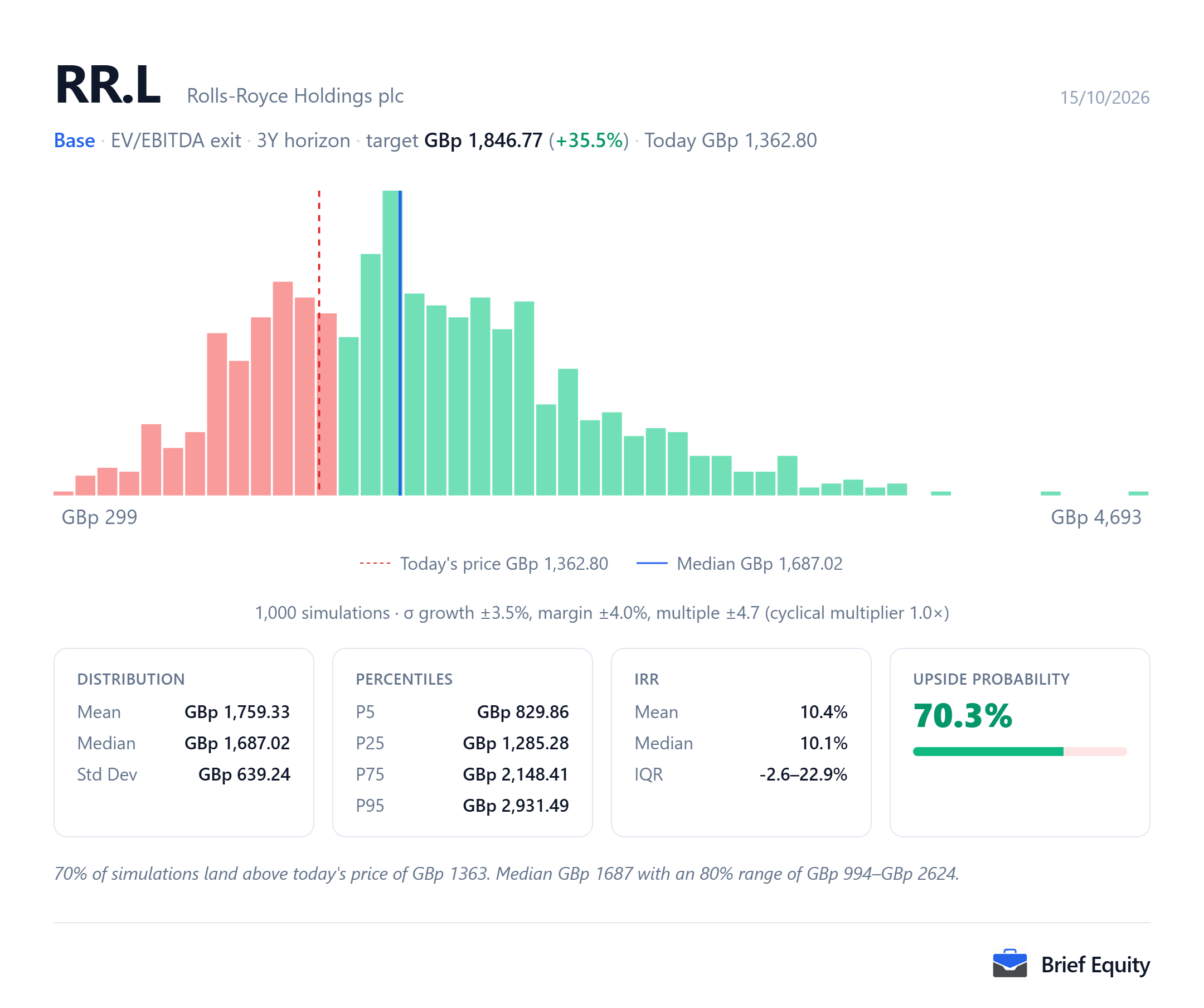
The estimate for Rolls-Royce moves with its assumptions, and the two pictures below show by how much. The first changes two assumptions at a time. The second runs the model many times with growth, margin and the exit multiple drawn at random.
Questions about Rolls-Royce
These questions about Rolls-Royce (RR.L) are answered from the documents listed under Sources.
- How much is Rolls-Royce returning to shareholders?
- Rolls-Royce plans share buybacks totalling GBP 7 billion to GBP 9 billion across 2026 to 2028, as it restated in its 2026 half-year results.
- Does Rolls-Royce have net cash?
- Rolls-Royce had net cash of GBP 2.1 billion at June 30, 2026, up from GBP 1.9 billion at the end of 2025.
- How many large engines does Rolls-Royce have on order?
- Rolls-Royce's large engine order book stood at 2,266 engines at the end of June 2026.
Sources
The quotations and facts about Rolls-Royce (RR.L) on this page rest on the documents below.
- Rolls-Royce 2026 half year results, July 30, 2026
- Rolls-Royce 2026 half year results presentation, July 30, 2026
- Rolls-Royce 2025 full year results, February 26, 2026
About this page
Brief Equity and its team hold no position in Rolls-Royce (RR.L) as of October 15, 2026.
This page is research, not investment advice. It describes one model and the assumptions behind it, and market data is delayed. Read how these models are built and our editorial policy.
Related guides: EV/EBITDA explained, What is enterprise value (EV), How to do a comparable-companies (comps) analysis.