Valuation · EV/EBITDA model
Is Rheinmetall (RHM.DE) stock undervalued?
Brief Equity's EV/EBITDA model of Rheinmetall (RHM.DE), dated October 16, 2026, puts the shares at EUR 2,412 by 2028, about 121% above the EUR 1,090.20 share price at that date. The stock looks somewhat undervalued after its fall from a record in October 2025. The estimate holds if the war in Ukraine continues.
By The Brief Equity Team · Model dated · Published
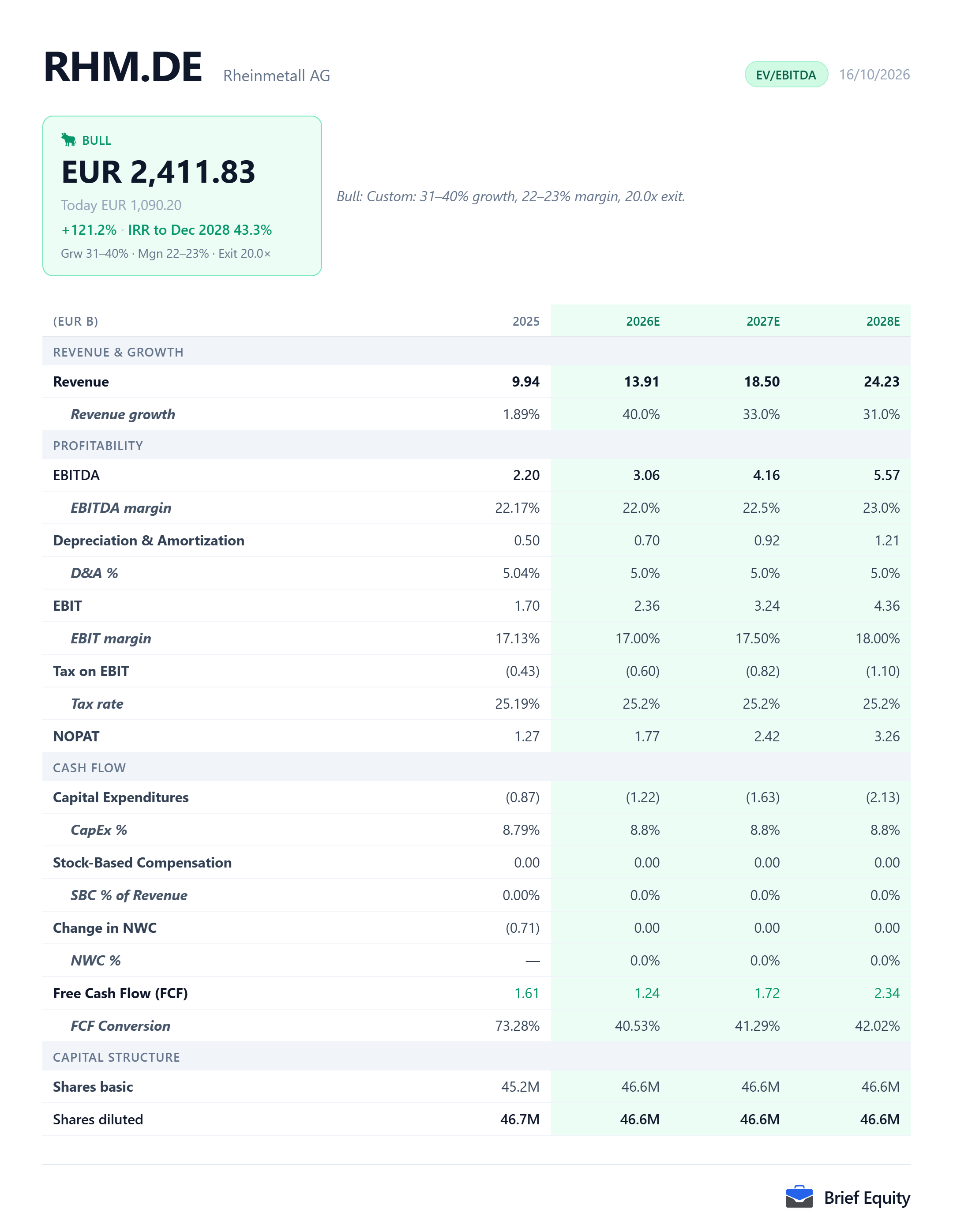
The model's assumptions for Rheinmetall
Rheinmetall's fiscal year is the calendar year, and it reports in euros under IFRS, which carries leases on the balance sheet, so the model's EBITDA is measured before rent. The figures come from a quick model, built on a small set of stated assumptions and projected over three years.
| 2026 | 2027 | 2028 | |
|---|---|---|---|
| Revenue, model | 13.91 | 18.50 | 24.23 |
| Revenue growth, model | 40.0% | 33.0% | 31.0% |
| EBITDA, model | 3.06 | 4.16 | 5.57 |
| EBITDA margin, model | 22.0% | 22.5% | 23.0% |
| Revenue, analysts' consensus | 13.90 | 18.58 | 24.63 |
Why Rheinmetall looks undervalued
Rheinmetall's shares look somewhat undervalued at EUR 1,090.20 if the war in Ukraine continues. The shares reached a record of EUR 2,008 in early October 2025, and several setbacks have followed.
On June 24, 2026, Rheinmetall's shares fell 18% on reports that Germany would drop the F126 frigate programme. In August 2026 the company lowered its sales guidance for 2026 by EUR 300 million.
Rheinmetall's shares have also fallen on progress in Ukraine peace talks, including a 4.5% decline on December 16, 2025, after President Trump said negotiators were closer than ever to a peace deal. Ukraine was the most important customer country of Rheinmetall's Weapon and Ammunition segment in 2025, and the segment's sales growth in the first half of 2026 came mainly from an ammunition package for Hungary and from artillery and medium-calibre ammunition for Ukraine.
Germany is also spending more: its draft federal budget for 2027 raises the defence ministry's budget by EUR 27.1 billion to EUR 109.7 billion. Rheinmetall's backlog was EUR 80.5 billion at June 30, 2026, of which EUR 2.1 billion was for the F126 programme and was written off in July; even without that amount, the backlog is far larger than the EUR 13.7 billion to EUR 14.2 billion of sales the company expects for 2026.
Rheinmetall has not yet signed its largest German order: Boxer vehicles worth EUR 12.4 billion to the company, with a down payment its chief executive put at more than EUR 3 billion. In March 2026 the order was expected in the second or third quarter, and a decision by the Bundestag is now expected on December 9, 2026.
The model assumes Rheinmetall's revenue grows 40% in 2026, inside the company's guidance of 37% to 42%, then 33% in 2027 and 31% in 2028, against the analysts' consensus of 33.6% and 32.5% for those years. Its EBITDA margin rises from 22% in 2026 to 23% in 2028, against a consensus of 21.1% for 2028. At 20 times 2028 EBITDA, the model puts the shares at EUR 2,412 at the end of 2028, about 121% above the price at the model's date.
What has to be true, and what would break it
The estimate for Rheinmetall holds only if the conditions below are met, and each of them can fail.
What has to be true
- The war in Ukraine continues.
- Revenue grows 40% in 2026, 33% in 2027 and 31% in 2028.
- The EBITDA margin rises from 22% in 2026 to 23% in 2028.
- The market values Rheinmetall at 20 times EBITDA at the end of 2028.
What would break it
- A peace deal ends the war in Ukraine.
- Large German orders, such as the Boxer contract, keep arriving later than expected.
- The market values Rheinmetall at a lower multiple of its EBITDA.
The parts of Rheinmetall's business
Rheinmetall reported three segments in 2025. The table gives the shares of Rheinmetall's revenue, and of its revenue growth, for its two largest segments, with the rest of the business in a third line.
| Share of revenue | Share of revenue growth | |
|---|---|---|
| Vehicle Systems | 49.3% | 51.0% |
| Weapon and Ammunition | 32.3% | 30.3% |
| The rest of the business | 18.4% | 18.7% |
Rheinmetall beside its peers
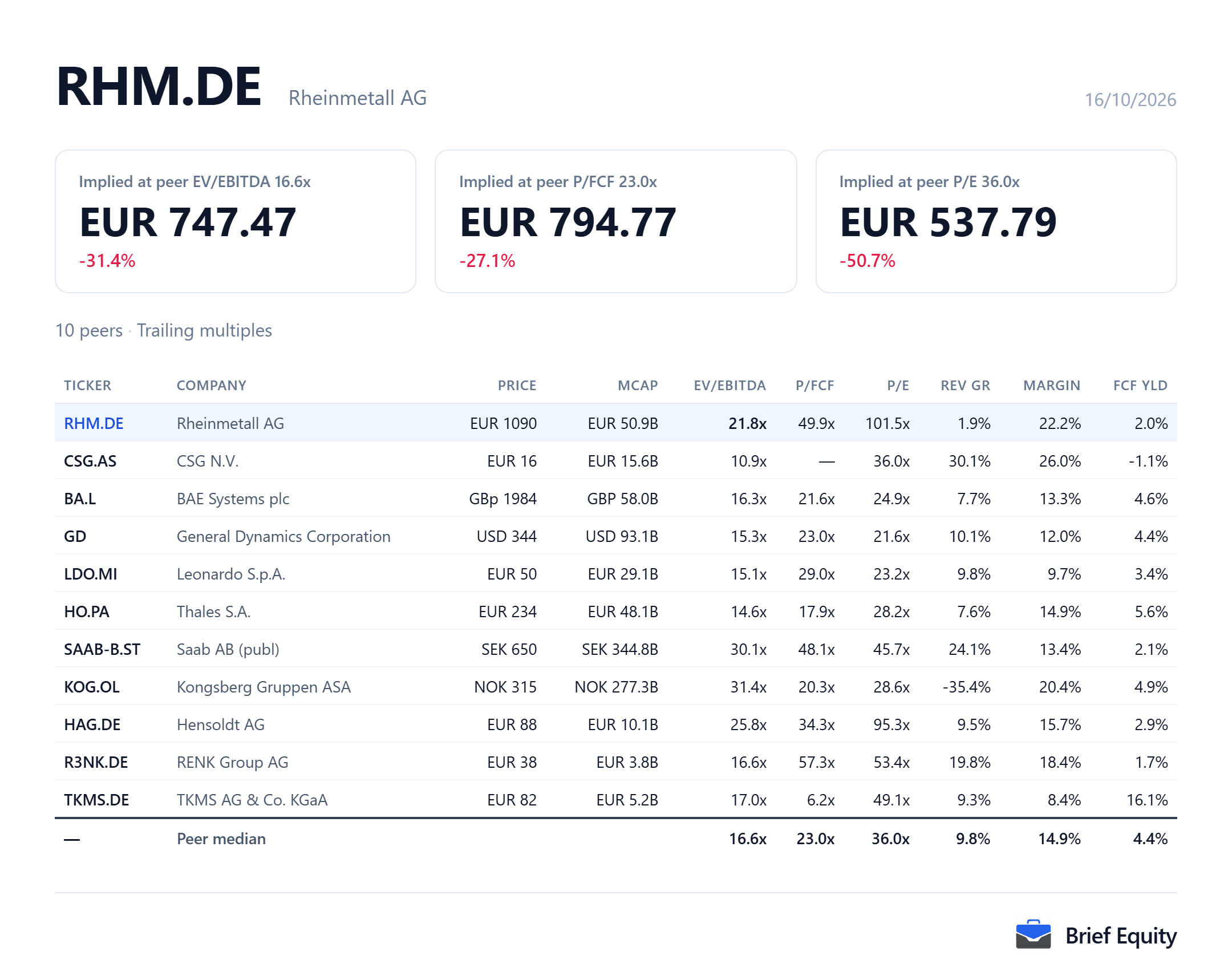
Rheinmetall is compared with ten defence companies, chosen so that each of its businesses has at least one peer.
- CSG.AS: ammunition, the closest rival to Weapon and Ammunition
- BA.L: artillery shells and tracked vehicles
- GD: armoured vehicles, against Vehicle Systems
- LDO.MI: land vehicles, through a joint venture with Rheinmetall, and defence electronics
- HO.PA: radars, air defence and defence electronics
- SAAB-B.ST: air defence and infantry weapons
- KOG.OL: air defence and missiles
- HAG.DE: German defence sensors and radars
- R3NK.DE: transmissions for tanks and armoured vehicles
- TKMS.DE: German naval shipbuilding, against Naval Systems
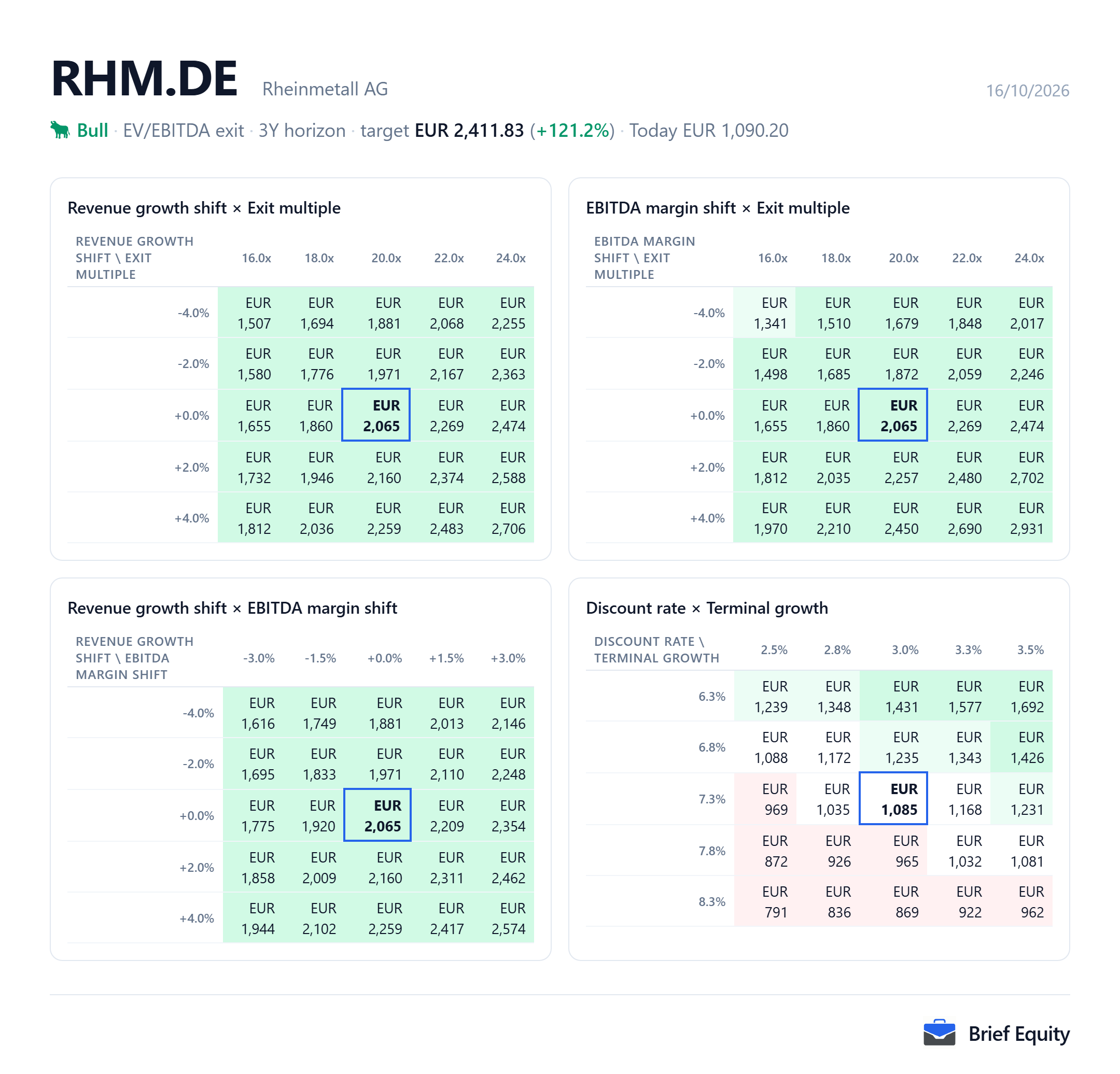
How the estimate moves with its assumptions
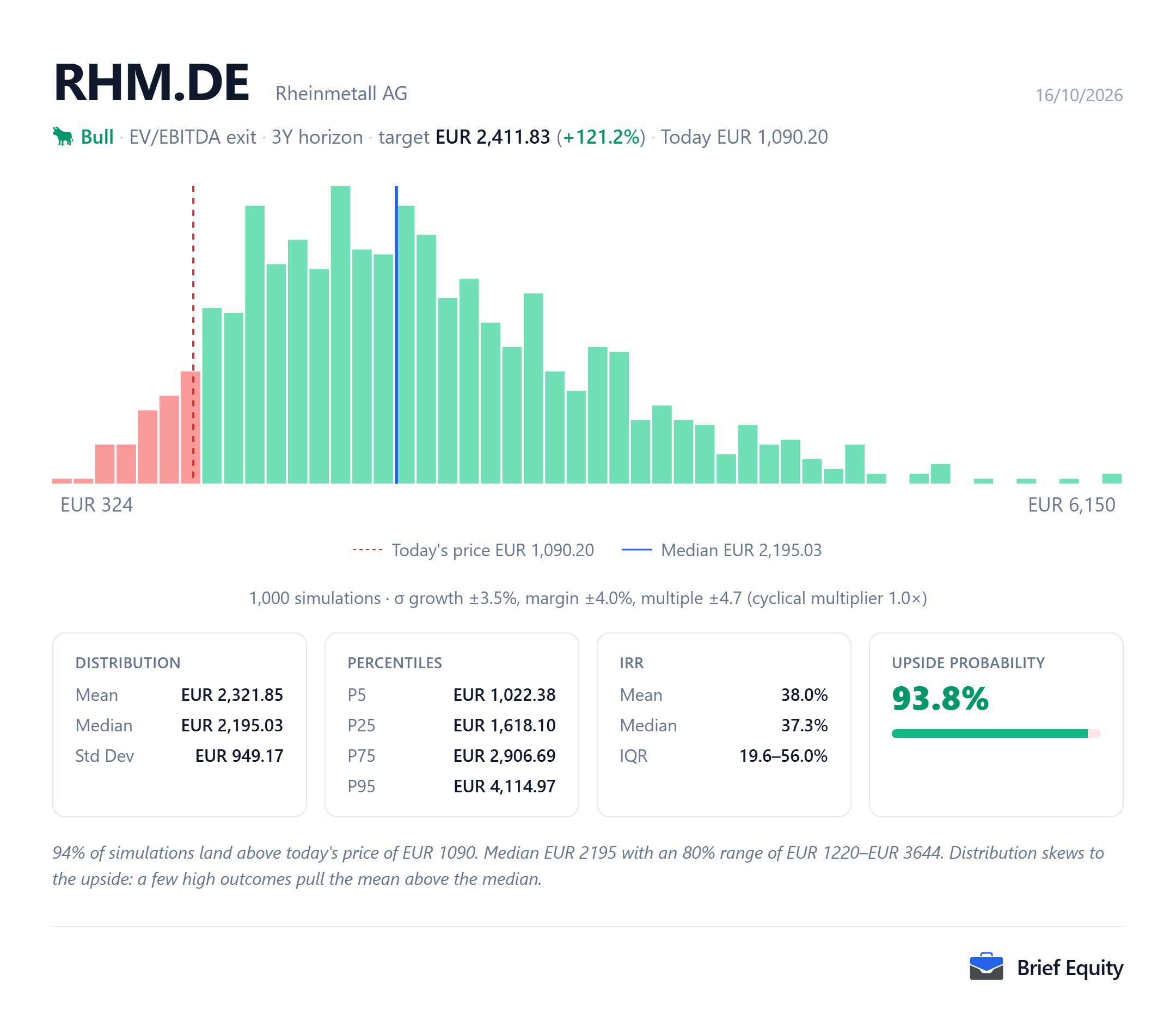
The estimate for Rheinmetall rests on a few assumptions, and the two pictures below show how much it changes when they move. The first changes two assumptions at a time. The second repeats the model many times with growth, margin and the exit multiple drawn at random.
Questions about Rheinmetall
These questions about Rheinmetall (RHM.DE) are answered from the documents listed under Sources.
- Who owns the rest of Rheinmetall's military vehicles business?
- Other shareholders hold 49% of Rheinmetall MAN Military Vehicles, according to Rheinmetall's consolidated financial statements for 2025.
- How much did Rheinmetall pay for Naval Vessels Lürssen?
- Rheinmetall paid a provisional purchase price of EUR 1,515 million in cash for Naval Vessels Lürssen in February 2026.
- Is Rheinmetall selling its civilian business?
- In early June 2026 Rheinmetall signed an agreement to sell its civilian activities to a subsidiary of AEQUITA, at a provisional purchase price of EUR 350 million.
- What dividend did Rheinmetall propose for 2025?
- Rheinmetall proposed a dividend of EUR 11.50 a share for fiscal year 2025, after EUR 8.10 for 2024.
Sources
The quotations and facts about Rheinmetall (RHM.DE) on this page rest on the documents below.
- Rheinmetall press release on the first half of 2026, August 6, 2026
- Rheinmetall Half-Yearly Financial Report 2026, August 6, 2026
- Rheinmetall press release presenting the Annual Report for 2025, March 11, 2026
- Rheinmetall consolidated financial statements, fiscal year 2025, March 11, 2026
- Rheinmetall Q3 analyst and investor recap document, October 5, 2026
- Rheinmetall investor presentation, September 2026, September 4, 2026
- Rheinmetall first-half 2026 earnings call, August 6, 2026
- Rheinmetall full-year 2025 earnings call, March 11, 2026
- CNBC, defence stocks fall on reports Germany is scrapping warships, June 24, 2026
- CNBC, European defence stocks fall as Trump says a Ukraine peace deal is closer, December 16, 2025
- Börse Online (dpa-AFX), defence shares and Rheinmetall's October 2025 record, October 22, 2025
- German Bundestag, the 2027 federal budget introduced, September 8, 2026
About this page
Brief Equity and its team hold no position in Rheinmetall (RHM.DE) as of October 16, 2026.
This page is research, not investment advice. It describes one model and the assumptions behind it, and market data is delayed. Read how these models are built and our editorial policy.
Related guides: EV/EBITDA explained, What is enterprise value (EV), How to build a DCF model (step by step).