Valuation · EV/EBITDA model
Is Parker-Hannifin (PH) stock undervalued?
On November 6, 2026, with the shares at $917.79, a quick EV/EBITDA model by Brief Equity valued Parker-Hannifin at about $1,396 for fiscal 2029. Parker-Hannifin looks undervalued on that model if its growth stays above the 4% to 6% organic rate it targets over a cycle after fiscal 2027, and the market keeps paying a premium multiple for the business.
By The Brief Equity Team · Model dated · Published
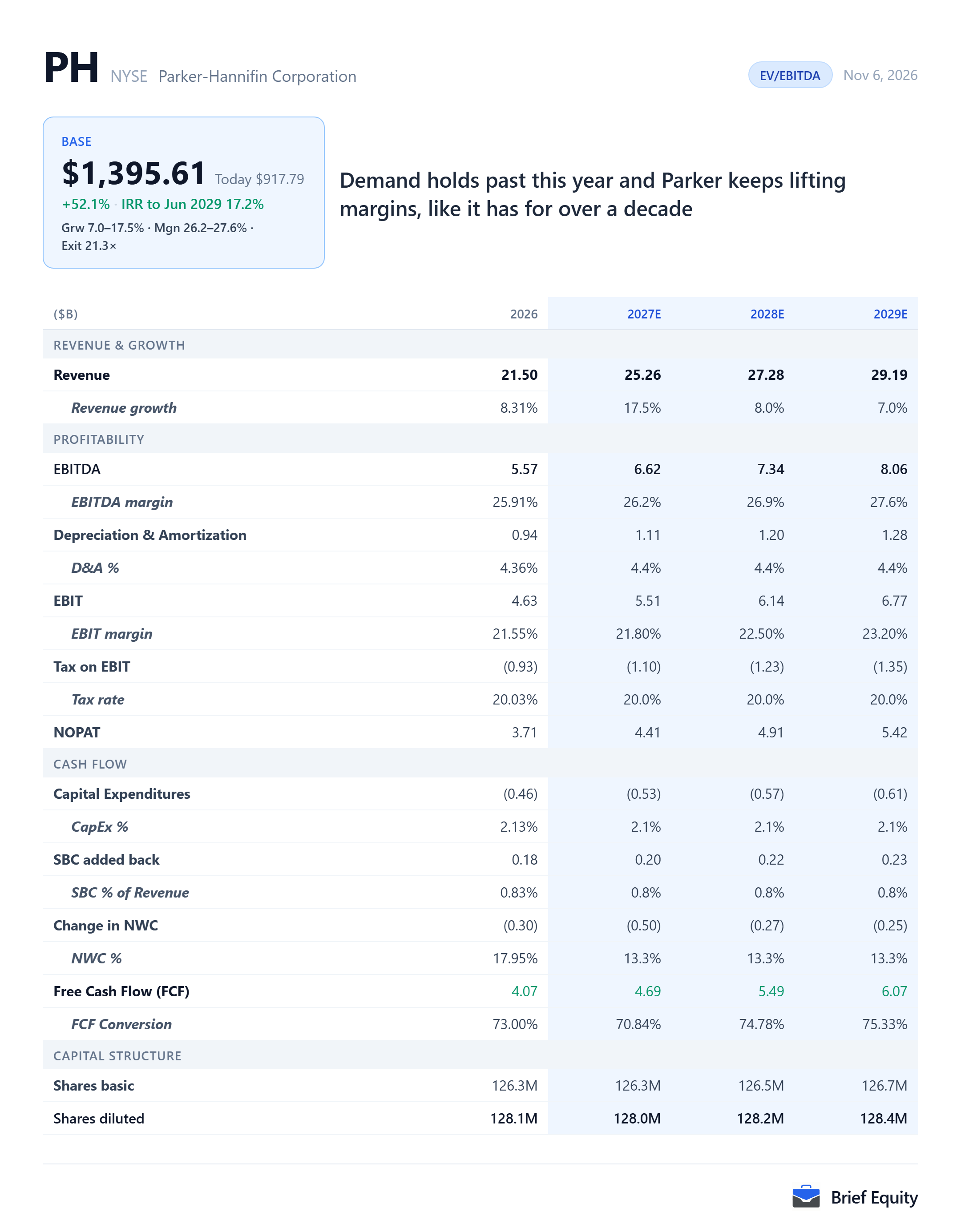
The model's assumptions for Parker-Hannifin
Parker-Hannifin's fiscal year ends on June 30, and the last year it has reported in full is fiscal 2026. The model runs three years, to fiscal 2029. Every row below is the model's own except the analyst consensus revenue. Fiscal 2027 includes Filtration Group, which Parker-Hannifin bought on August 13, 2026.
| 2027 | 2028 | 2029 | |
|---|---|---|---|
| Revenue, model | 25.26 | 27.28 | 29.19 |
| Revenue growth, model | 17.5% | 8.0% | 7.0% |
| EBITDA, model | 6.62 | 7.34 | 8.06 |
| EBITDA margin, model | 26.2% | 26.9% | 27.6% |
| Revenue, analyst consensus | 24.98 | 26.80 | 28.30 |
Why Parker-Hannifin looks undervalued
Parker-Hannifin delivered its first quarter of double-digit organic sales growth in over three years in the first quarter of fiscal 2027. In fiscal 2026 it surpassed the margin target it had set for fiscal 2029, and it raised the target again. Its chief executive, Jennifer Parmentier, said on the fiscal 2026 fourth-quarter call:
“And now for the fifth time in just over 10 years, we are raising our adjusted segment operating margin target once again.”
Jennifer Parmentier, Chairman and Chief Executive Officer, Parker-Hannifin fourth-quarter fiscal 2026 earnings call, August 6, 2026
Parker-Hannifin's order rates were up by double digits in every business in the first quarter of fiscal 2027, and its backlog reached a record $13.7 billion. The company raised its organic growth guidance for fiscal 2027 to 9% from 7% at the midpoint, and it expects $220 million of cost synergies from Filtration Group, the filtration business it bought in August 2026.
The model has Parker-Hannifin's revenue growing 17.5% in fiscal 2027 with Filtration Group included, the midpoint of the company's guidance of 16% to 19%, then 8.0% in fiscal 2028 and 7.0% in fiscal 2029, above the 4% to 6% organic growth the company targets over a cycle. The EBITDA margin rises from 26.2% to 27.6%. With an exit multiple of 21.3 times EBITDA, the model values Parker-Hannifin at about $1,396 a share for fiscal 2029, about 52% above the share price.
Parker-Hannifin's case rests on demand holding after fiscal 2027. Aerospace Systems was 32.8% of the company's fiscal 2026 revenue and accounted for 53.1% of its revenue growth that year, and its rolling twelve-month orders growth slowed to 14% in the first quarter of fiscal 2027 from 18% in the quarter before.
What has to be true, and what would break it
Parker-Hannifin looks undervalued on this model if demand holds after fiscal 2027 and the market keeps paying a premium multiple for the business.
What has to be true
- Parker-Hannifin's revenue grows 17.5% in fiscal 2027, then 8.0% in fiscal 2028 and 7.0% in fiscal 2029.
- Parker-Hannifin's EBITDA margin rises from 26.2% in fiscal 2027 to 27.6% in fiscal 2029.
- Orders keep growing across the industrial and aerospace businesses after fiscal 2027.
- The market pays about 21.3 times Parker-Hannifin's EBITDA at the end of fiscal 2029.
What would break it
- Orders roll over after fiscal 2027 and growth falls back to the 4% to 6% organic rate Parker-Hannifin targets over a cycle.
- Aerospace orders keep slowing from the 14% growth of the first quarter of fiscal 2027.
- The market pays less than 21.3 times Parker-Hannifin's EBITDA at the end of fiscal 2029.
The parts of Parker-Hannifin's business
Parker-Hannifin reports three parts: Diversified Industrial North America, Diversified Industrial International and Aerospace Systems.
| Share of revenue | Share of revenue growth | |
|---|---|---|
| Diversified Industrial North America | 39.0% | 15.6% |
| Diversified Industrial International | 28.1% | 31.2% |
| Aerospace Systems | 32.8% | 53.1% |
Parker-Hannifin beside its peers
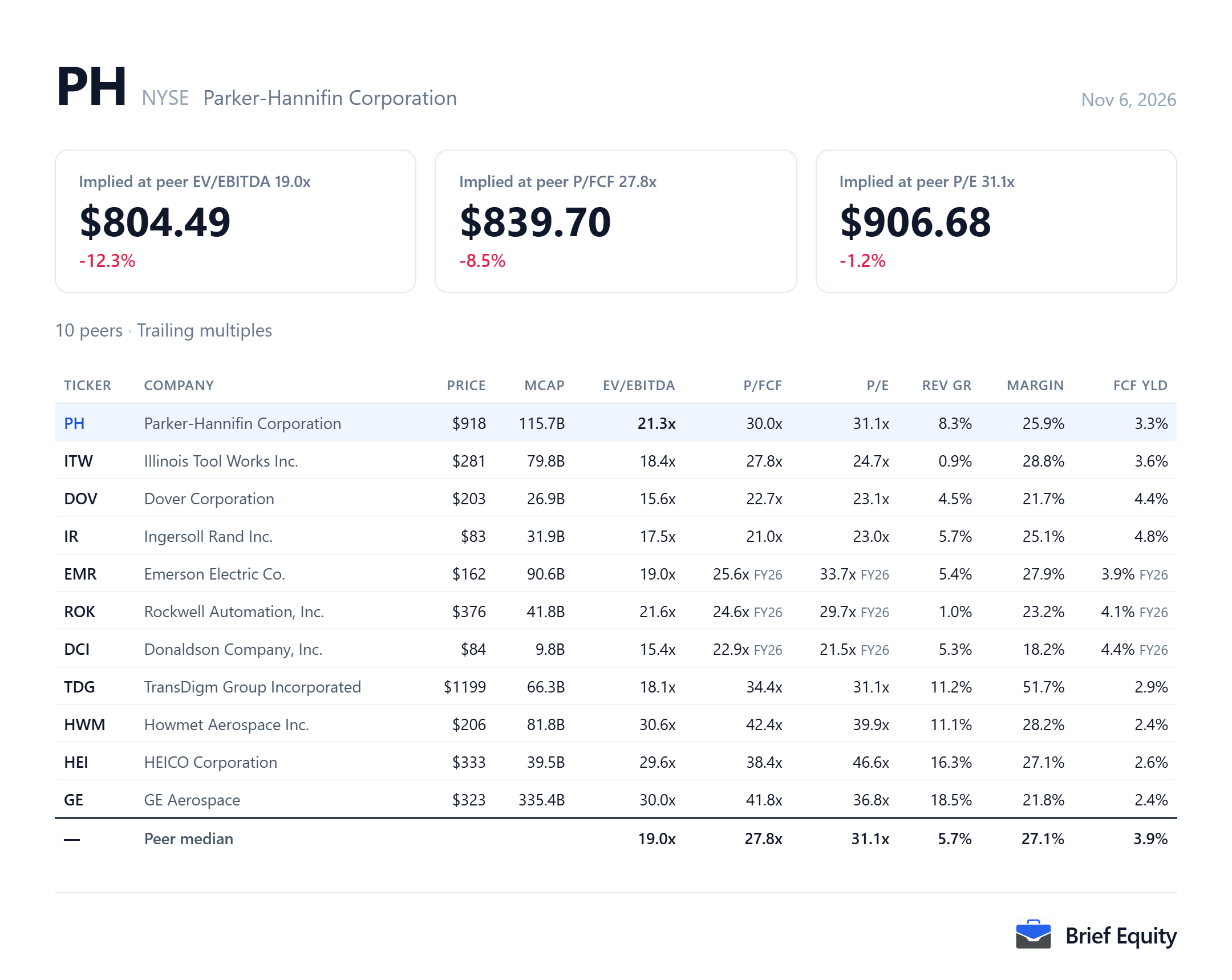
Parker-Hannifin is compared here with ten US-listed companies, chosen to cover its industrial businesses, its filtration business and Aerospace Systems.
- ITW: General industrial, against Diversified Industrial
- DOV: Engineered components, against Diversified Industrial
- IR: Compressors and pumps, against Diversified Industrial
- EMR: Automation, against Diversified Industrial
- ROK: Industrial automation, against Diversified Industrial
- DCI: Filtration, against Filtration Group
- TDG: Aircraft components, against Aerospace Systems
- HWM: Engine and airframe parts, against Aerospace Systems
- HEI: Aftermarket aircraft parts, against Aerospace Systems
- GE: Aircraft engines, against Aerospace Systems
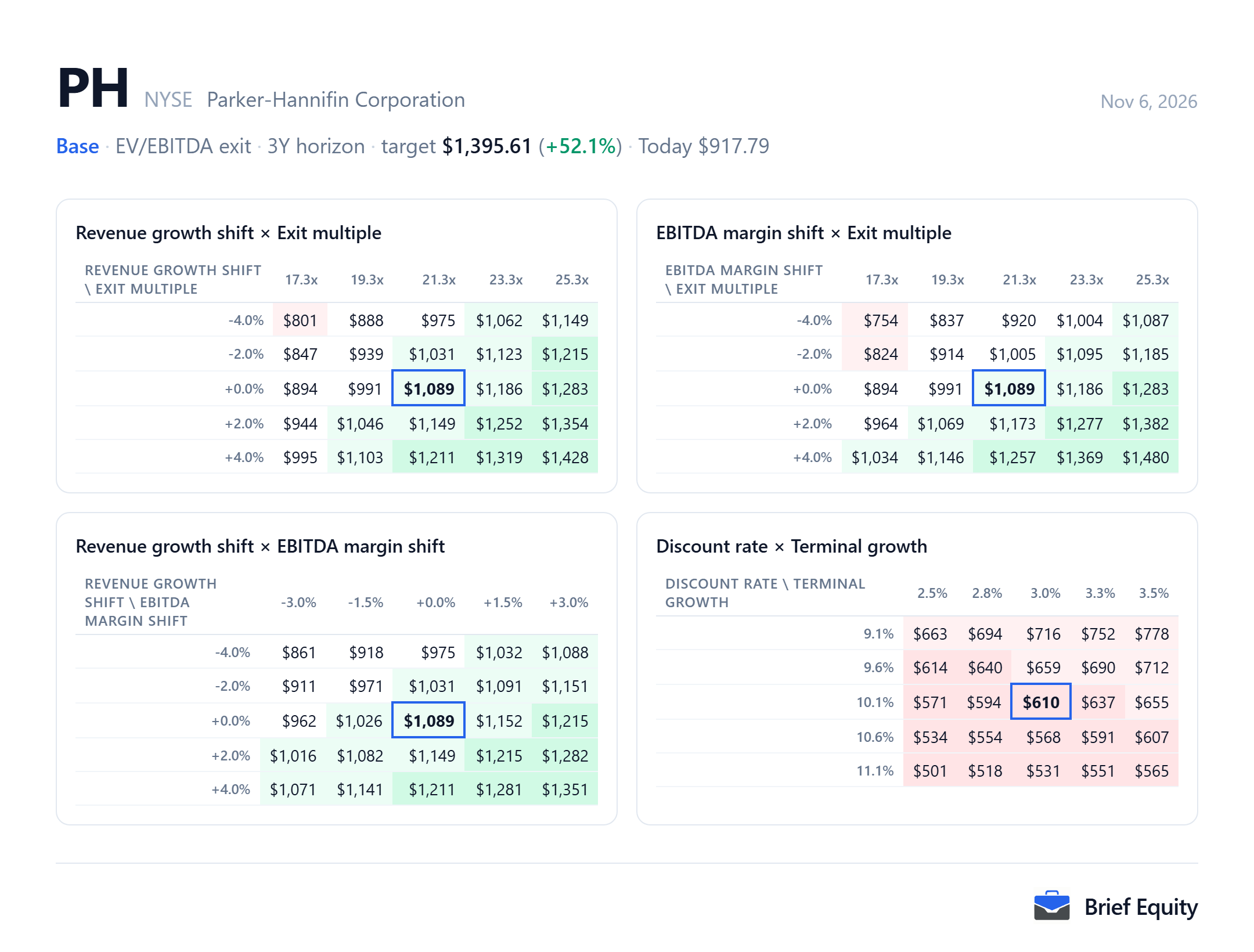
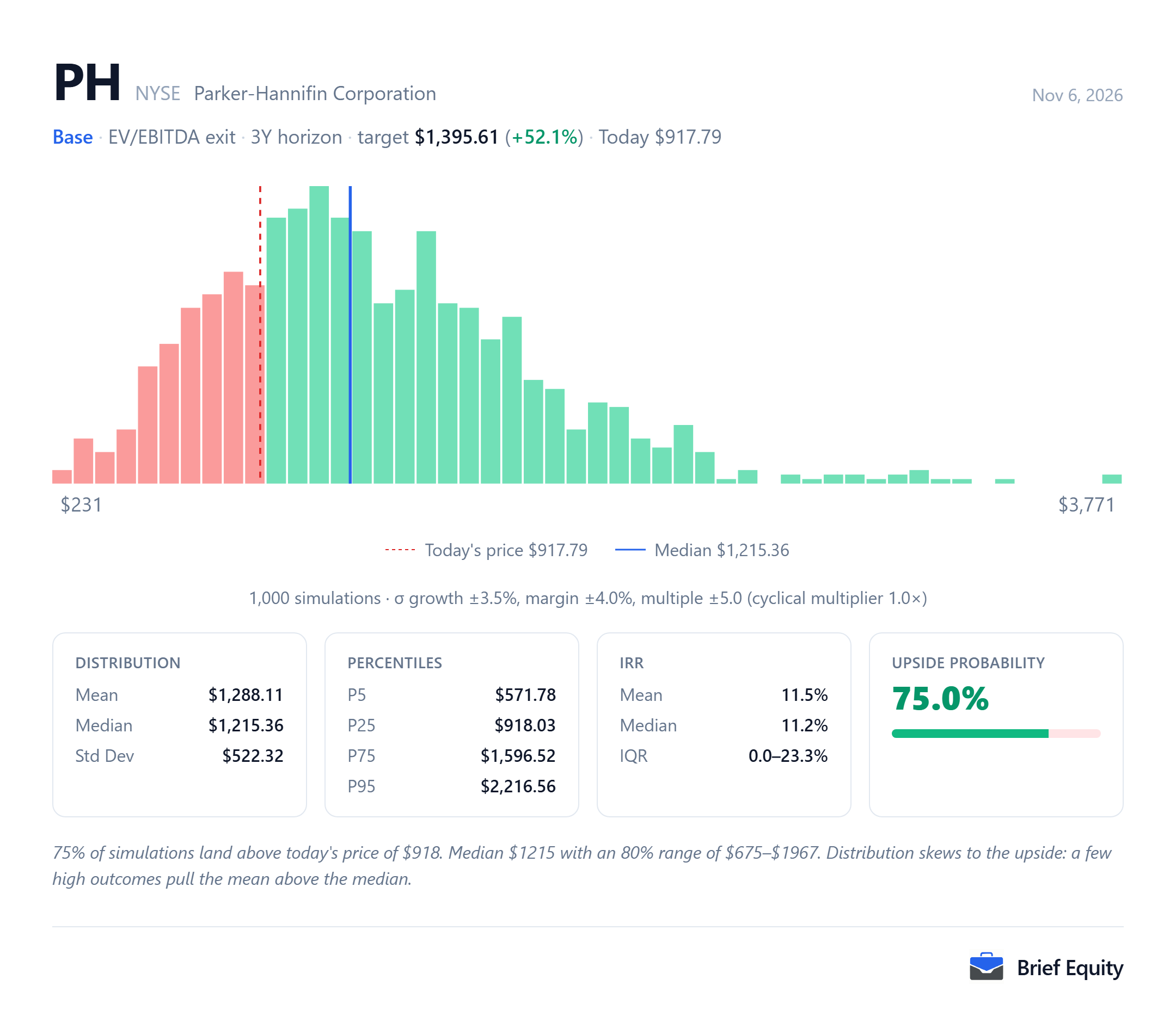
How the estimate moves with its assumptions
The two Parker-Hannifin cards below test the estimate: the sensitivity grids move two assumptions at a time, and the Monte Carlo card reruns the model many times with growth, margin and the exit multiple drawn at random.
Questions about Parker-Hannifin
These questions about Parker-Hannifin (PH) are answered from the documents listed under Sources.
- When does Parker-Hannifin's fiscal year end?
- Parker-Hannifin's fiscal year ends on June 30, so fiscal 2027 runs from July 2026 to June 2027, according to its annual report for fiscal 2026.
- What did Parker-Hannifin pay for Filtration Group?
- Parker-Hannifin completed the Filtration Group acquisition on August 13, 2026, for approximately $9.1 billion, net of cash acquired, according to its quarterly report for the quarter ended September 30, 2026.
- What other acquisition has Parker-Hannifin agreed to?
- On May 21, 2026, Parker-Hannifin announced a definitive agreement to acquire CIRCOR Aerospace for approximately $2.55 billion in cash, which it expects to fund with a credit facility and cash, according to its quarterly report for the quarter ended September 30, 2026.
Sources
The quotations and facts about Parker-Hannifin (PH) on this page rest on the documents below.
- Parker-Hannifin annual report on Form 10-K for fiscal 2026, August 21, 2026
- Parker-Hannifin quarterly report on Form 10-Q for the first quarter of fiscal 2027, November 5, 2026
- Parker-Hannifin first-quarter fiscal 2027 earnings release, November 5, 2026
- Parker-Hannifin first-quarter fiscal 2027 earnings call, November 5, 2026
- Parker-Hannifin fourth-quarter fiscal 2026 earnings call, August 6, 2026
About this page
Brief Equity and its team hold no position in Parker-Hannifin (PH) as of November 6, 2026.
This page is research, not investment advice. It describes one model and the assumptions behind it, and market data is delayed. Read how these models are built and our editorial policy.
Related guides: How to read a 10-K (SEC filing), Where to read earnings transcripts and filings in one place, How to value a stock yourself (without Excel).