Valuation · EV/EBITDA model
Is Netflix (NFLX) stock overvalued?
Brief Equity's EV/EBITDA model of Netflix (NFLX), dated October 21, 2026, puts the shares at $79 by 2028, about 22% above the $65.04 share price at that date. Netflix still looks a bit expensive at that price, because the model's cash flows alone would need about 32% revenue growth a year to support it. The stock looks cheap only if Netflix keeps a premium multiple.
By The Brief Equity Team · Model dated · Published
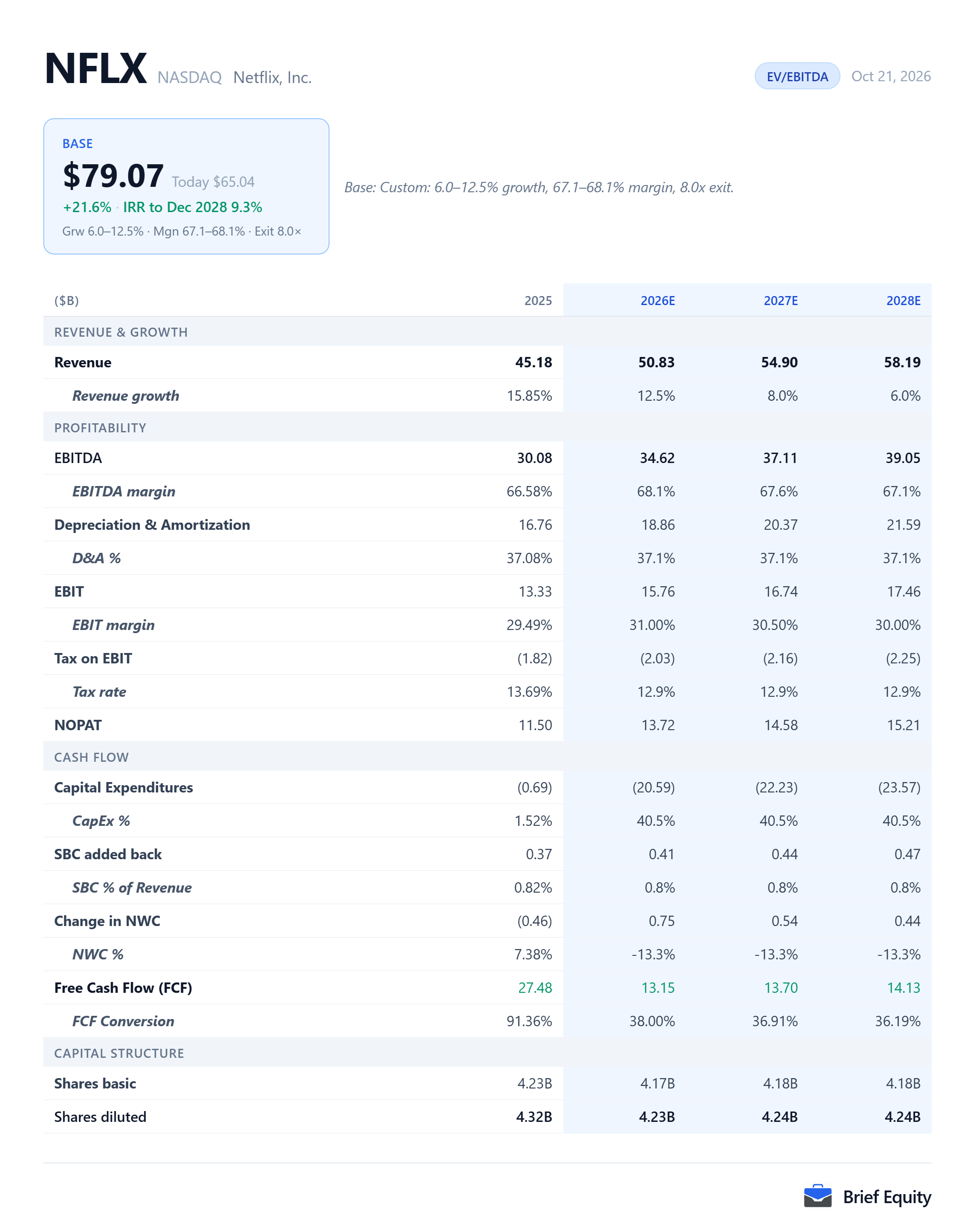
The model's assumptions for Netflix
Netflix's fiscal year is the calendar year, and at the model's date it had reported the first three quarters of 2026, so every column below is an estimate. The figures come from a quick model, built on a small set of stated assumptions and projected over three years. The model's EBITDA is before content amortization, Netflix's largest cost, so it is not the same figure as an EBITDA that deducts it.
| 2026 | 2027 | 2028 | |
|---|---|---|---|
| Revenue, model | 50.83 | 54.90 | 58.19 |
| Revenue growth, model | 12.5% | 8.0% | 6.0% |
| EBITDA before content amortization, model | 34.62 | 37.11 | 39.05 |
| EBITDA margin before content amortization, model | 68.1% | 67.6% | 67.1% |
| Revenue, analysts' consensus | 51.17 | 56.75 | 62.33 |
Why Netflix looks overvalued
Netflix still looks a bit expensive at $65.04, even though its share price is close to the bottom of its 52-week range and has fallen about 40% over the past year. Deadline named slowing growth in viewing as the main reason for that fall.
“In the current moment, there are a few factors that have combined to send the stock down 40% over the past year. Chief among them is its slowing viewership growth of late, a trend that prompted last week’s replacement of Bajaria with Peter Rice.”
Deadline report on Netflix's third-quarter 2026 results, October 20, 2026
Netflix's view hours grew 2% in the first half of 2026, according to its second-quarter call. In June 2026, YouTube had 13.5% of US television viewing time and Netflix had 7.9%, according to MediaPost's report on Nielsen's figures. Skydance completed its acquisition of Warner Bros. Discovery on October 6, 2026, and said its streaming services will unify into a single service over time. Skydance put the combined company's pro forma content spending at more than $30 billion for the last twelve months.
Netflix faces that competition in the markets where it relies most on price. Its co-chief executive said on the third-quarter 2026 call that growth in its most mature markets, such as the United States, the United Kingdom and Australia, would come mainly from revenue per membership and advertising. Netflix also lowered its forecast for 2026 advertising revenue to about $2.7 billion from about $3 billion, because some of its advertising products rolled out more slowly than it expected.
“We're more deeply penetrated, so our revenue growth drivers in those markets are going to skew towards ARM and advertising growth.”
Greg Peters, Co-Chief Executive Officer, Netflix third-quarter 2026 earnings interview, October 20, 2026
The model has Netflix's revenue growing 12.5% in 2026, 8.0% in 2027 and 6.0% in 2028, below the analysts' consensus of 10.9% for 2027 and 9.8% for 2028. Its operating margin falls from 31.00% in 2026 to 30.00% in 2028, on the assumption that Netflix has to spend more to keep growing. The cash Netflix pays for content is counted as capital spending, at 40.5% of revenue, which leaves free cash flow of $13.15 billion in 2026, rising to $14.13 billion in 2028.
On those cash flows, the share price of $65.04 would need revenue growth of about 32% a year, with the rest of the model held constant. The model's value of $79 a share by 2028 comes from valuing Netflix at 8 times its 2028 EBITDA before content amortization.
Netflix looks cheap at $65.04 only for a buyer who expects it to keep a premium multiple.
What has to be true, and what would break it
The estimate for Netflix holds only if the conditions below are met, and each of them can fail.
What has to be true
- Investors keep valuing Netflix at about 8 times its EBITDA before content amortization in 2028.
- Revenue grows 12.5% in 2026, 8.0% in 2027 and 6.0% in 2028, with the operating margin between 30.00% and 31.00%.
- The cash Netflix pays for content stays near 40.5% of revenue.
What would break it
- YouTube keeps taking a larger share of US television viewing, and Netflix's price increases in its most mature markets stop holding.
- Advertising keeps falling behind Netflix's own forecasts, as it did when the 2026 forecast was lowered to about $2.7 billion.
- The market values Netflix at a lower multiple of its EBITDA before content amortization than the model uses.
The parts of Netflix's business
Netflix reports one segment and splits its revenue by region. The table gives each region's share of Netflix's revenue in 2025, and its share of the growth in revenue over 2024.
| Share of revenue | Share of revenue growth | |
|---|---|---|
| United States and Canada (UCAN) | 44.2% | 42.0% |
| Europe, Middle East, and Africa (EMEA) | 32.1% | 34.4% |
| Latin America (LATAM) | 11.9% | 8.4% |
| Asia-Pacific (APAC) | 11.8% | 15.2% |
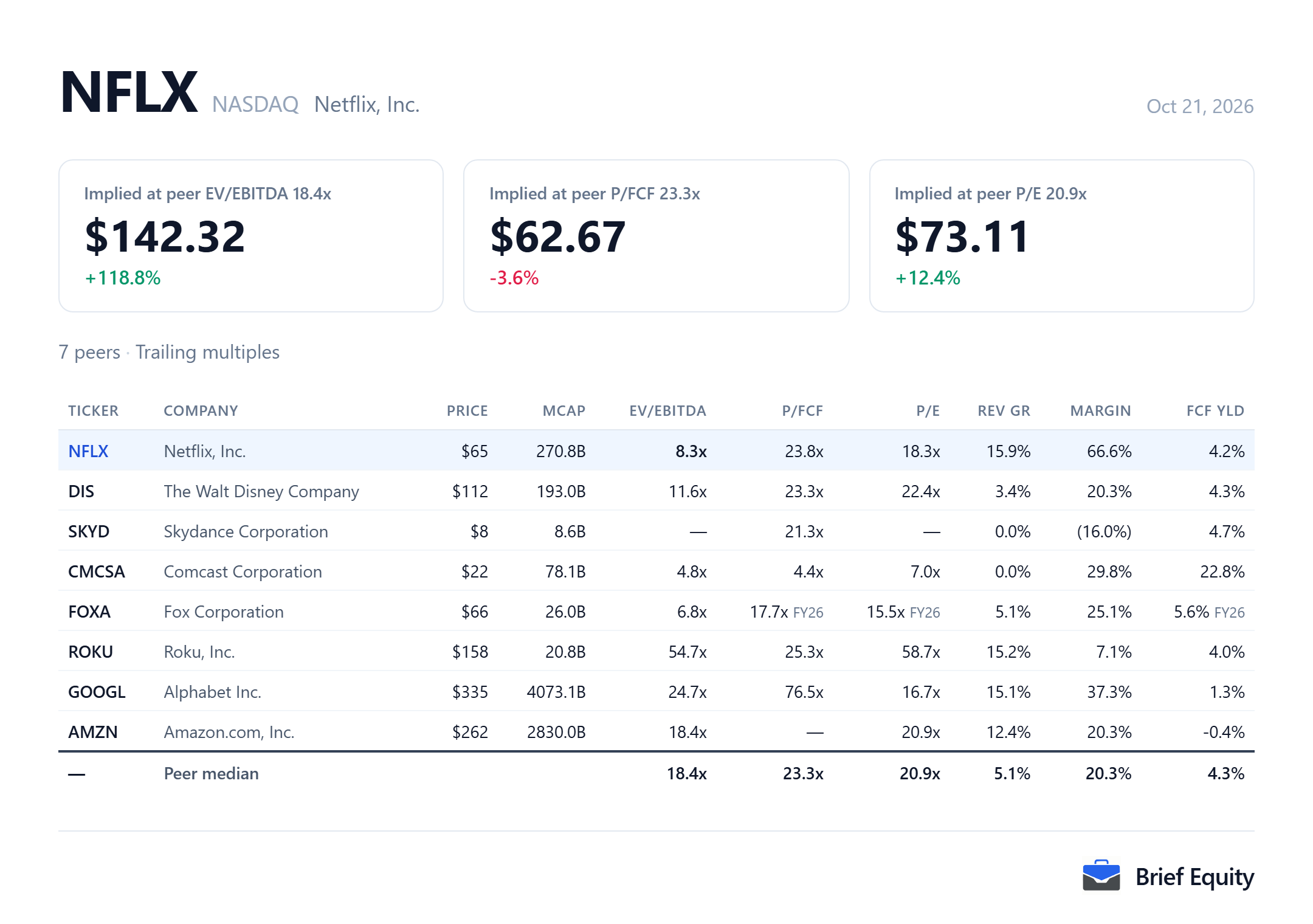
Netflix beside its peers
Netflix is compared with seven companies, chosen so that each of the main services competing for its viewers' time has a peer.
- DIS: Disney+ and Hulu
- SKYD: HBO Max and Paramount+, one company since October 6, 2026
- CMCSA: Peacock
- FOXA: Tubi, free streaming with advertising
- ROKU: the television platform and its free channels
- GOOGL: YouTube
- AMZN: Prime Video
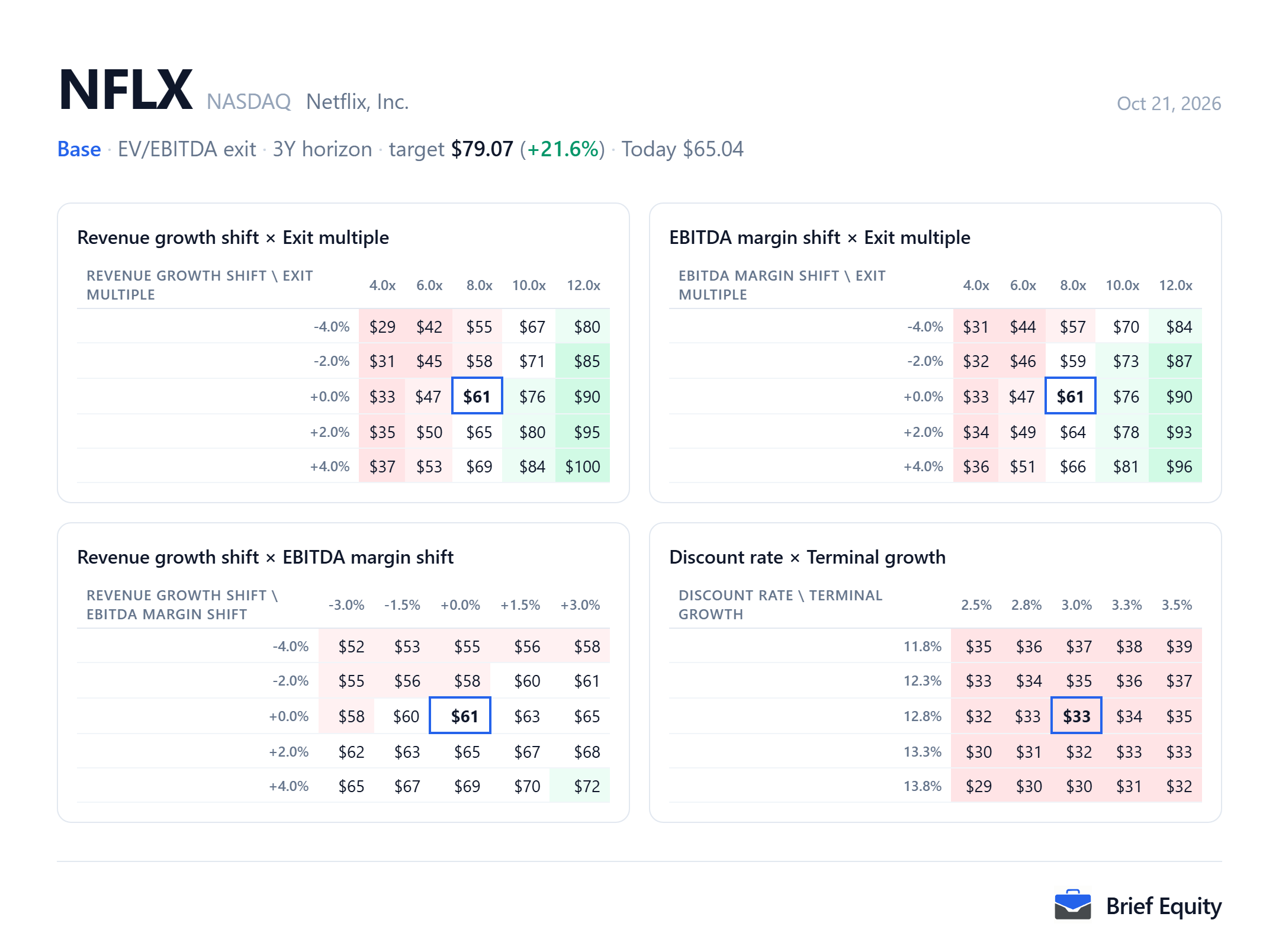
How the estimate moves with its assumptions
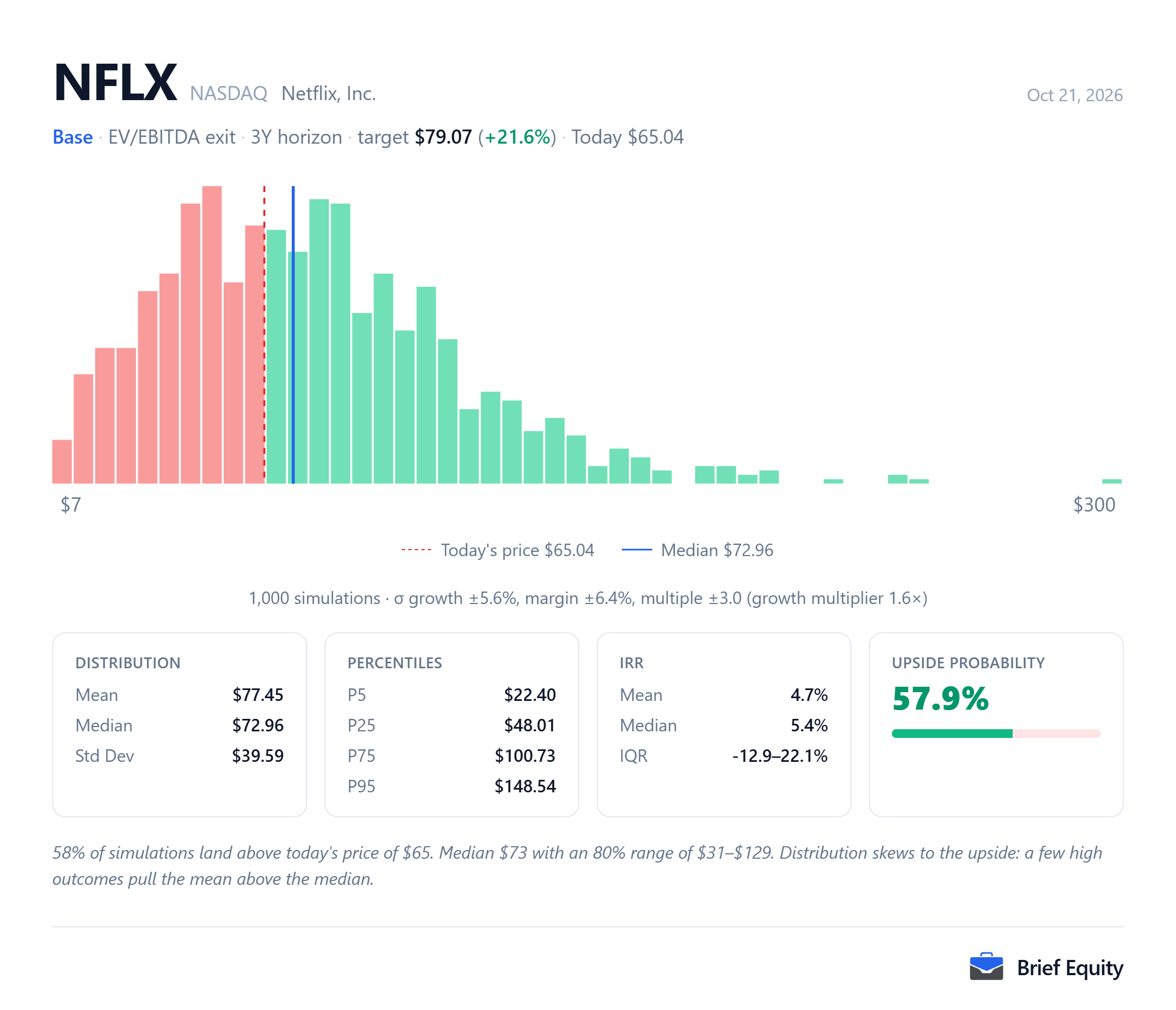
The estimate for Netflix rests on a few assumptions, and the two pictures below show how far it moves when they change. The first changes two assumptions at a time, and the second runs the model many times with growth, margin and the exit multiple drawn at random.
Questions about Netflix
These questions about Netflix (NFLX) are answered from the documents listed under Sources.
- How many shares did Netflix buy back in the third quarter of 2026?
- Netflix bought back 63.9 million shares for $4.8 billion in the third quarter of 2026, its largest quarter of repurchases. In its letter of October 20, 2026, it said it had $22.3 billion of capacity left under its authorizations.
- How much debt did Netflix have at the end of September 2026?
- Netflix ended the third quarter of 2026 with gross debt of $15.3 billion and cash and cash equivalents of $8.2 billion.
- How much cash does Netflix spend on content compared with its content amortization?
- In its letter for the third quarter of 2026, Netflix said it continues to expect an annual ratio of cash content spending to content amortization of about 1.1 times.
- In how many new countries will Netflix launch its advertising tier in 2027?
- Netflix said in its third-quarter 2026 letter that it will introduce its advertising tier in 15 new countries in 2027.
Sources
The quotations and facts about Netflix (NFLX) on this page rest on the documents below.
- Netflix letter to shareholders for the third quarter of 2026, October 20, 2026
- Netflix third-quarter 2026 earnings interview, October 20, 2026
- Netflix second-quarter 2026 earnings interview, July 16, 2026
- Deadline report on Netflix's third-quarter 2026 results, October 20, 2026
- MediaPost report on Nielsen's June 2026 share of US television viewing, August 18, 2026
- Skydance announcement completing its acquisition of Warner Bros. Discovery, October 6, 2026
About this page
Brief Equity and its team hold no position in Netflix (NFLX) as of October 21, 2026.
This page is research, not investment advice. It describes one model and the assumptions behind it, and market data is delayed. Read how these models are built and our editorial policy.
Related guides: EV/EBITDA explained, How to do a comparable-companies (comps) analysis.