Valuation · EV/EBITDA model
Is Meta Platforms (META) stock undervalued?
Brief Equity's EV/EBITDA model of Meta Platforms (META), dated October 23, 2026, puts the shares at $1,124 by 2028, about 73% above the $648.85 share price at that date. Meta looks cheap at that price, provided its capital expenditure falls as a share of revenue by 2028 while its advertising keeps growing.
By The Brief Equity Team · Model dated · Published
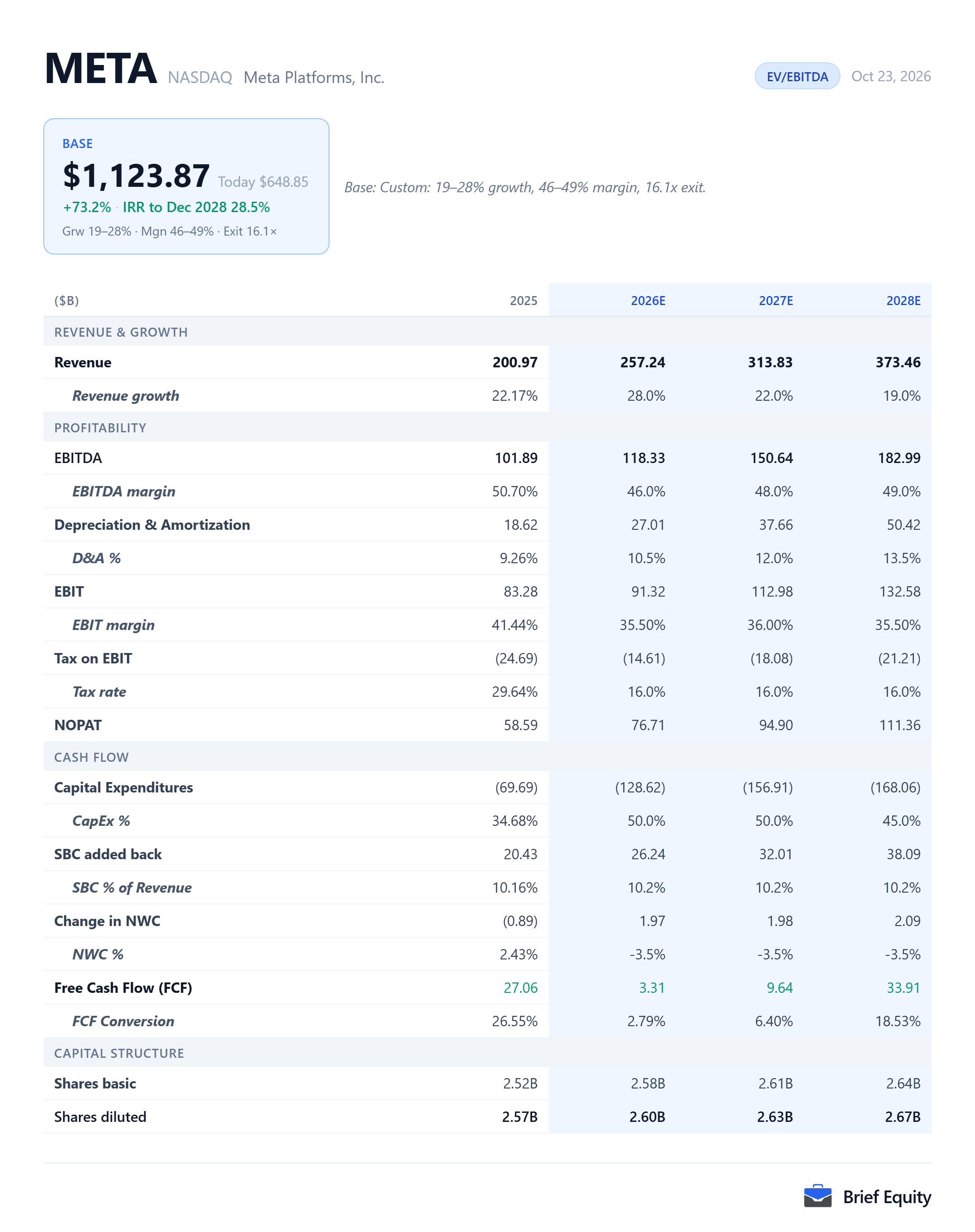
The model's assumptions for Meta Platforms
Meta Platforms' fiscal year is the calendar year, so the model's years are the company's own. The figures come from a quick model, built on a small set of stated assumptions and projected over three years.
| 2026 | 2027 | 2028 | |
|---|---|---|---|
| Revenue, model | 257.24 | 313.83 | 373.46 |
| Revenue growth, model | 28.0% | 22.0% | 19.0% |
| EBITDA, model | 118.33 | 150.64 | 182.99 |
| EBITDA margin, model | 46.0% | 48.0% | 49.0% |
| Revenue, analysts' consensus | 256.07 | 310.81 | 369.06 |
Why Meta Platforms looks undervalued
Meta Platforms' free cash flow was negative in the third quarter of 2026, and the company said it expects to continue investing aggressively beyond 2026. At $648.85 the stock looks cheap, provided its capital expenditure falls as a share of revenue by 2028 and its advertising keeps growing.
In that quarter Meta generated $32.79 billion of cash from operating activities and spent $34.91 billion on capital expenditures, including principal payments on finance leases, so its free cash flow was negative $2.12 billion. It narrowed its 2026 capital expenditure outlook to a range of $135 billion to $145 billion and has given no figure for 2027.
Meta's advertising kept growing in the third quarter of 2026, when its advertising revenue was $63,061 million, up 26% from a year earlier.
Meta's margin fell in its Family of Apps segment, whose operating margin was 27% in the third quarter of 2026 against 49% a year earlier, a quarter that included a $9.89 billion charge for the agreement with state attorneys general. Excluding that charge, Meta still expects its 2026 operating income to be above its 2025 operating income.
Meta's Reality Labs segment lost $4,129 million in the third quarter of 2026, against $4,432 million a year earlier, and Meta now expects its Reality Labs losses for 2026 to be in a range of $18 billion to $19 billion.
“Separately, we remain focused on improving Reality Labs profitability and expect losses to narrow next year to around $15 billion as we reallocate investment toward other priority areas, primarily AI.”
Meta Platforms press release on its third quarter 2026 results, October 21, 2026
The model assumes that Meta's revenue grows 28.0% in 2026, 22.0% in 2027 and 19.0% in 2028, against the analysts' consensus of 27.4%, 21.4% and 18.7%. It raises the EBITDA margin from 46.0% in 2026 to 49.0% in 2028 and sets capital expenditure at 50.0% of revenue in 2026 and 2027 and 45.0% in 2028. Valued at 16.1 times its 2028 EBITDA, Meta reaches $1,124 a share by 2028, about 73% above the share price at the model's date.
What has to be true, and what would break it
The estimate for Meta Platforms holds only if the conditions below are met, and each of them can fail.
What has to be true
- Capital expenditure falls from 50.0% of revenue in 2026 and 2027 to 45.0% in 2028.
- Revenue grows 28.0% in 2026, 22.0% in 2027 and 19.0% in 2028.
- The EBITDA margin reaches 49.0% in 2028.
- The market values Meta at 16.1 times its 2028 EBITDA.
What would break it
- Meta's capital expenditure for 2028 stays at or above half of its revenue.
- Revenue growth falls well below the analysts' consensus.
- The Family of Apps operating margin does not recover once the attorneys general charge is behind it.
- Reality Labs losses do not narrow to around $15 billion in 2027.
The parts of Meta Platforms's business
Meta Platforms reports its revenue in three lines: advertising, other revenue and Reality Labs. The table gives each one's share of Meta's revenue, and of its revenue growth, for 2025.
| Share of revenue | Share of revenue growth | |
|---|---|---|
| Advertising | 97.6% | 97.5% |
| Other revenue | 1.3% | 2.4% |
| Reality Labs | 1.1% | 0.2% |
Meta Platforms beside its peers
Meta Platforms is compared with eight companies, chosen so that its advertising business and its spending on AI infrastructure each have peers.
- GOOGL: search and YouTube advertising
- PINS: social advertising
- SNAP: social advertising
- RDDT: social advertising
- APP: mobile advertising platform
- TTD: advertising buying platform
- MSFT: AI infrastructure spending
- AMZN: AI infrastructure spending
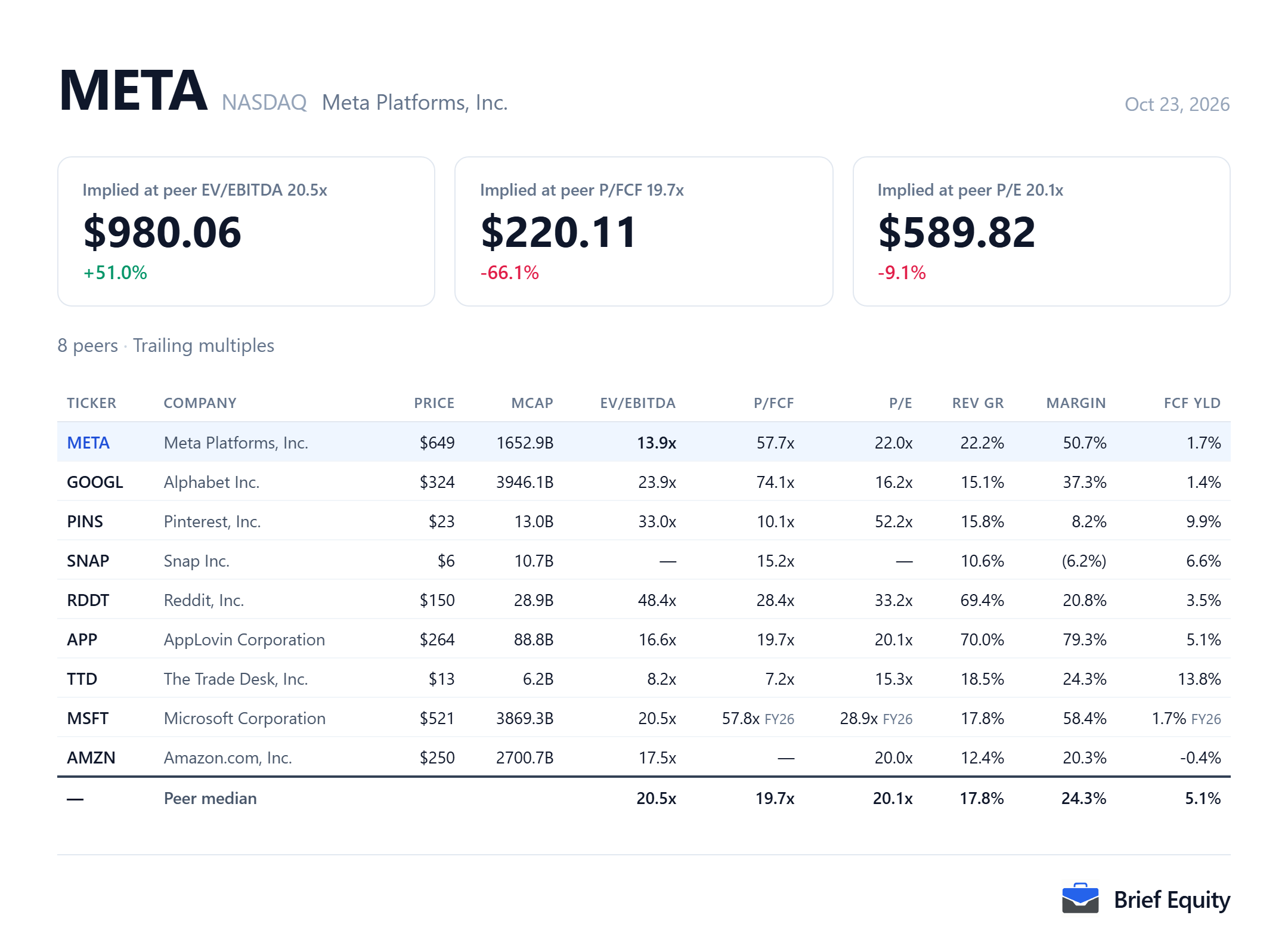
How the estimate moves with its assumptions
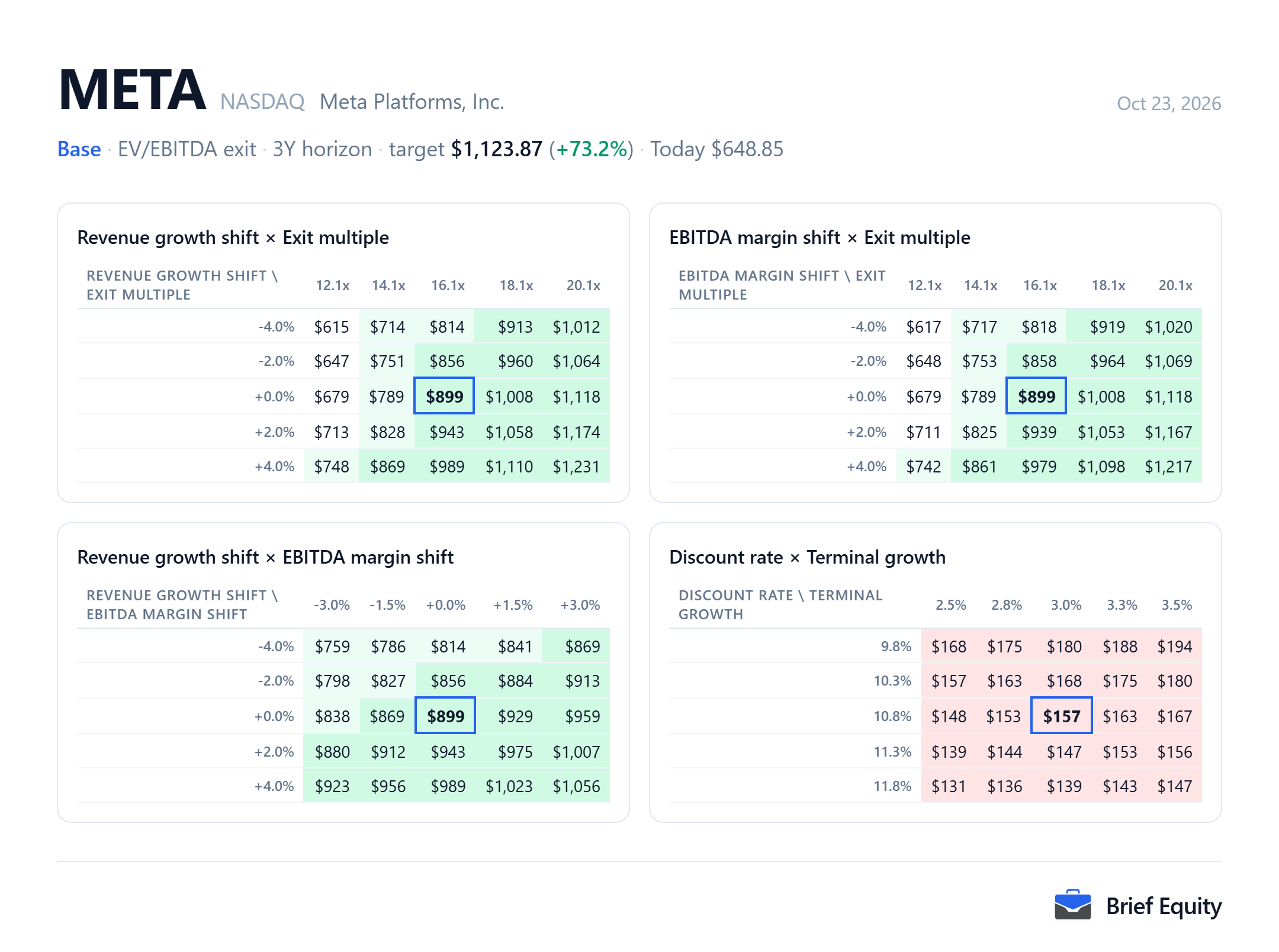
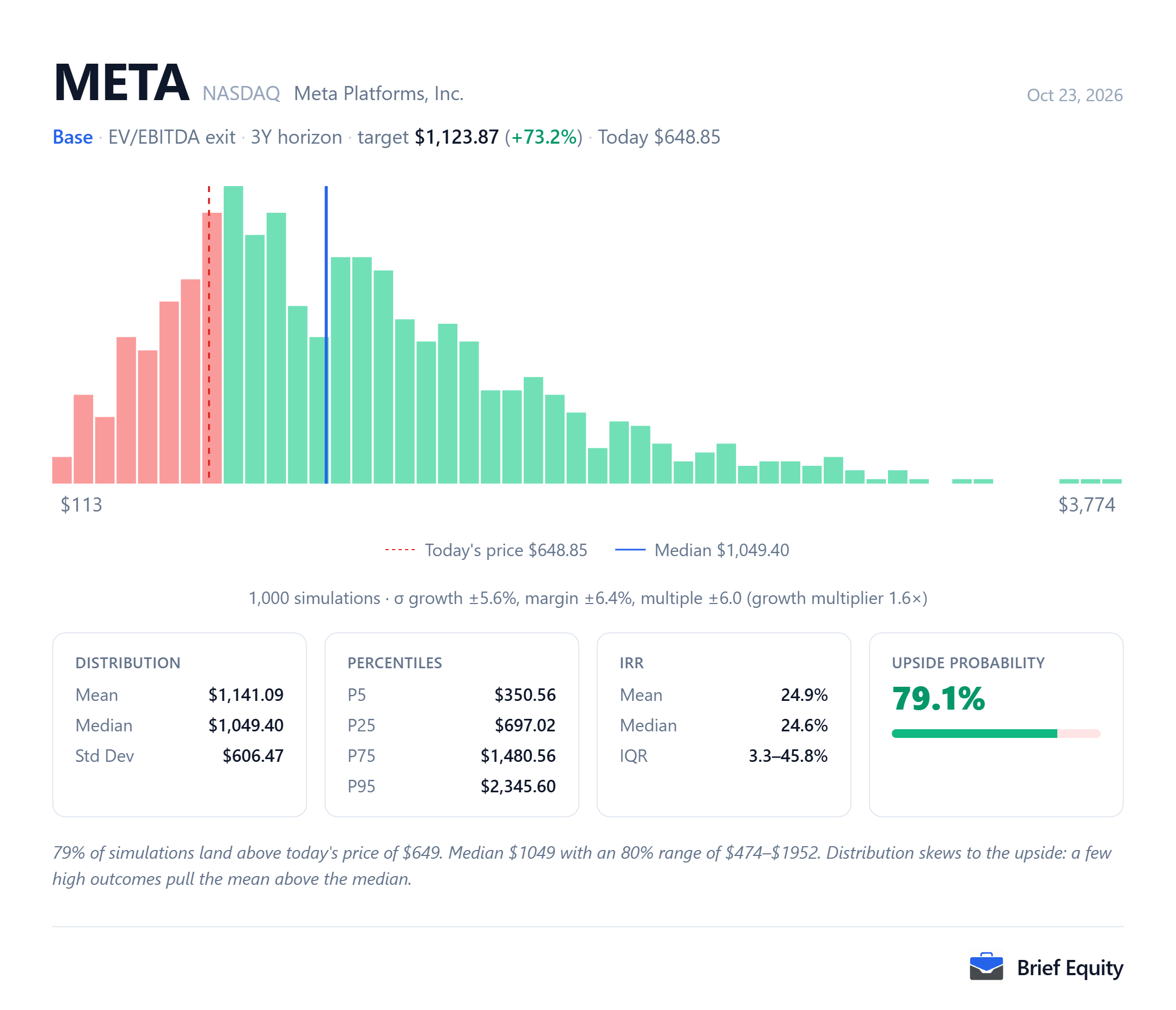
The estimate for Meta Platforms depends on a handful of assumptions, and the two pictures below show how far it moves when they change: the first moves two of them at a time, and the second runs the model many times with growth, margin and the exit multiple drawn at random.
Questions about Meta Platforms
These questions about Meta Platforms (META) are answered from the documents listed under Sources.
- What is Meta's new Class C stock?
- In October 2026 Meta's board declared a dividend of one share of a new non-voting Class C common stock for each outstanding Class A and Class B share, to be paid after a restated charter takes effect on January 19, 2027. Meta expects to treat the dividend as a stock split for accounting purposes, according to its 10-Q for the third quarter of 2026.
- What does Meta owe under its agreement with state attorneys general?
- Meta's August 2026 agreement with 52 attorneys general provides for payments of up to approximately $18.59 billion, of which approximately $12.7 billion is payable in annual installments over a 10-year period. Meta has not recognized a liability for $5.3 billion of contingent amounts, according to its 10-Q for the third quarter of 2026.
- How many people use Meta's Muse agent?
- On its earnings call of October 21, 2026, Meta said more than 10 million people in the US and Canada had set up Muse personal agents in about a month and a half. It said about 25% of people who have set up Muse use it on any given day.
- How large are the leases Meta has signed that have not yet started?
- At September 30, 2026, Meta had lease obligations of approximately $355.73 billion that had not yet commenced, consisting of data centers, energy-related infrastructure, colocations and certain network infrastructure. They will commence from the rest of 2026 through 2036, with terms of more than one year to 30 years.
- Has Meta bought back shares in 2026?
- Meta made no share repurchases in the nine months ended September 30, 2026, according to its 10-Q for that period. At September 30, 2026, $25.03 billion remained available and authorized for repurchases under its program.
Sources
The quotations and facts about Meta Platforms (META) on this page rest on the documents below.
- Meta Platforms Annual Report on Form 10-K for 2025, January 29, 2026
- Meta Platforms Quarterly Report on Form 10-Q for the third quarter of 2026, October 22, 2026
- Meta Platforms press release on its third quarter 2026 results, October 21, 2026
- Meta Platforms third-quarter 2026 earnings call, October 21, 2026
About this page
Brief Equity and its team hold no position in Meta Platforms (META) as of October 23, 2026.
This page is research, not investment advice. It describes one model and the assumptions behind it, and market data is delayed. Read how these models are built and our editorial policy.
Related guides: EV/EBITDA explained, What is enterprise value (EV), What is free cash flow.