Valuation · EV/EBITDA model
Is LVMH (MC.PA) stock undervalued?
Brief Equity's EV/EBITDA model of LVMH (MC.PA), dated October 14, 2026, puts the shares at EUR 657 by 2028, about 69% above the EUR 389.55 share price at that date. The stock looks undervalued after its fall in 2026. The estimate holds if LVMH's growth and margins recover slowly toward their past levels by 2028.
By The Brief Equity Team · Model dated · Published
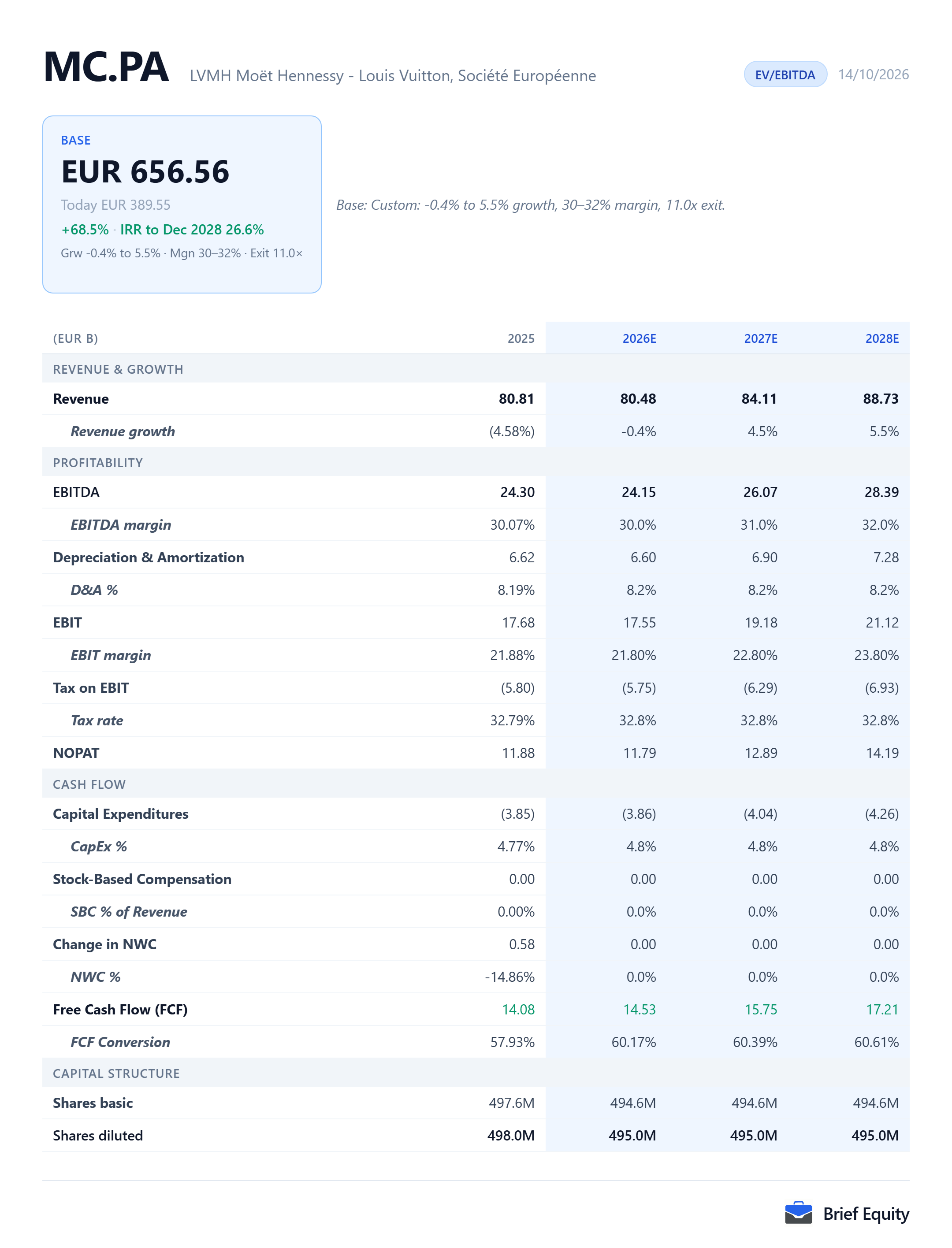
The model's assumptions for LVMH
LVMH's fiscal year is the calendar year, and it reports in euros. The figures come from a quick model, built on a small set of stated assumptions and projected over three years. LVMH reports under IFRS, which carries leases on the balance sheet, so the model's EBITDA is measured before rent.
| 2026 | 2027 | 2028 | |
|---|---|---|---|
| Revenue, model | 80.48 | 84.11 | 88.73 |
| Revenue growth, model | -0.4% | 4.5% | 5.5% |
| EBITDA, model | 24.15 | 26.07 | 28.39 |
| EBITDA margin, model | 30.0% | 31.0% | 32.0% |
| Revenue, analysts' consensus | 80.47 | 84.01 | 88.02 |
Why LVMH looks undervalued
LVMH's shares look undervalued at EUR 389.55 if the company's growth and margins slowly return toward their past levels. By October 12, 2026, the shares had fallen by more than 40% during the year, on course for their worst annual performance since 2008.
In the third quarter of 2026, LVMH's Fashion & Leather Goods revenue fell 5% on an organic basis, against an expected decline of 1.8%, and spending by Chinese customers in that business fell by a percentage in the mid-teens. China's campaign to tax offshore wealth has weighed on spending by the country's richest consumers, and LVMH's chief financial officer said the Molly Tea controversy had a negative impact on Louis Vuitton at least at the start of the quarter. The conflict in the Middle East had already cut one point from first-half growth.
“The Fashion & Leather Goods business group continued to benefit from the buoyant US market but was affected in the third quarter by the slowdown in demand in China.”
LVMH revenue for the first nine months of 2026, October 12, 2026
LVMH's chief financial officer also said growth in September was better than the average for the third quarter, and sales in the United States grew 5% in the quarter.
The model assumes a slow recovery for LVMH: revenue roughly flat in 2026, then growth of 4.5% in 2027 and 5.5% in 2028, against the analysts' consensus of 4.4% and 4.8% for those years. Its EBIT margin rises from 21.80% in 2026 to 23.80% in 2028, between the 21.4% operating margin LVMH reported for 2019 and the 26.7% it reported for 2021.
At 11 times 2028 EBITDA, against about 9.28 times on October 14, 2026 and 14.3 times at the end of 2025, the model puts LVMH's shares at EUR 657 by 2028, about 69% above the price at the model's date.
What has to be true, and what would break it
The estimate for LVMH holds only if the conditions below are met, and each of them can fail.
What has to be true
- Spending by Chinese customers recovers after the third quarter of 2026.
- Revenue grows 4.5% in 2027 and 5.5% in 2028.
- The EBIT margin rises from 21.80% in 2026 to 23.80% in 2028.
- The market values LVMH at 11 times EBITDA at the end of 2028.
What would break it
- Spending by Chinese customers keeps falling, and Fashion & Leather Goods keeps shrinking.
- Growth stays too low for the margin to rise.
- The market keeps valuing LVMH at about 9 times EBITDA.
The parts of LVMH's business
LVMH reports five business groups. The table gives each group's share of LVMH's revenue in the first half of 2026.
| Share of revenue | |
|---|---|
| Fashion & Leather Goods | 46.9% |
| Selective Retailing | 21.8% |
| Watches & Jewelry | 13.5% |
| Perfumes & Cosmetics | 10.1% |
| Wines & Spirits | 6.7% |
LVMH beside its peers
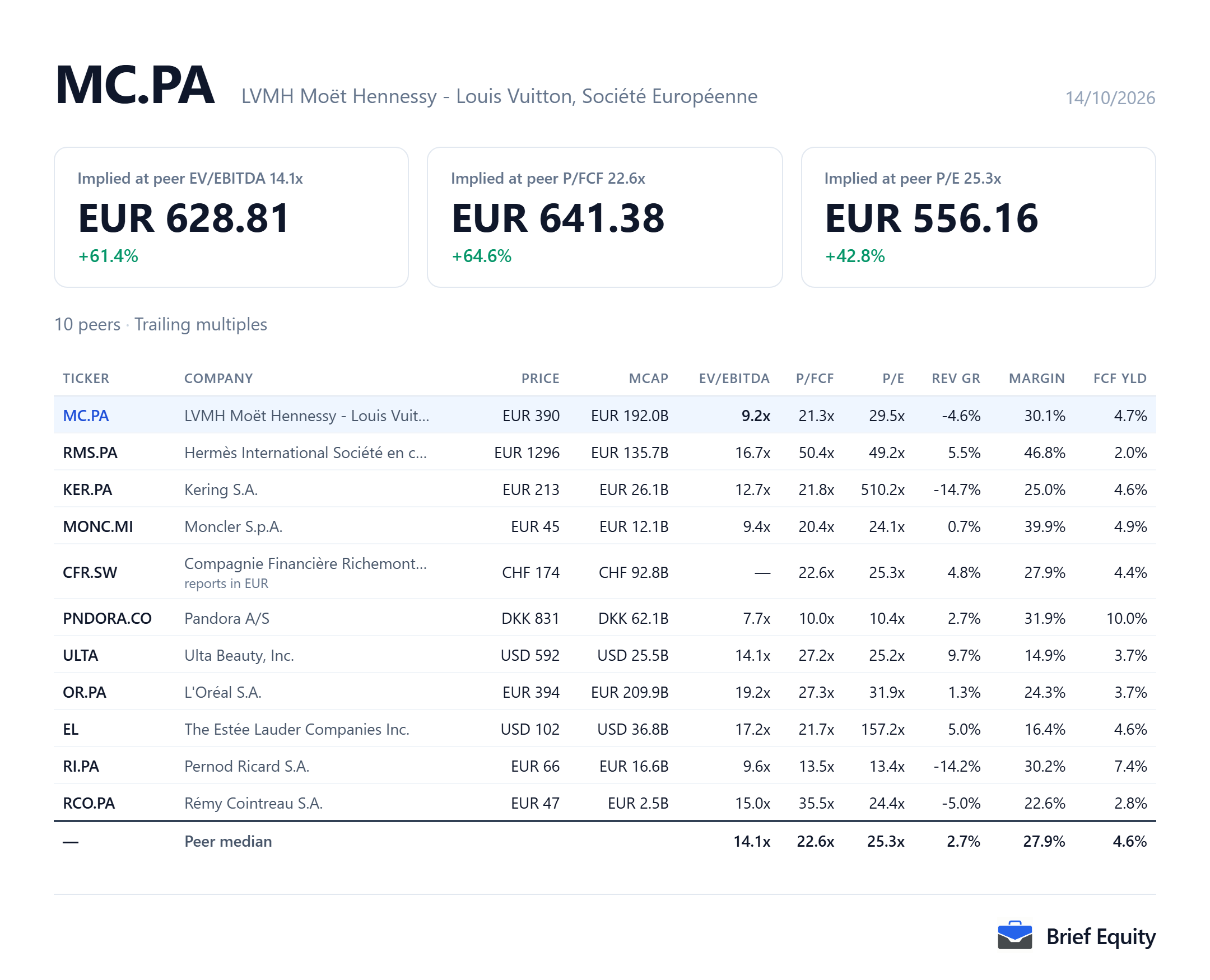
LVMH is compared with ten companies, chosen so that each of its businesses has at least one peer.
- RMS.PA: leather goods at the top end of the market, against Louis Vuitton and Dior
- KER.PA: fashion and leather goods
- MONC.MI: fashion
- CFR.SW: jewelry, against Tiffany and Bvlgari
- PNDORA.CO: jewelry at the more accessible end of the market
- ULTA: beauty retail, against Sephora
- OR.PA: perfume and beauty
- EL: prestige beauty
- RI.PA: champagne and spirits
- RCO.PA: cognac, against Hennessy
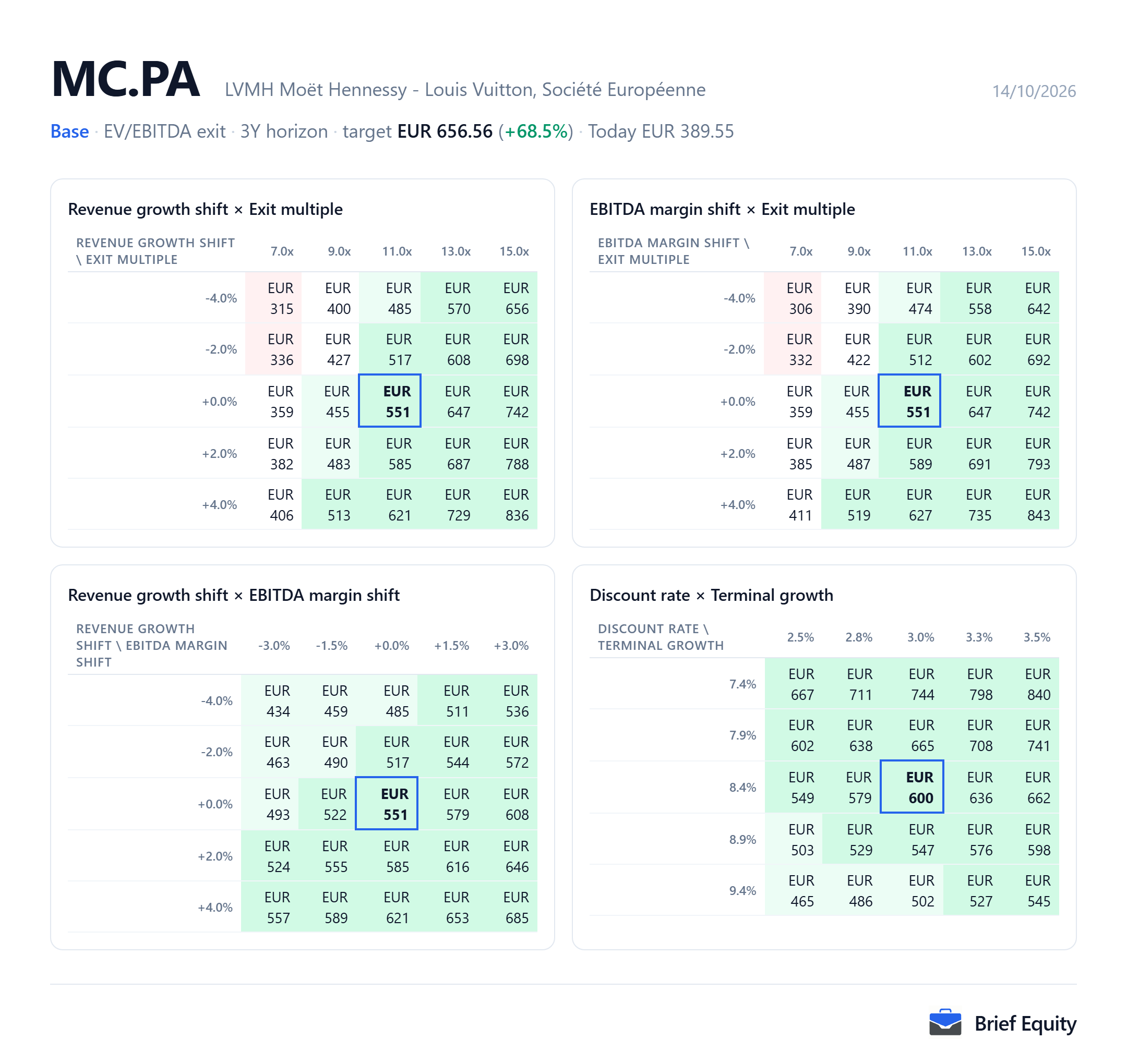
How the estimate moves with its assumptions
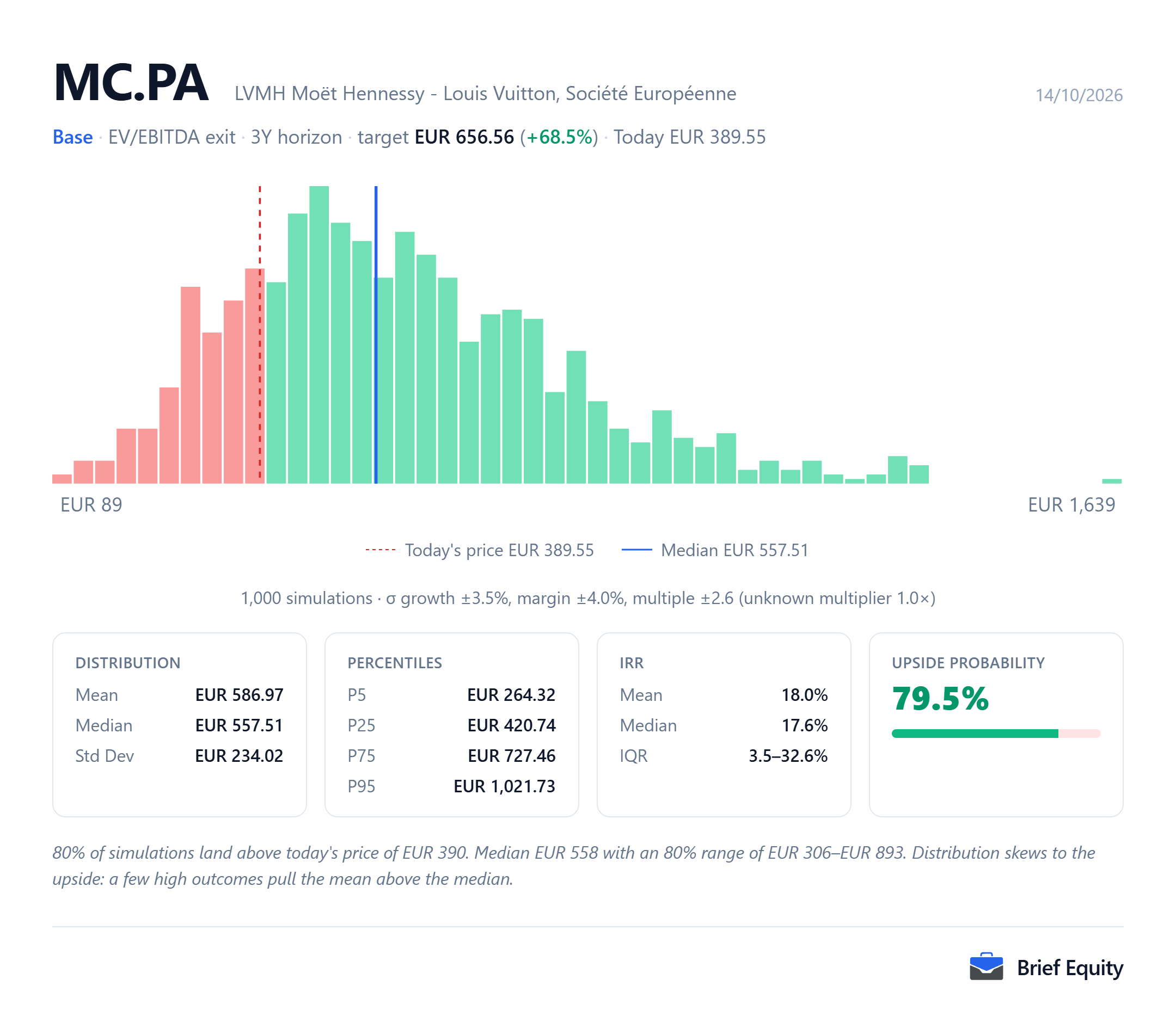
The estimate for LVMH depends on its assumptions, and the two pictures below show how far it moves when they change. The first varies two assumptions at a time. The second runs the model many times with growth, margin and the exit multiple varied at random.
Questions about LVMH
These questions about LVMH (MC.PA) are answered from the documents listed under Sources.
- Who controls LVMH?
- The Arnault family held 50.01% of LVMH's capital and 65.94% of its voting rights, as reported in February 2026.
- Who owns the rest of Moët Hennessy?
- Diageo owns 34% of Moët Hennessy, and LVMH has committed to buy that stake for 80% of its fair value if Diageo asks, according to LVMH's financial statements for 2025.
- How much of LVMH's revenue comes from Asia?
- Asia excluding Japan accounted for 26% of LVMH's revenue in 2025 by region of delivery, down 2 points from 2024.
- Did LVMH buy back shares in 2026?
- LVMH bought 3,633,742 of its own shares for 1,800 million euros in the first half of 2026.
- What dividend did LVMH propose for 2025?
- LVMH proposed a total gross dividend of 13 euros a share for fiscal year 2025.
Sources
The quotations and facts about LVMH (MC.PA) on this page rest on the documents below.
- LVMH revenue for the first nine months of 2026, October 12, 2026
- LVMH interim financial report, six months ended June 30, 2026, July 27, 2026
- LVMH first-half 2026 results call, July 27, 2026
- LVMH consolidated financial statements, fiscal year 2025, January 27, 2026
- LVMH business review, fiscal year 2025, January 27, 2026
- LVMH 2019 results, January 28, 2020
- LVMH 2021 results, January 27, 2022
- The Edge Malaysia, LVMH's third-quarter sales and its share price in 2026, October 12, 2026
- KSL, LVMH third-quarter sales dragged down by weak Chinese demand, October 12, 2026
- The Edge Malaysia, China's tax campaign and luxury sales in July 2026, August 20, 2026
- BFM Bourse, LVMH's growth slows in the third quarter, October 12, 2026
- BFM Bourse, LVMH limits the damage on the stock market, October 13, 2026
- Valuation statistics for LVMH, October 14, 2026
- EV/EBITDA at LVMH's fiscal year-ends, 2016 to 2025, October 14, 2026
- Modaes, the Arnault family's stake in LVMH, February 25, 2026
About this page
Brief Equity and its team hold no position in LVMH (MC.PA) as of October 14, 2026.
This page is research, not investment advice. It describes one model and the assumptions behind it, and market data is delayed. Read how these models are built and our editorial policy.
Related guides: EV/EBITDA explained, What is enterprise value (EV), How to do a comparable-companies (comps) analysis.