Valuation · EV/EBITDA model
Is Jack Henry (JKHY) stock undervalued?
Brief Equity's EV/EBITDA model of Jack Henry (JKHY), dated October 10, 2026, values the shares at $227 by fiscal 2029, about 52% above the $149.31 share price at that date. On that model the stock looks undervalued: the return is moderate, and a comparatively safe one. It depends on the record 58 core wins of fiscal 2026 converting on the company's usual schedule of 15 to 24 months.
By The Brief Equity Team · Model dated · Published
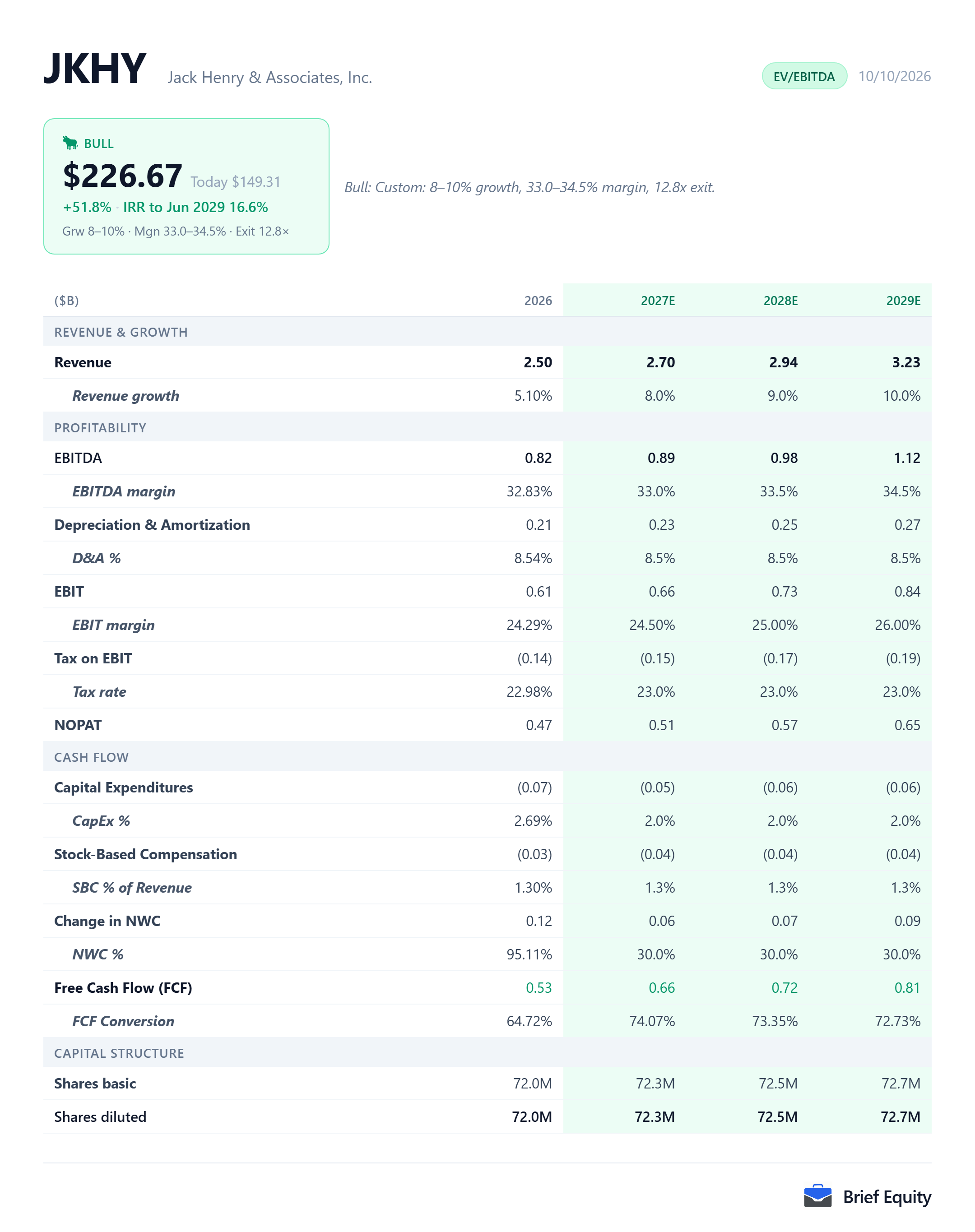
The model's assumptions for Jack Henry
Jack Henry's fiscal year ends in June, so fiscal 2027 is the twelve months to June 2027. The figures below come from a quick model, built on a small set of stated assumptions and projected over three fiscal years. Analyst consensus revenue is shown beside the model's revenue for the same years.
| Fiscal 2027 | Fiscal 2028 | Fiscal 2029 | |
|---|---|---|---|
| Revenue, model | 2.70 | 2.94 | 3.23 |
| Revenue, analyst consensus | 2.69 | 2.88 | 3.10 |
| Revenue growth, model | 8.0% | 9.0% | 10.0% |
| EBITDA, model | 0.89 | 0.98 | 1.12 |
| EBITDA margin, model | 33.0% | 33.5% | 34.5% |
Why Jack Henry looks undervalued
Jack Henry reported a record 58 competitive core wins for fiscal 2026, and only 6 of them were de novo institutions. The remaining wins came from institutions that changed provider. At $149.31 a share the stock looks undervalued on this model: the return it implies is moderate rather than exceptional, and it is a comparatively safe one, provided those conversions are completed on schedule.
“Just 6 of our 58 wins in fiscal year '26 were de novos.”
Gregory Adelson, President and Chief Executive Officer, Jack Henry fiscal 2026 fourth-quarter earnings call, August 19, 2026
The chief executive expects requests for proposal for core systems to run at 250 to 275 a year, against the usual 200, and gave two reasons: unrest at competitors and consolidation among banks.
“I think that the -- if you take the average number of RFPs that we typically talk about in a year, which is roughly 200, I think that number will be closer to 250 to 275 over the next couple of years with, one, the unrest that's going on at some of the competitors, but also just the whole M&A story itself.”
Gregory Adelson, President and Chief Executive Officer, Jack Henry fiscal 2026 third-quarter earnings call, May 6, 2026
One of those competitors, Fiserv, is in a difficult period. It cut its 2026 outlook for organic revenue to a range of -1% to 0%. Its banking revenue fell 10% on an organic basis in the second quarter of 2026, and client attrition was part of the decline. Fiserv's shares fell 63.93% over the 52 weeks before the model's date and those of FIS fell 50.04%, while Jack Henry's fell 0.08%.
The 58 wins do not reach revenue quickly. Jack Henry says a new core client usually takes 15 to 24 months from signing to conversion. In the model, revenue growth therefore rises from 8% in fiscal 2027 to 9% in fiscal 2028 and 10% in fiscal 2029, which takes revenue to $3.23 billion in that year. Analysts' estimates for the same year stand at $3.10 billion.
“As you've heard us say this before, it's usually anywhere from 15 to 24 months.”
Gregory Adelson, President and Chief Executive Officer, Jack Henry fiscal 2026 fourth-quarter earnings call, August 19, 2026
Conversions cost money before they earn it, so margins move little in the early years. The Core segment's non-GAAP operating margin fell 139 basis points in the fiscal fourth quarter on implementation work, and the company's guide for fiscal 2027 is 20 to 40 basis points of non-GAAP operating margin expansion. The model takes the EBITDA margin from 33.0% to 34.5% by fiscal 2029.
“Core segment non-GAAP revenue increased 6% for the quarter with non-GAAP operating margin contraction of 139 basis points due to temporary product mix of lower-margin revenue sources such as implementations, where we added 2 new conversion teams and customer work orders.”
Mimi Carsley, Chief Financial Officer and Treasurer, Jack Henry fiscal 2026 fourth-quarter earnings call, August 19, 2026
The model then applies an exit multiple of 12.8 times EBITDA to fiscal 2029. That produces a target of $227 a share, about 52% above the share price at the model's date.
The business is also a durable one. Jack Henry's hosted clients are typically on six-year contracts, and $8.44 billion of contracted revenue was still to be recognized at the end of fiscal 2026.
“The majority of our support and services revenue is derived from our private and public cloud services for our hosted clients that are typically on a six-year contract, recurring electronic payment solutions that are generally on a contract term of six years, and our on-premise clients that are typically on a one-year contract.”
Jack Henry & Associates annual report (Form 10-K) for fiscal 2026, August 28, 2026
Cash generation is lighter than EBITDA suggests. In fiscal 2026 Jack Henry capitalized $184 million of software in addition to $67 million of capital expenditures, and its free cash flow was $539 million.
What has to be true, and what would break it
The estimate for Jack Henry holds only if the conditions below are met, and each of them can fail.
What has to be true
- The 58 core wins of fiscal 2026 are converted on the company's usual schedule of 15 to 24 months.
- Revenue growth rises from 8% in fiscal 2027 to 10% in fiscal 2029, which takes revenue to $3.23 billion against analysts' $3.10 billion.
- The EBITDA margin widens from 33.0% to 34.5% while conversion work is still being paid for.
- The shares are valued at 12.8 times EBITDA in fiscal 2029.
What would break it
- Conversions take longer than the usual 15 to 24 months.
- Requests for proposal for core systems fall back to the usual 200 a year.
- Implementation work holds the EBITDA margin near 33.0% through fiscal 2029.
- The multiple applied in fiscal 2029 is lower than 12.8 times EBITDA.
The parts of Jack Henry's business
Jack Henry reports its revenue in four segments. The table gives each segment's share of revenue and of the year's revenue growth.
| Share of revenue | Share of revenue growth | |
|---|---|---|
| Core | 30.2% | 21.0% |
| Payments | 36.8% | 37.0% |
| Complementary | 29.6% | 34.0% |
| Corporate Services | 3.4% | 8.0% |
Jack Henry beside its peers
Jack Henry is compared with eight companies: two of its direct competitors, four that each stand for one of its segments, and two other providers of software and processing to financial institutions.
- FIS: bank cores and card processing, a direct competitor
- FISV: bank cores and payments, a direct competitor
- QTWO: digital banking, for the Complementary segment
- ALKT: digital banking, for the Complementary segment
- NCNO: bank software, for the Complementary segment
- ACIW: bank payments software, for the Payments segment
- BR: processing for financial institutions
- SSNC: software and processing for financial institutions
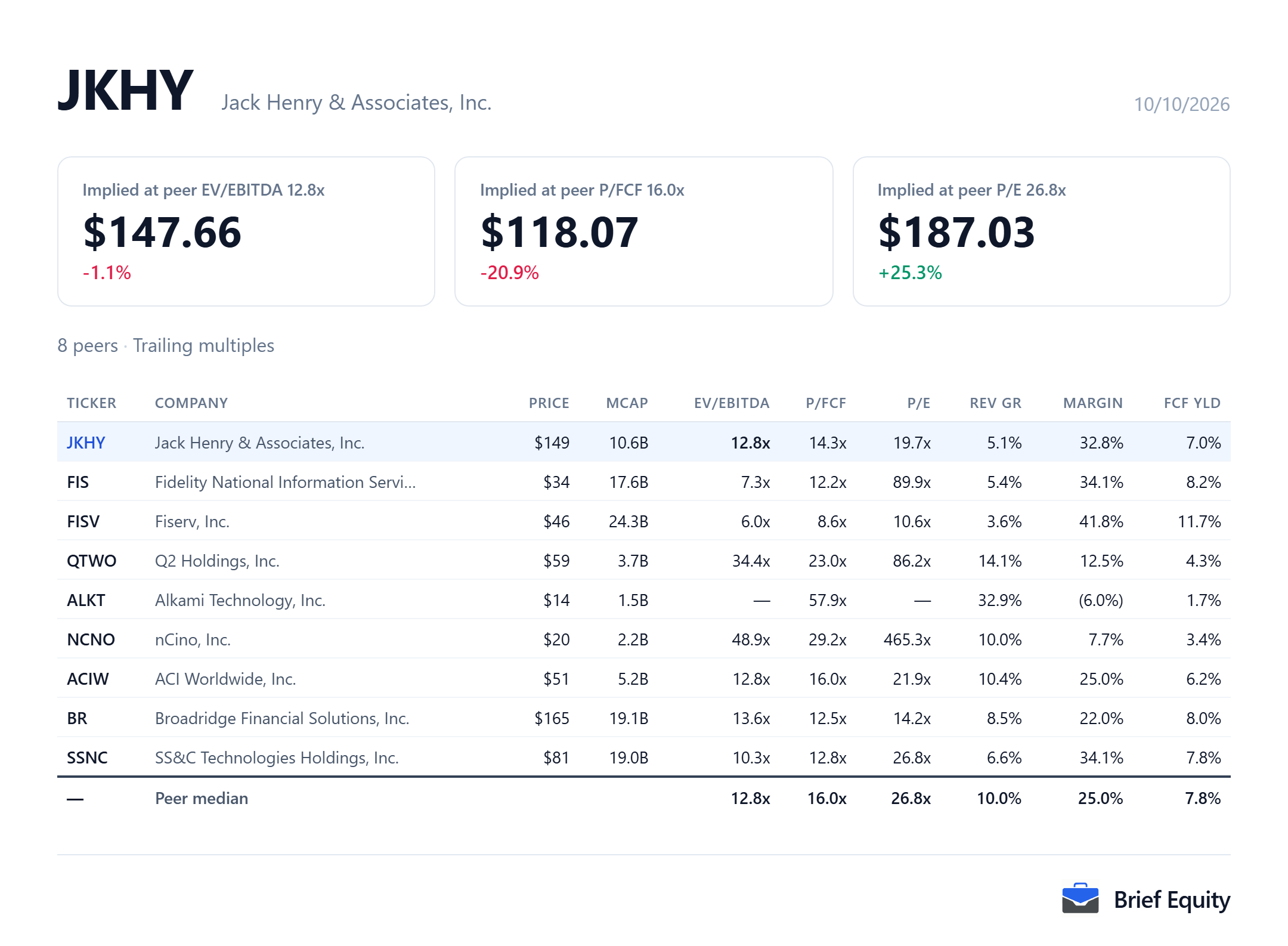
How the estimate moves with its assumptions
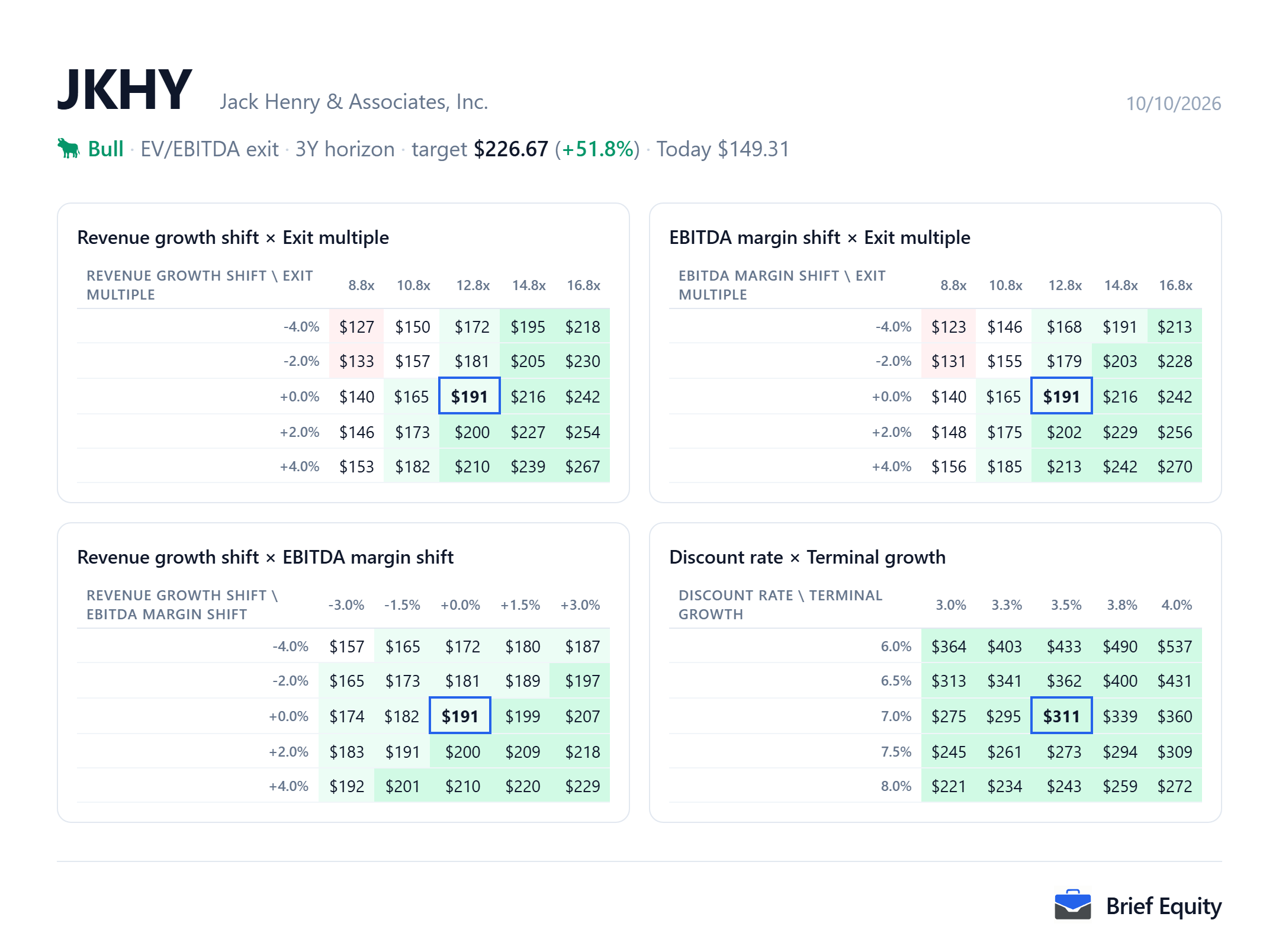
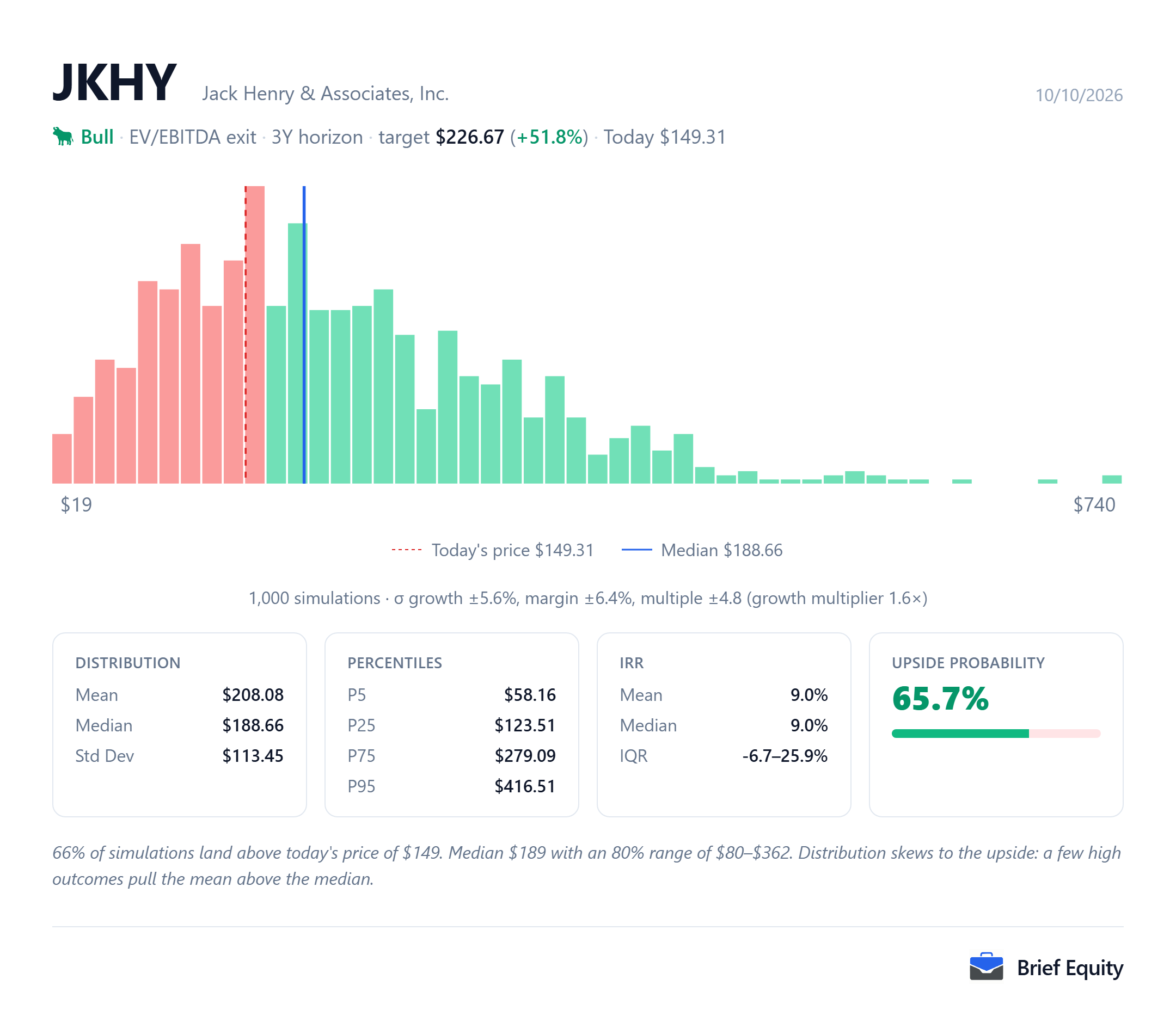
The estimate for Jack Henry depends on its assumptions, and the two pictures below show how far it moves when they change. The first varies two assumptions at a time. The second runs the model many times with growth, margin and the exit multiple varied at random.
Questions about Jack Henry
These questions about Jack Henry (JKHY) are answered from the documents listed under Sources.
- What does Jack Henry sell?
- Jack Henry provides core processing systems, payments processing and complementary software to banks and credit unions. Its annual report for fiscal 2026 counts more than 900 banks and more than 700 credit unions as core clients.
- Who does Jack Henry compete with for core systems?
- Its annual report for fiscal 2026 names Fidelity National Information Services, Fiserv, Corelation and Finastra as competitors for core systems.
Sources
The quotations and facts about Jack Henry (JKHY) on this page rest on the documents below.
- Jack Henry fiscal 2026 fourth-quarter earnings call, August 19, 2026
- Jack Henry fiscal 2026 third-quarter earnings call, May 6, 2026
- Jack Henry & Associates annual report (Form 10-K) for fiscal 2026, August 28, 2026
- Jack Henry fiscal 2026 fourth-quarter and full-year earnings release, August 18, 2026
- Fiserv second-quarter 2026 earnings release, August 6, 2026
- American Banker, "Another tough quarter for Fiserv may lead to product changes", August 7, 2026
- 52-week share price change for Jack Henry, October 9, 2026
- 52-week share price change for Fiserv, October 9, 2026
- 52-week share price change for FIS, October 9, 2026
About this page
Brief Equity and its team hold no position in Jack Henry (JKHY) as of October 10, 2026.
This page is research, not investment advice. It describes one model and the assumptions behind it, and market data is delayed. Read how these models are built and our editorial policy.
Related guides: EV/EBITDA explained, How to do a comparable-companies (comps) analysis, How to build a DCF model (step by step).