Valuation · EV/EBITDA model
Is J.B. Hunt (JBHT) stock overvalued?
Brief Equity's EV/EBITDA model of J.B. Hunt (JBHT), dated October 20, 2026, puts the shares at $288 by 2028, about 27% above the $226.40 share price at that date. J.B. Hunt looks expensive at that price, which already pays for intermodal price increases that the company says take into next year to show up. The estimate holds only if those increases, set in the 2027 bid season, stick without slowing the move of freight from road to rail.
By The Brief Equity Team · Model dated · Published
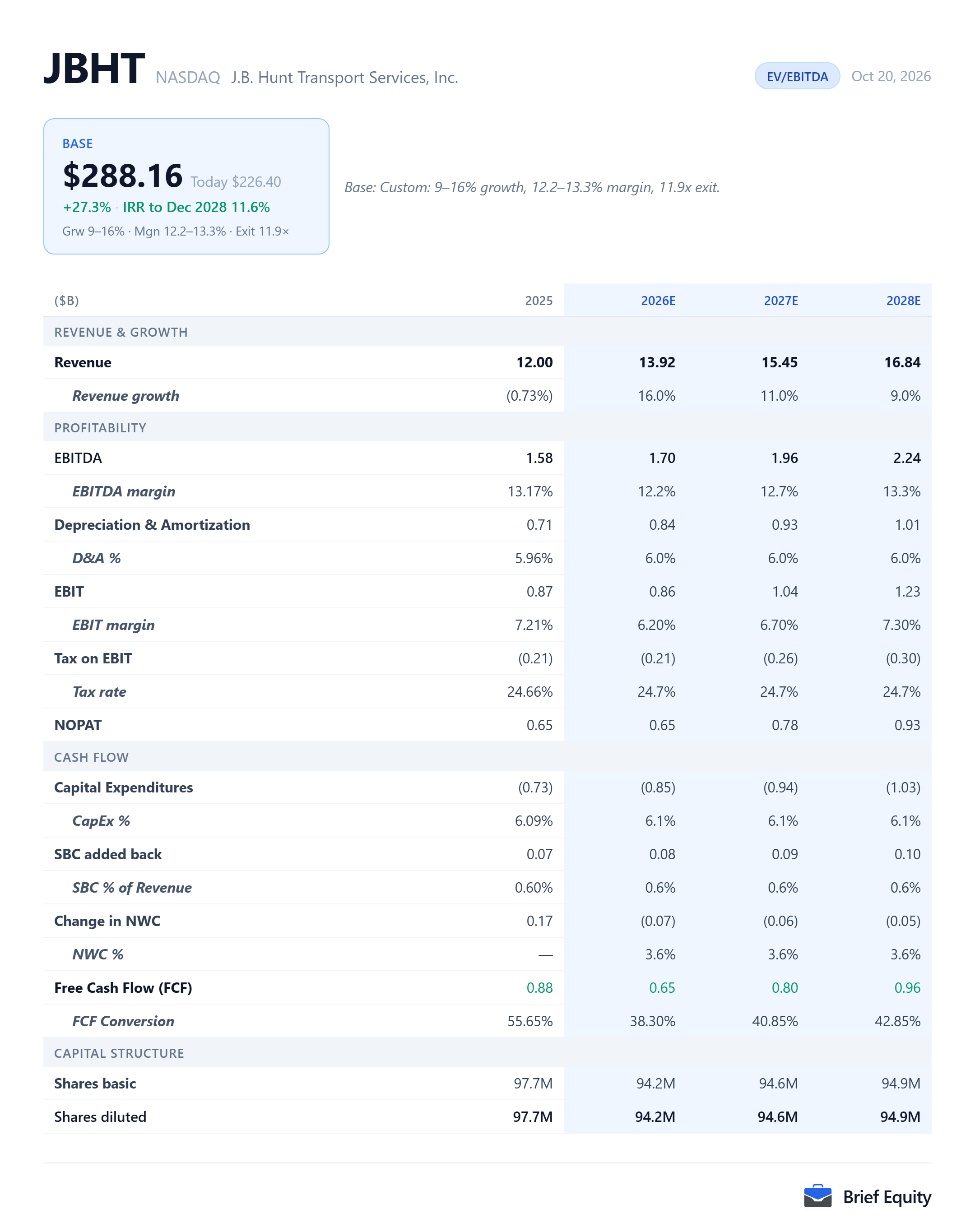
The model's assumptions for J.B. Hunt
J.B. Hunt's fiscal year is the calendar year, and at the model's date it had reported the first three quarters of 2026, so every column below is an estimate. The figures come from a quick model, built on a small set of stated assumptions and projected over three years.
| 2026 | 2027 | 2028 | |
|---|---|---|---|
| Revenue, model | 13.92 | 15.45 | 16.84 |
| Revenue growth, model | 16.0% | 11.0% | 9.0% |
| EBITDA, model | 1.70 | 1.96 | 2.24 |
| EBITDA margin, model | 12.2% | 12.7% | 13.3% |
| Revenue, analysts' consensus | 13.97 | 15.51 | 16.86 |
Why J.B. Hunt looks overvalued
J.B. Hunt's President of Intermodal said on the third-quarter 2026 call that its price increases take some time into next year to show up, and at $226.40 the stock looks expensive.
“So it does take some time into next year before the prices really begin to show up.”
Darren Field, President of Intermodal, J.B. Hunt third-quarter 2026 earnings call, October 15, 2026
J.B. Hunt's costs are rising now. Its revenue rose 20% in the third quarter of 2026 while its operating income rose 2%, and slightly more than half of the more than $50 million of added costs against the second quarter went to drivers, in onboarding, training, sign-on bonuses and wages, according to the chief financial officer.
Prices adjust in stages. About 10% of intermodal volume is repriced in the fourth quarter and 30% in each of the first three quarters of the year, and intermodal revenue per load excluding fuel surcharge revenue increased 2% in the third quarter.
Part of J.B. Hunt's revenue growth comes from diesel. Revenue excluding fuel surcharge revenue increased 13% in the third quarter, and diesel prices exceeded $6 a gallon, against nearly $3.65 a year earlier.
The model assumes that diesel stays high and that truck drivers stay scarce. It has J.B. Hunt's revenue growing 16.0% in 2026, 11.0% in 2027 and 9.0% in 2028, close to the analysts' consensus of 12.0% a year from 2025 to 2028. Its EBIT margin is 7.30% in 2028, against 7.21% in 2025. Valued at 11.9 times its 2028 EBITDA, J.B. Hunt reaches $288 a share by 2028, about 27% above the share price at the model's date.
That growth depends on diesel staying around $6 a gallon, while the US Energy Information Administration forecasts an average retail diesel price of $4.49 in 2027.
At $226.40, a buyer of J.B. Hunt pays today for the price increases of the 2027 bid season, which have to stick without slowing the move of freight from road to rail.
What has to be true, and what would break it
The estimate for J.B. Hunt holds only if the conditions below are met, and each of them can fail.
What has to be true
- Intermodal and dedicated customers accept the price increases of the 2027 bid season.
- The shortage of truck drivers lasts.
- Revenue grows 16.0% in 2026, 11.0% in 2027 and 9.0% in 2028, with diesel staying around $6 a gallon, and the EBITDA margin climbs from 12.2% to 13.3%.
What would break it
- Diesel falls toward the $4.49 average that the US Energy Information Administration forecasts for 2027, taking fuel surcharge revenue below the model's growth path.
- Price increases that narrow intermodal's discount to trucking below about 15% slow the conversion of freight from road to rail, as J.B. Hunt's President of Intermodal has said they would.
- Driver and medical costs keep rising faster than prices.
The parts of J.B. Hunt's business
J.B. Hunt reports five segments. The table gives each one's share of J.B. Hunt's revenue in 2025; revenue fell slightly that year, so no share of growth is given.
| Share of revenue | |
|---|---|
| Intermodal (JBI) | 49.8% |
| Dedicated Contract Services (DCS) | 28.1% |
| Integrated Capacity Solutions (ICS) | 9.2% |
| Final Mile Services (FMS) | 6.9% |
| Truckload (JBT) | 6.1% |
J.B. Hunt beside its peers
J.B. Hunt is compared with six transport companies, chosen so that its intermodal, dedicated, brokerage and truckload businesses each have peers.
- SNDR: intermodal, dedicated and truckload, the closest match
- KNX: truckload with its own intermodal business
- WERN: dedicated fleets
- CHRW: freight brokerage, against Integrated Capacity Solutions
- LSTR: asset-light truckload capacity
- RXO: freight brokerage
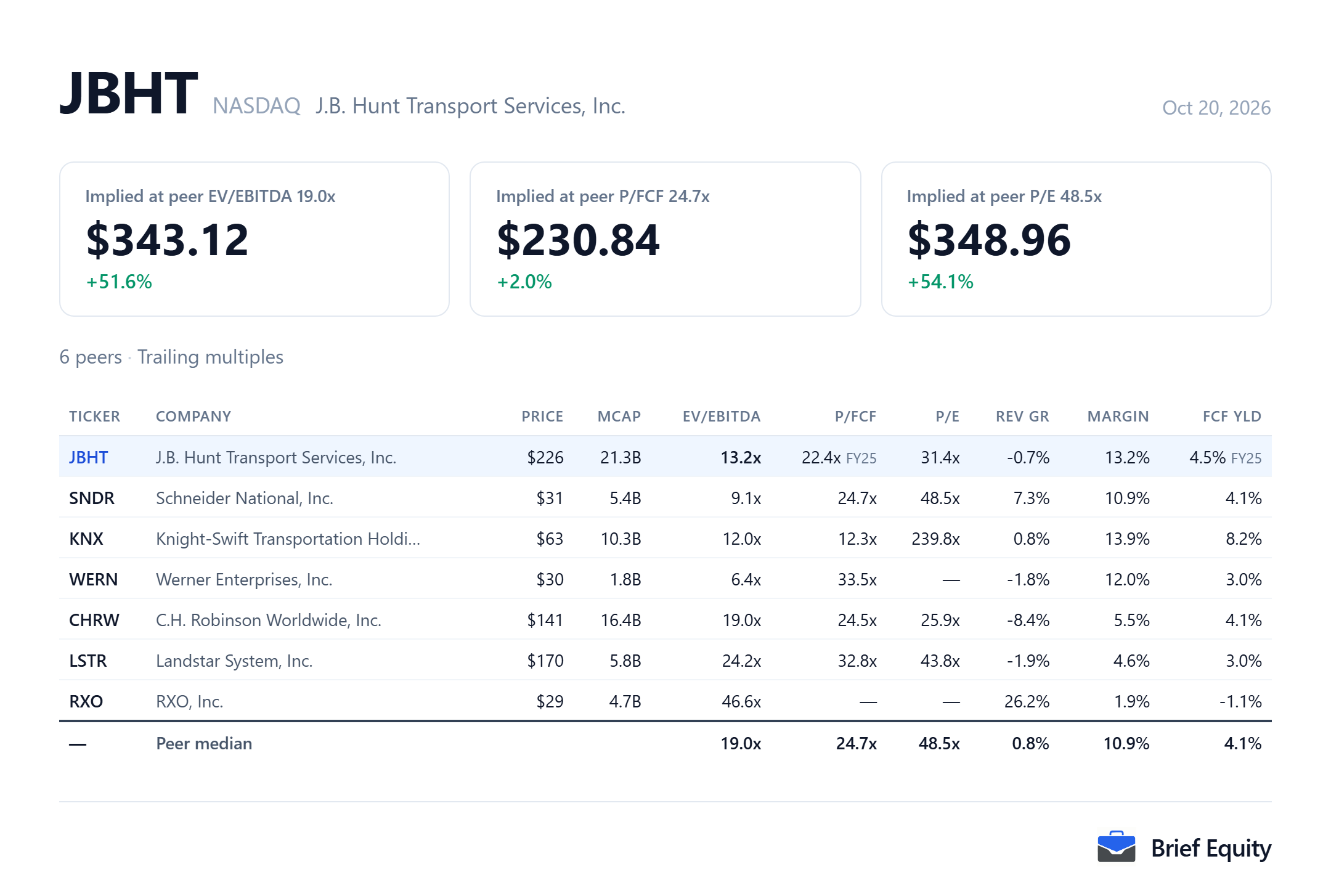
How the estimate moves with its assumptions
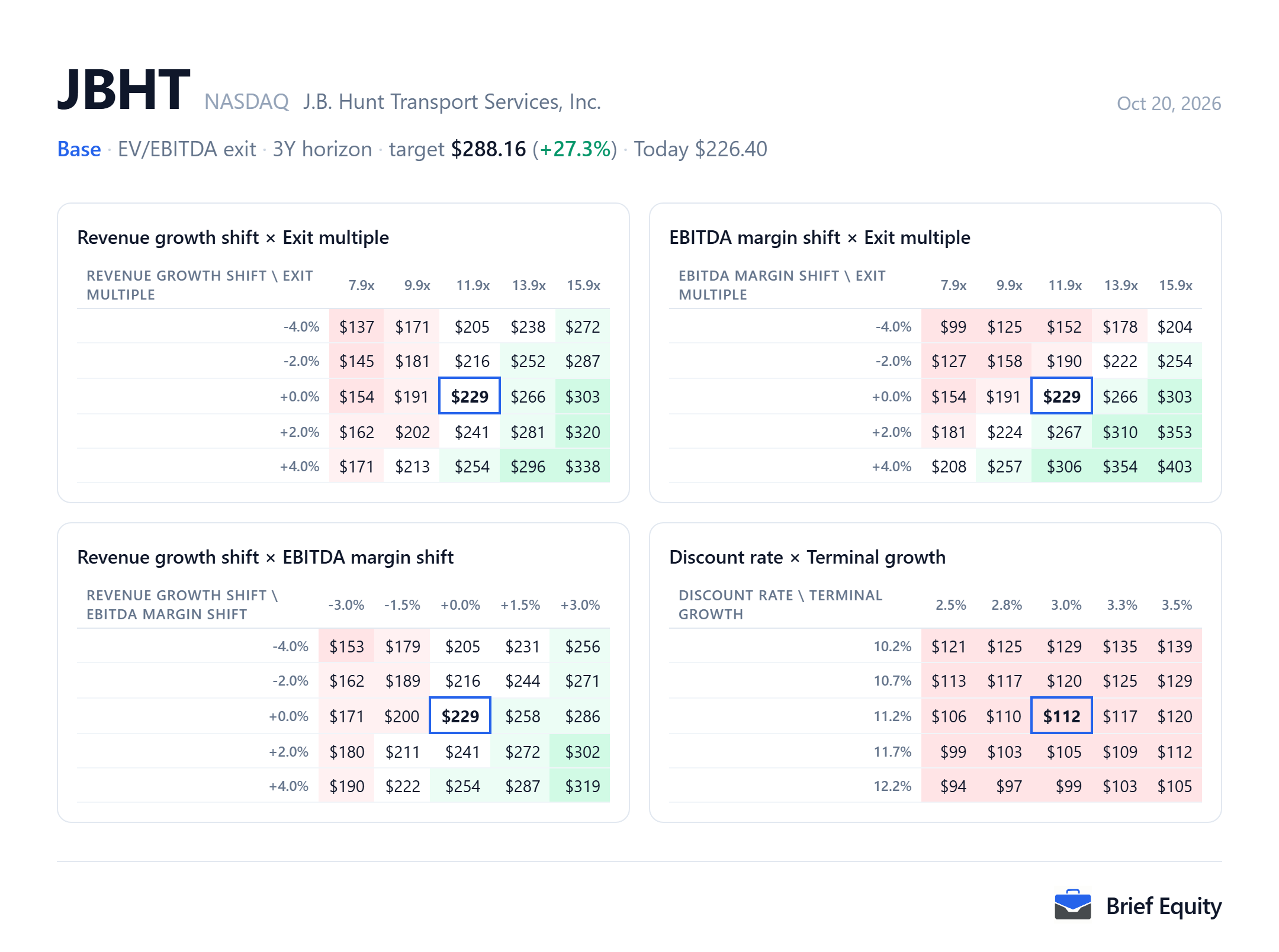
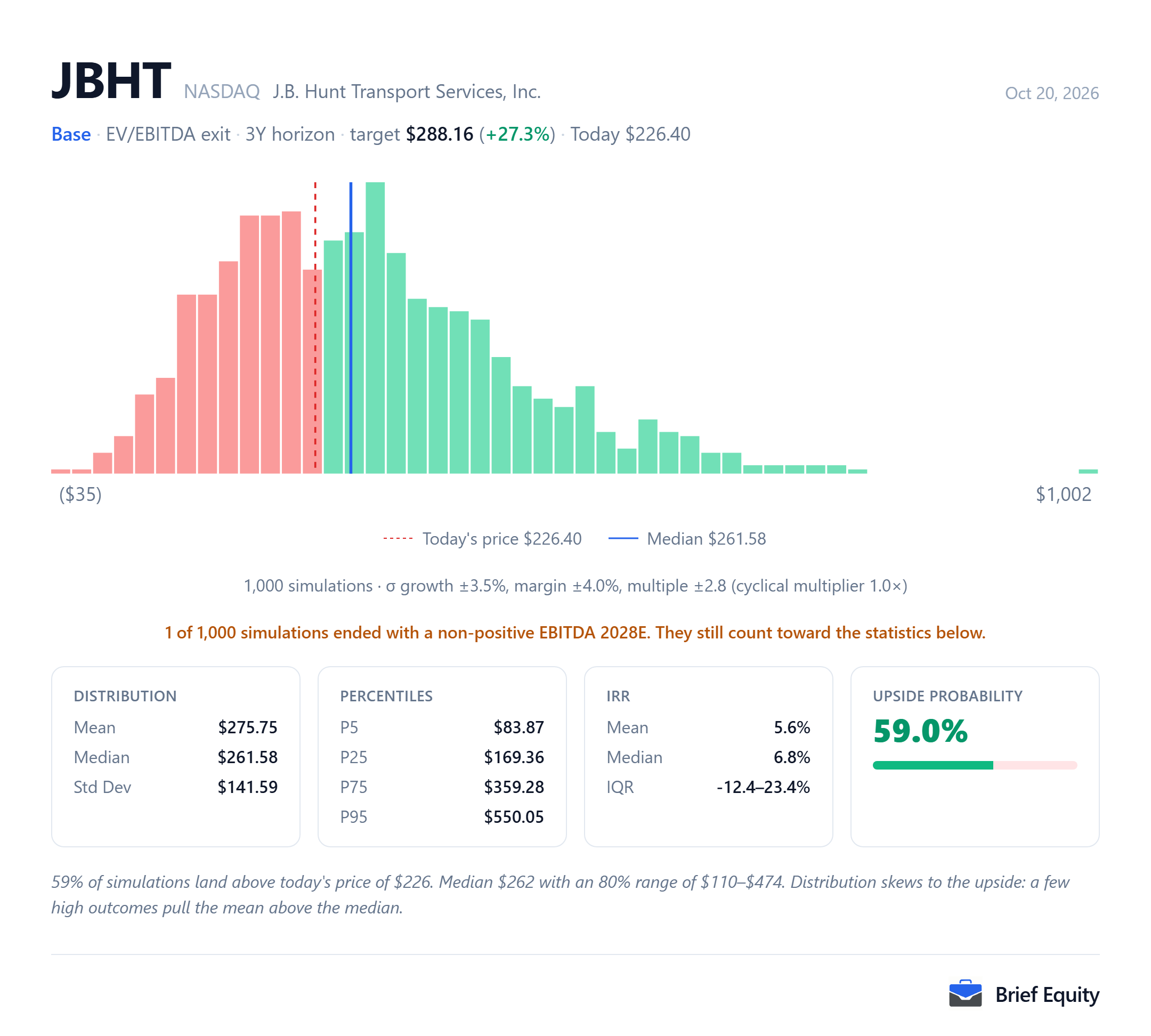
The estimate for J.B. Hunt rests on a few assumptions, and the two pictures below show how far it moves when they change. The first changes two assumptions at a time, and the second runs the model many times with growth, margin and the exit multiple drawn at random.
Questions about J.B. Hunt
These questions about J.B. Hunt (JBHT) are answered from the documents listed under Sources.
- How much did J.B. Hunt's intermodal volume grow in the third quarter of 2026?
- J.B. Hunt's intermodal volume increased 8% in the third quarter of 2026 against the same quarter of 2025, with Eastern network loads up 18% and transcontinental loads up 1%.
- How many trucks did J.B. Hunt's Dedicated segment sell in 2026?
- J.B. Hunt's Dedicated segment had sold 970 trucks of new deals in 2026 by the end of the third quarter, against a full-year target of 1,000 to 1,200, according to its call of October 15, 2026.
- How many shares did J.B. Hunt buy back in the third quarter of 2026?
- J.B. Hunt purchased approximately 704,000 shares for approximately $174 million in the third quarter of 2026. Approximately $619 million remained under its share repurchase authorization at September 30, 2026.
- How much debt did J.B. Hunt have at the end of September 2026?
- J.B. Hunt had approximately $1.12 billion outstanding on various debt instruments at September 30, 2026, compared to $1.60 billion at September 30, 2025.
Sources
The quotations and facts about J.B. Hunt (JBHT) on this page rest on the documents below.
- J.B. Hunt press release on its third quarter 2026 results, October 15, 2026
- J.B. Hunt third-quarter 2026 earnings call, October 15, 2026
- Report on J.B. Hunt's third-quarter 2026 results, its costs and diesel prices, October 16, 2026
- US Energy Information Administration Short-Term Energy Outlook, October 2026, October 6, 2026
- J.B. Hunt Annual Report on Form 10-K for 2025, February 24, 2026
About this page
Brief Equity and its team hold no position in J.B. Hunt (JBHT) as of October 20, 2026.
This page is research, not investment advice. It describes one model and the assumptions behind it, and market data is delayed. Read how these models are built and our editorial policy.
Related guides: EV/EBITDA explained, How to do a comparable-companies (comps) analysis.