Valuation · EV/EBITDA model
Is Harrow (HROW) stock undervalued?
On November 10, 2026, with the shares at $27.47, a quick EV/EBITDA model by Brief Equity valued Harrow at about $157 for 2028, about 470% above the price. Harrow looks undervalued on that model if its launches, starting with the OPUVIZ biosimilar in 2027, carry revenue past $900 million by 2028 and its margins rise as that revenue arrives.
By The Brief Equity Team · Model dated · Published
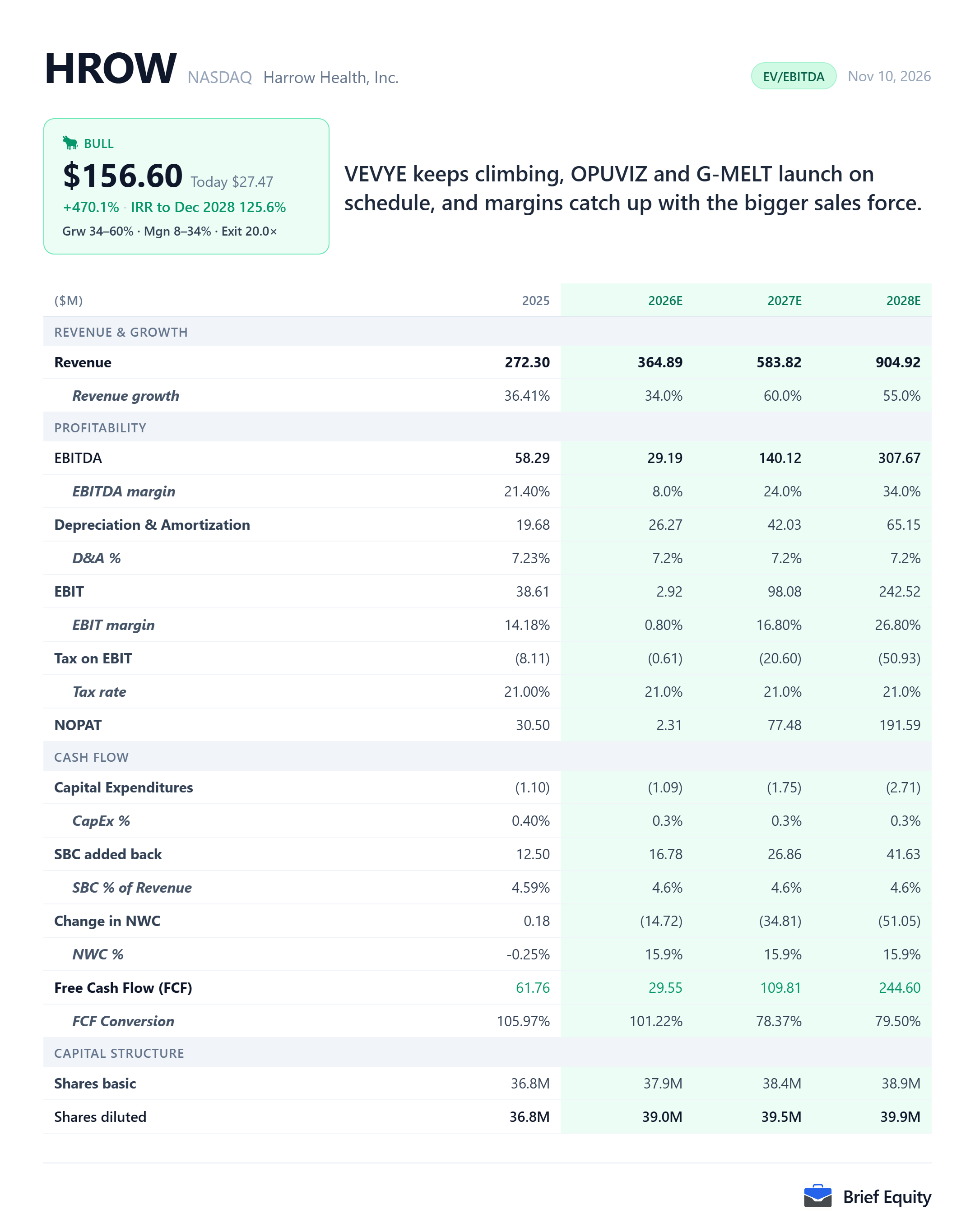
The model's assumptions for Harrow
Harrow's fiscal year is the calendar year, and the last year it has reported in full is 2025. The model runs three years, to 2028, and values the company on a multiple of its 2028 EBITDA. Every figure below is the model's own except the analysts' revenue, which is the consensus the model was built beside.
| 2026 | 2027 | 2028 | |
|---|---|---|---|
| Revenue, model | 364.89 | 583.82 | 904.92 |
| Revenue growth, model | 34.0% | 60.0% | 55.0% |
| EBITDA, model | 29.19 | 140.12 | 307.67 |
| EBITDA margin, model | 8.0% | 24.0% | 34.0% |
| Revenue, analysts' consensus | 349.85 | 526.45 | 708.73 |
Why Harrow looks undervalued
Harrow's VEVYE had record revenue of $39.7 million in the third quarter of 2026, up 75% from a year earlier, and the company's launches are only beginning. BYOOVIZ, a biosimilar to LUCENTIS, launched on July 1, 2026, OPUVIZ, a biosimilar to EYLEA, is expected to launch in 2027, and Harrow plans to submit its New Drug Application for G-MELT before the end of 2026. The view here is that Harrow looks undervalued at $27.47.
In its letter to stockholders of November 9, 2026, Harrow's chief executive compared the two biosimilars.
“Just as importantly, the lessons we are learning from this initial launch will inform the anticipated 2027 launch of OPUVIZ®, our EYLEA®-referenced biosimilar, which we believe represents a substantially larger commercial opportunity for Harrow.”
Harrow 29th quarterly letter to stockholders, third quarter of 2026, November 9, 2026
On its first-quarter call in May 2026, Harrow's chief executive spoke of its goal of $250 million of quarterly revenue by the end of 2027. Its revenue for the third quarter of 2026 was a record $99.3 million.
For Harrow, the Brief Equity model is a quick one. It has revenue reaching $364.89 million in 2026, the top of the company's guidance, then growing 60.0% in 2027 and 55.0% in 2028 to $904.92 million, where analysts' consensus for 2028 is $708.73 million. The EBITDA margin rises to 34.0% by 2028. At 20.0 times 2028 EBITDA, that values Harrow at about $157 a share in 2028, about 470% above the price of $27.47.
On November 9, 2026, Harrow lowered its 2026 Adjusted EBITDA guidance to more than $40 million, from $80 million to $100 million, so the view depends on the launches turning into higher margins.
What has to be true, and what would break it
The view that Harrow looks undervalued at $27.47 rests on its launches carrying revenue far above analysts' consensus by 2028, with margins rising as that revenue arrives.
What has to be true
- Harrow's revenue grows 60.0% in 2027 and 55.0% in 2028, reaching $904.92 million, above analysts' consensus of $708.73 million for 2028.
- OPUVIZ launches in 2027, and the launches together add the revenue that growth needs.
- The EBITDA margin rises to 34.0% by 2028.
- The market pays about 20.0 times EBITDA for Harrow in 2028.
What would break it
- The launches arrive late or sell less than the model assumes.
- The launches do not turn into higher margins.
- The market pays a lower multiple of EBITDA for Harrow than 20.0 times.
The parts of Harrow's business
Harrow reports its revenue by product. In the first nine months of 2026, VEVYE was its largest product by revenue and carried most of the period's revenue growth, while compounded products shrank.
| Share of revenue | |
|---|---|
| VEVYE | 42.0% |
| Compounding | 20.5% |
| IHEEZO | 20.0% |
| TRIESENCE | 9.4% |
| Other branded products | 7.9% |
| Other revenues | 0.2% |
Harrow beside its peers
Harrow is compared here with eight companies chosen for this post: eye care companies, and makers of generics and biosimilars.
- BLCO: Eye care
- ALC: Eye care, including cataract surgery
- COO: Eye care
- GKOS: Eye care, launching new eye drugs
- ANIP: Branded eye drugs and generics
- AMRX: Generics and biosimilars
- OGN: Biosimilars
- TEVA: Generics and biosimilars
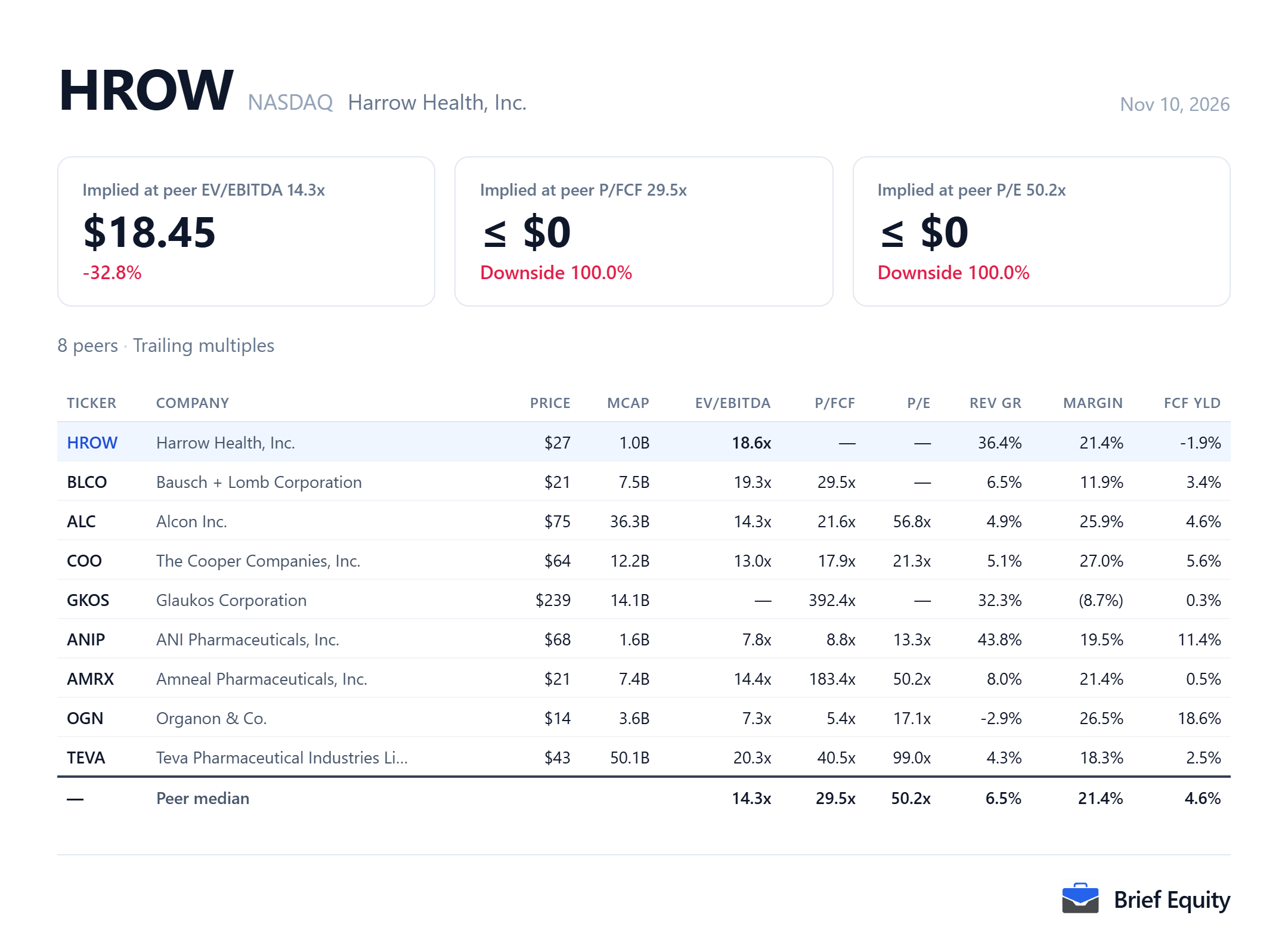
How the estimate moves with its assumptions
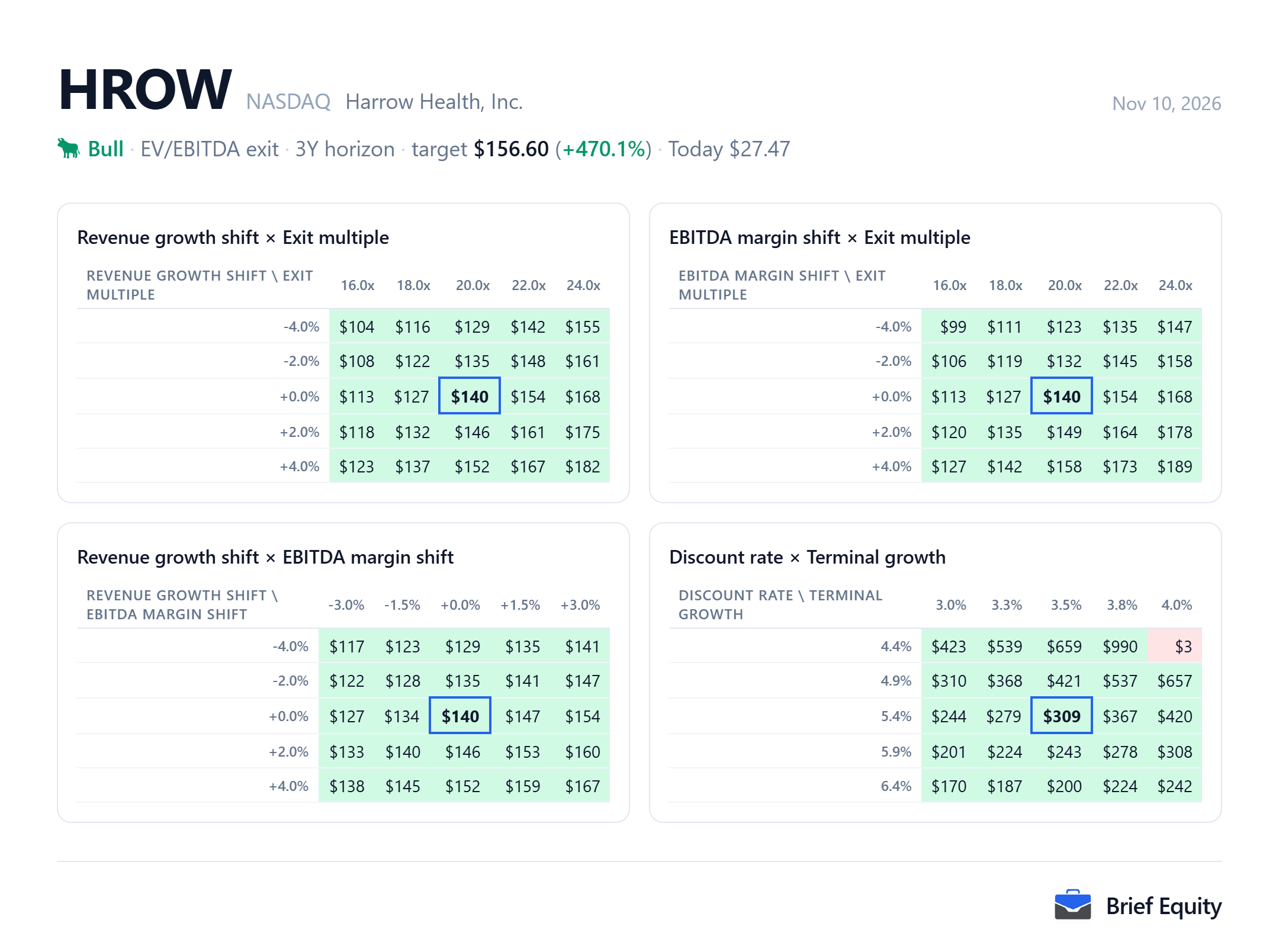
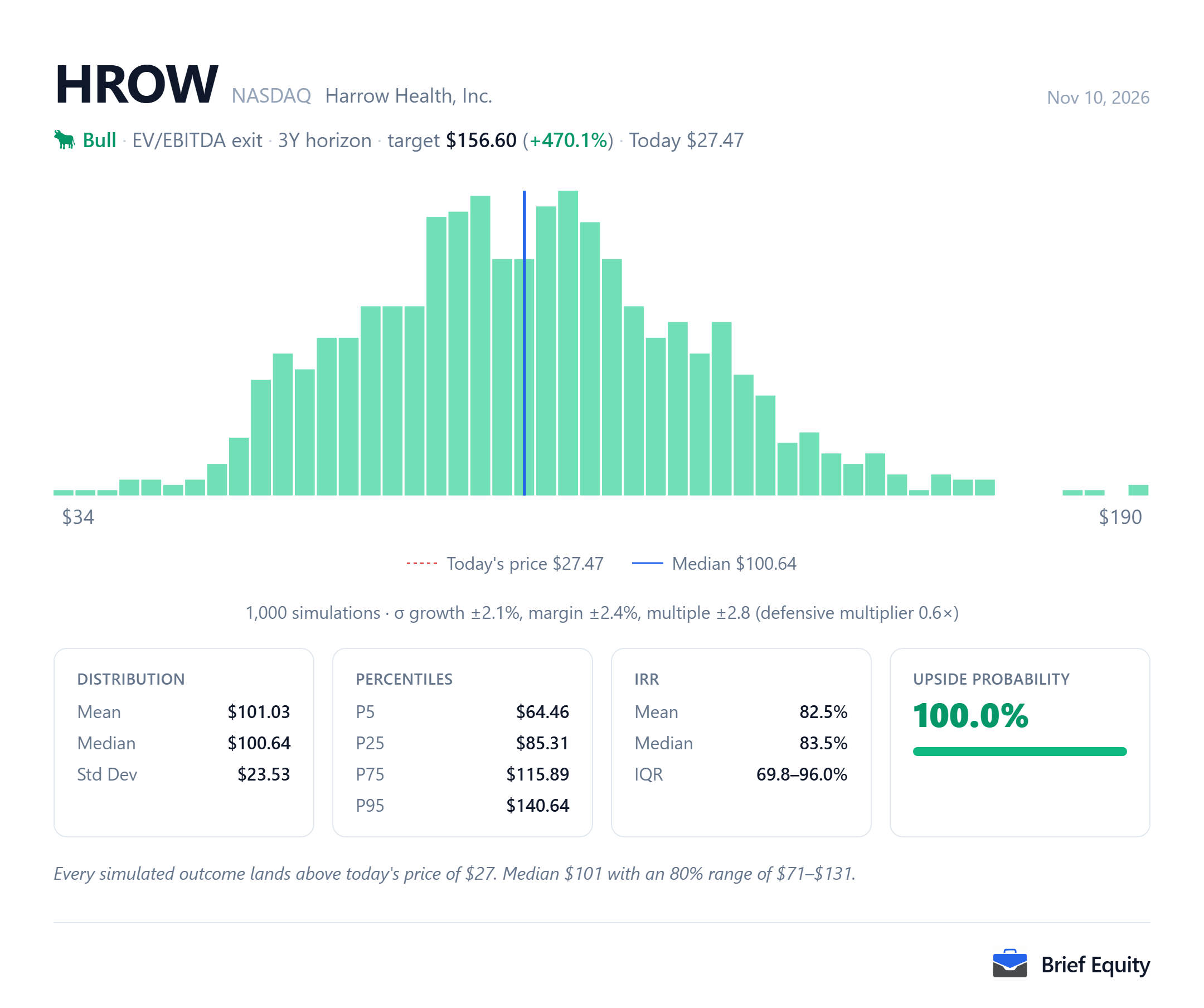
The two Harrow cards below test the estimate: the sensitivity grids move two assumptions at a time, and the Monte Carlo card reruns the model many times with growth, margin and the exit multiple drawn at random.
Questions about Harrow
These questions about Harrow (HROW) are answered from the documents listed under Sources.
- What debt does Harrow have?
- As of its 10-Q for the third quarter of 2026, Harrow's debt was $300 million of 8.625% Senior Notes due September 2030, with no principal due before 2030.
- What did Harrow pay for TYRVAYA?
- Harrow paid $30 million in cash when it closed the TYRVAYA acquisition on October 1, 2026, and may pay up to $70 million more in milestone payments if TYRVAYA's net sales reach set thresholds in periods ending on or before December 31, 2029.
Sources
The quotations and facts about Harrow (HROW) on this page rest on the documents below.
- Harrow third-quarter 2026 financial results release, November 9, 2026
- Harrow 29th quarterly letter to stockholders, third quarter of 2026, November 9, 2026
- Harrow first-quarter 2026 earnings call, May 12, 2026
- Harrow quarterly report on Form 10-Q for the third quarter of 2026, November 9, 2026
- Harrow annual report on Form 10-K for 2025, March 2, 2026
About this page
Brief Equity and its team hold no position in Harrow (HROW) as of November 10, 2026.
This page is research, not investment advice. It describes one model and the assumptions behind it, and market data is delayed. Read how these models are built and our editorial policy.
Related guides: How to read a 10-K (SEC filing), How to research a stock before you buy, Where to read earnings transcripts and filings in one place.