Valuation · EV/Sales model
Is GitLab (GTLB) stock undervalued?
Brief Equity's quick EV/Sales model of GitLab, dated October 24, 2026, values the shares at about $88 for fiscal 2029, against a price of $56.28 that day. On those assumptions GitLab looks cheap, with a return of about 56%. The view rests on one condition: that the extra use AI coding agents bring to GitLab keeps turning into revenue growth of 20% a year or more.
By The Brief Equity Team · Model dated · Published
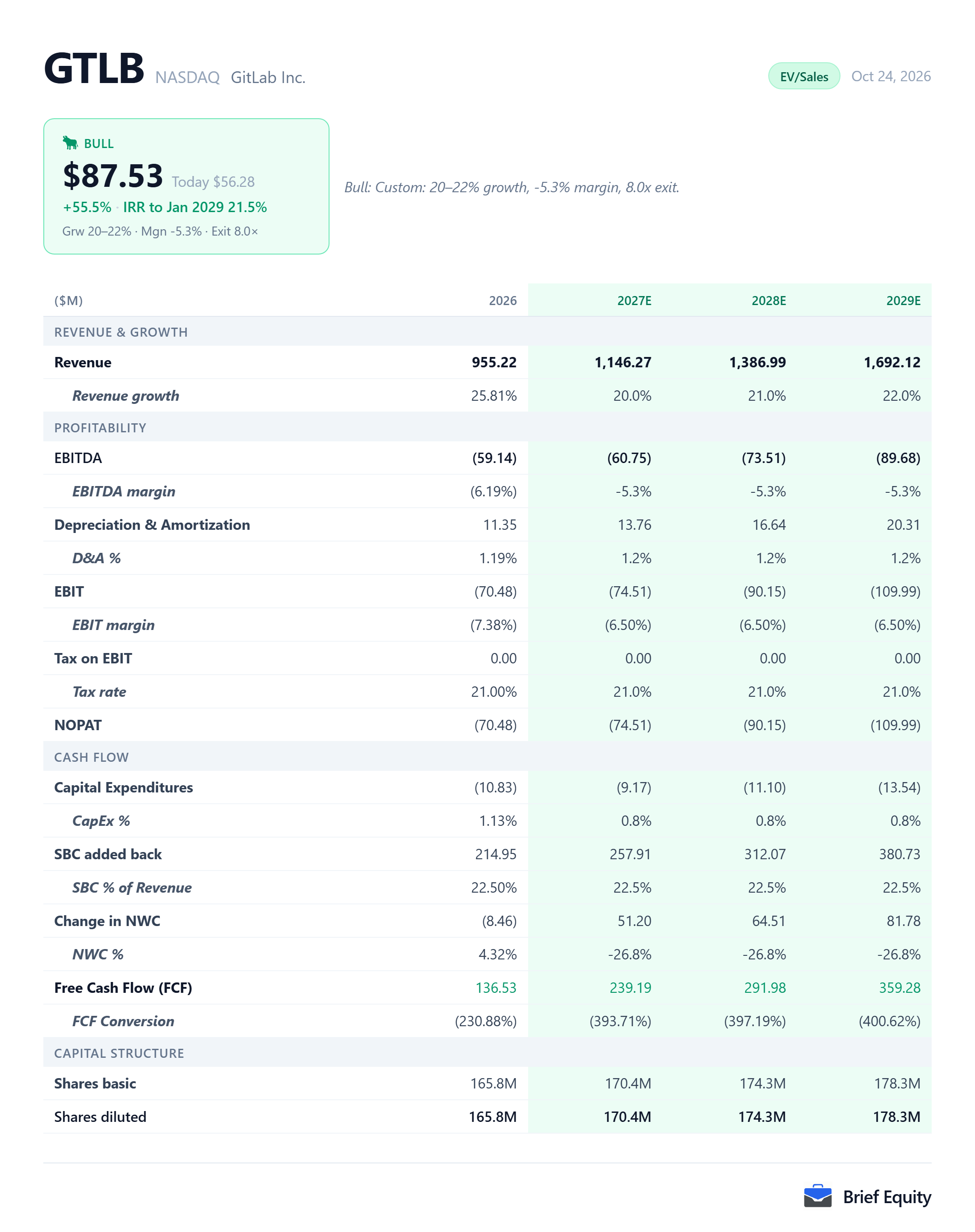
The model's assumptions for GitLab
GitLab's fiscal year ends on January 31, so fiscal 2027 is the year to January 2027. The figures below come from a quick model of GitLab, built on a few stated assumptions and projected to fiscal 2029, with analyst consensus revenue beside the model's revenue for the same three years.
| Fiscal 2027 | Fiscal 2028 | Fiscal 2029 | |
|---|---|---|---|
| Revenue, model | 1,146.27 | 1,386.99 | 1,692.12 |
| Revenue growth, model | 20.0% | 21.0% | 22.0% |
| Fiscal 2027 | Fiscal 2028 | Fiscal 2029 | |
|---|---|---|---|
| Revenue, model | 1,146.27 | 1,386.99 | 1,692.12 |
| Revenue, analyst consensus | 1131.33 | 1306.67 | 1508.07 |
Why GitLab looks undervalued
GitLab looks cheap at a share price in the 50s, provided the extra use that AI coding agents bring to its software keeps turning into revenue growth of 20% a year or more.
Brief Equity's model of GitLab is a quick one. It has revenue growing 20.0% in fiscal 2027, 21.0% in fiscal 2028 and 22.0% in fiscal 2029, against analysts' expected growth of 16.4% a year from fiscal 2026 to fiscal 2029. Valuing the company at 8 times its fiscal 2029 sales gives about $88 a share, about 56% above the price on the model's date.
GitLab's chief executive said on the second-quarter fiscal 2027 call that customers who adopt more AI development tools use more of GitLab, and that about 80% of the query volume on its Orbit context tool comes from customers connecting it to outside agents such as Claude Code. He gave the year-over-year growth in two measures of that use.
“code pushes grew 50%, and CICD pipelines grew 40%.”
William Staples, Chief Executive Officer, GitLab second-quarter fiscal 2027 earnings call, September 1, 2026
GitLab's bookings grew faster than its revenue in that quarter: net ARR grew 42% from a year earlier, while revenue rose 21%. Separately, the introduction of its Flex pricing took paid consumption run rate from $15 million at the end of the first quarter to more than $40 million at the end of the second.
GitLab's shares traded at $21.33 on April 8, 2026, after falling with other software stocks on the day Anthropic announced Managed Agents, following the correction in software stocks that dominated the early months of 2026. A sales multiple above 8 times in fiscal 2029 would raise the return above the model's.
What has to be true, and what would break it
GitLab looks cheap on this model only while a few things hold, and the view fails if they do not.
What has to be true
- The extra use that AI coding agents bring to GitLab keeps turning into revenue.
- Revenue grows 20.0% to 22.0% a year through fiscal 2029.
- Investors pay at least 8 times sales for the company in fiscal 2029.
What would break it
- Bookings return to a more normal pace after the second quarter of fiscal 2027, as GitLab's own outlook assumes, and revenue growth keeps slowing.
- AI agents reduce the number of developer seats that customers pay for, the fear behind the April 2026 fall in software stocks.
The parts of GitLab's business
GitLab reports one segment, and its annual report divides revenue four ways. Self-managed subscriptions are the largest part, and SaaS took a larger share of the growth in fiscal 2026 than it holds of revenue.
| Share of revenue | Share of revenue growth | |
|---|---|---|
| Subscription, self-managed | 59.5% | 55.9% |
| SaaS | 31.0% | 40.8% |
| License, self-managed | 7.2% | 0.3% |
| Professional services and other | 2.3% | 3.0% |
GitLab beside its peers
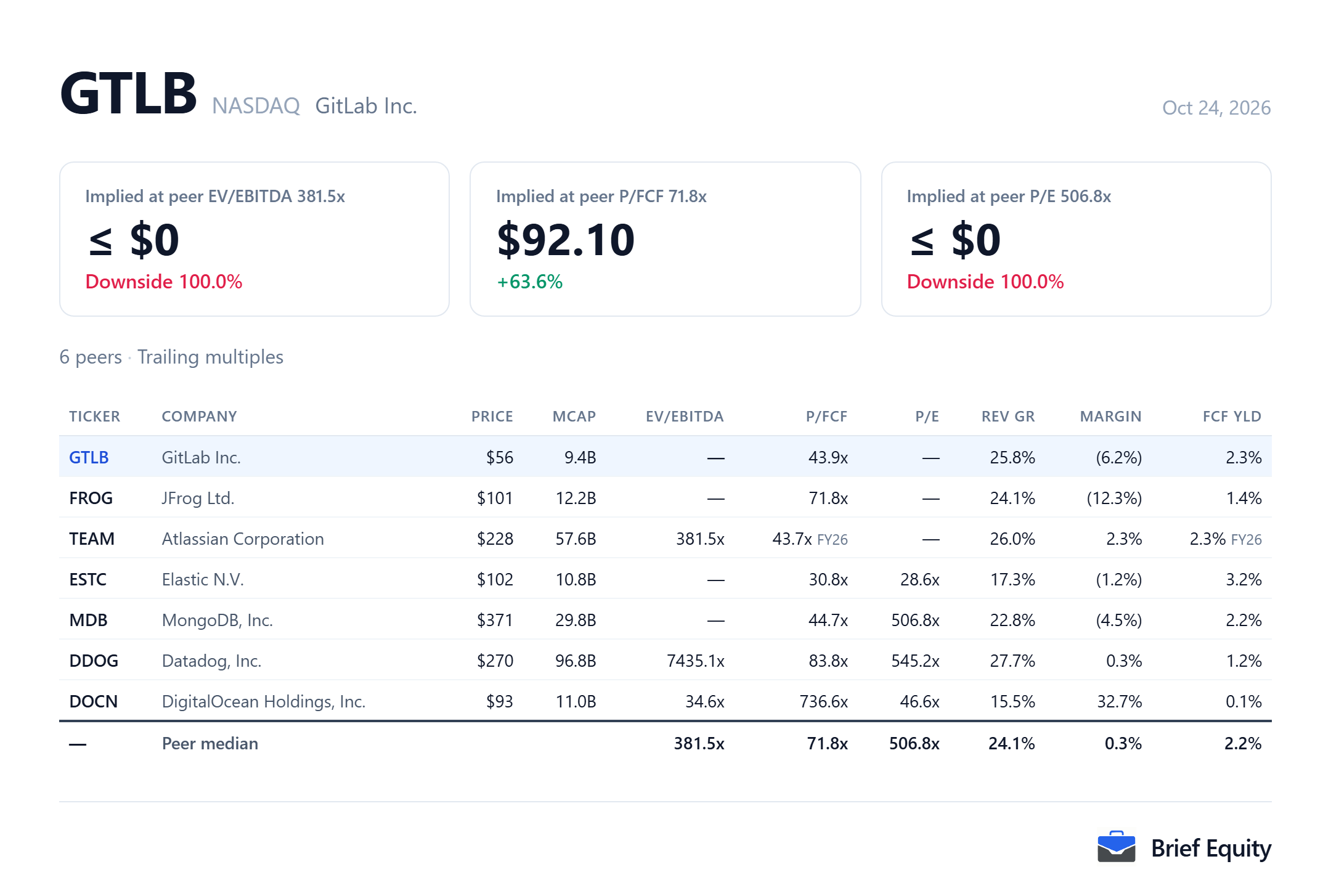
GitLab is compared here with six companies, chosen to cover its self-managed developer platform, its move to the cloud and its new usage-based pricing.
- FROG: A self-managed developer platform, the closest match to GitLab's own
- TEAM: Developer tools sold per seat, moving from self-managed to cloud
- ESTC: Self-managed and cloud subscriptions sold side by side
- MDB: A developer platform moving to usage-based pricing, as GitLab's Flex does
- DDOG: Developer and operations software priced on usage
- DOCN: Usage-priced cloud sold to developers and startups
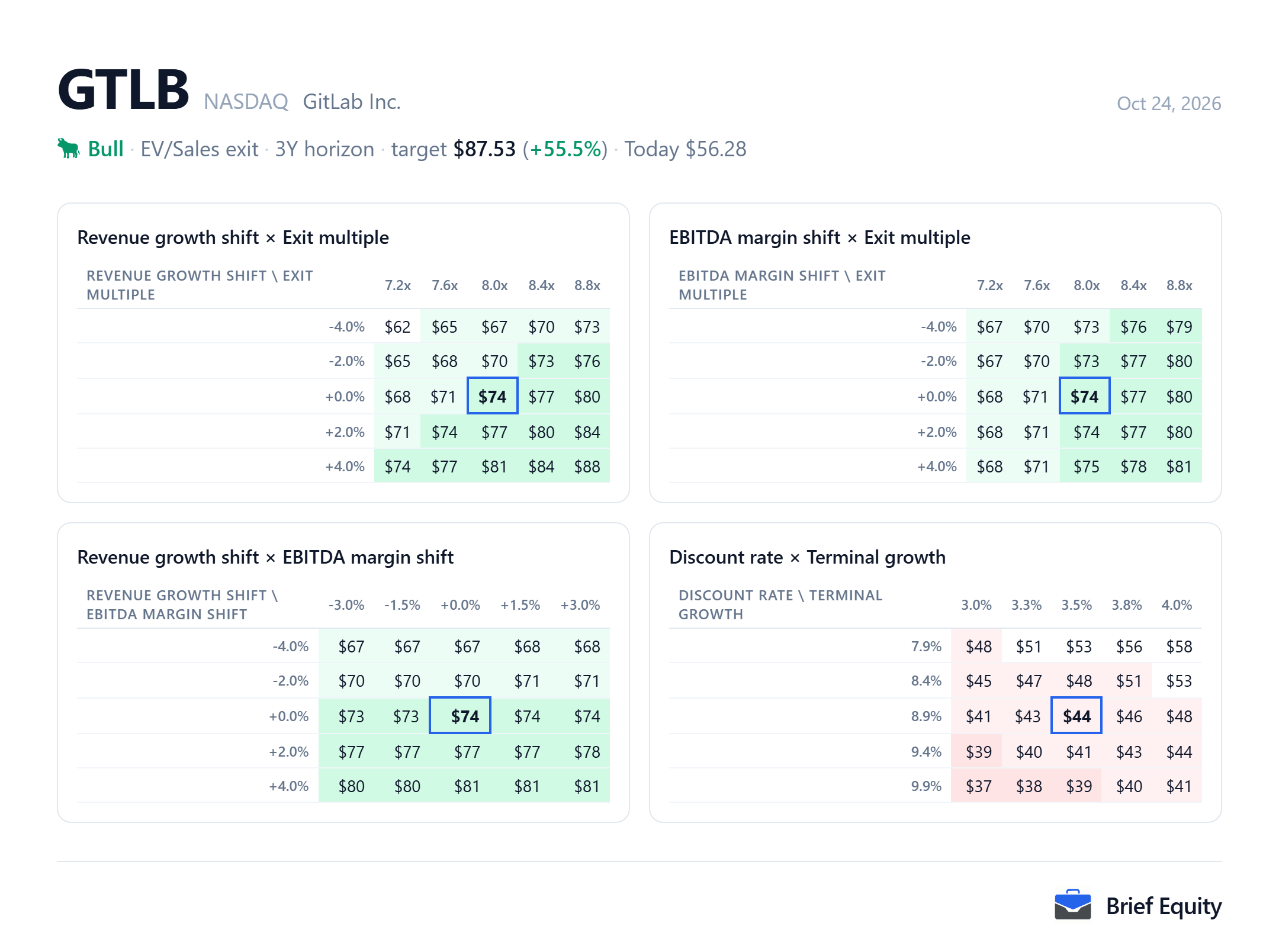
How the estimate moves with its assumptions
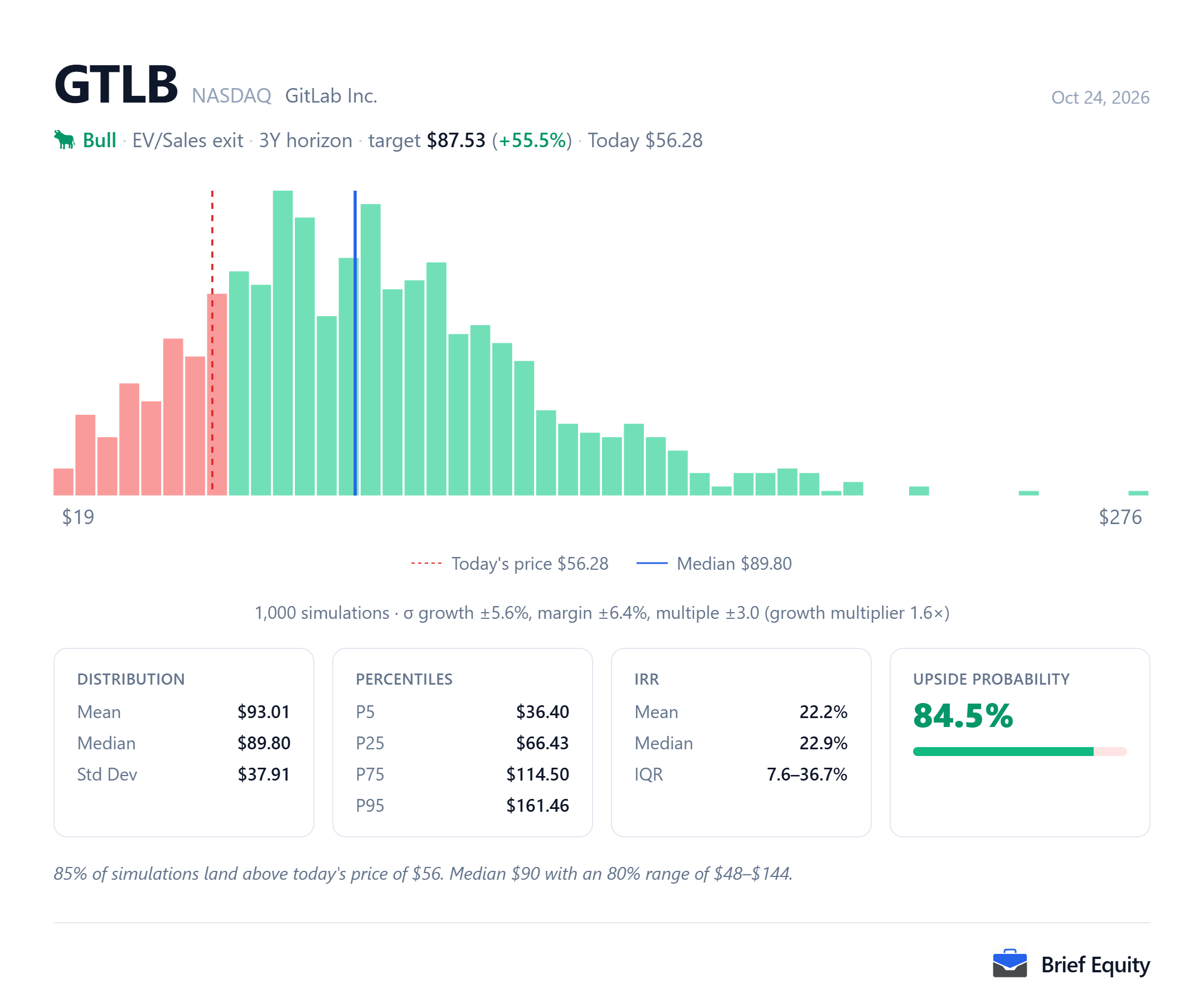
GitLab's estimate depends on its assumptions, and the two pictures below show how far it moves when they change. The first varies two assumptions at a time. The second runs the model many times with growth, margin and the exit multiple drawn at random.
Questions about GitLab
These questions about GitLab (GTLB) are answered from the documents listed under Sources.
- How much revenue did GitLab report for fiscal 2026?
- GitLab reported revenue of $955.2 million for fiscal 2026, the year ended January 31, 2026, up 26% from $759.2 million in fiscal 2025.
- Does GitLab have debt?
- GitLab's balance sheet at July 31, 2026 shows no borrowings, and its cash, cash equivalents and short-term investments came to $1,257.0 million that day.
- How many shares has GitLab bought back?
- In the six months ended July 31, 2026, GitLab repurchased 5,840,297 Class A shares for $154.7 million, at an average of $26.47 a share. $245.3 million remained available under its 2026 program at that date.
- Does GitLab still have two classes of shares?
- No. On August 21, 2026, all outstanding Class B shares converted into Class A shares on a one-for-one basis.
- What is GitLab's revenue guidance for fiscal 2027?
- On September 1, 2026, GitLab raised its fiscal 2027 revenue guidance to $1.129 billion to $1.133 billion, about 18% to 19% growth. The guidance leaves out the effect of Flex, which management expects to move at most about $13 million of fiscal 2027 revenue into later periods.
Sources
The quotations and facts about GitLab (GTLB) on this page rest on the documents below.
- GitLab annual report (Form 10-K) for fiscal 2026, the year ended January 31, 2026, March 17, 2026
- GitLab quarterly report (Form 10-Q) for the quarter ended July 31, 2026, September 2, 2026
- GitLab second-quarter fiscal 2027 earnings release, September 1, 2026
- GitLab second-quarter fiscal 2027 earnings call, September 1, 2026
- GitLab first-quarter fiscal 2027 earnings call, June 2, 2026
- Software stocks fall after Anthropic announces Managed Agents, April 8, 2026
About this page
Brief Equity and its team hold no position in GitLab (GTLB) as of October 24, 2026.
This page is research, not investment advice. It describes one model and the assumptions behind it, and market data is delayed. Read how these models are built and our editorial policy.
Related guides: What is enterprise value (EV), How to value a stock yourself (without Excel), How to write an investment thesis.