Valuation · EV/EBITDA model
Is Fair Isaac (FICO) stock undervalued?
On November 16, 2026, with the shares at $721.91, a quick EV/EBITDA model by Brief Equity valued Fair Isaac at about $880 for fiscal 2029, about 22% above the price. Fair Isaac looks somewhat undervalued on that model, though not by a wide margin, if enough mortgage lenders keep paying $10 for a FICO score while two of the credit bureaus sell VantageScore for $1 or less.
By The Brief Equity Team · Model dated · Published
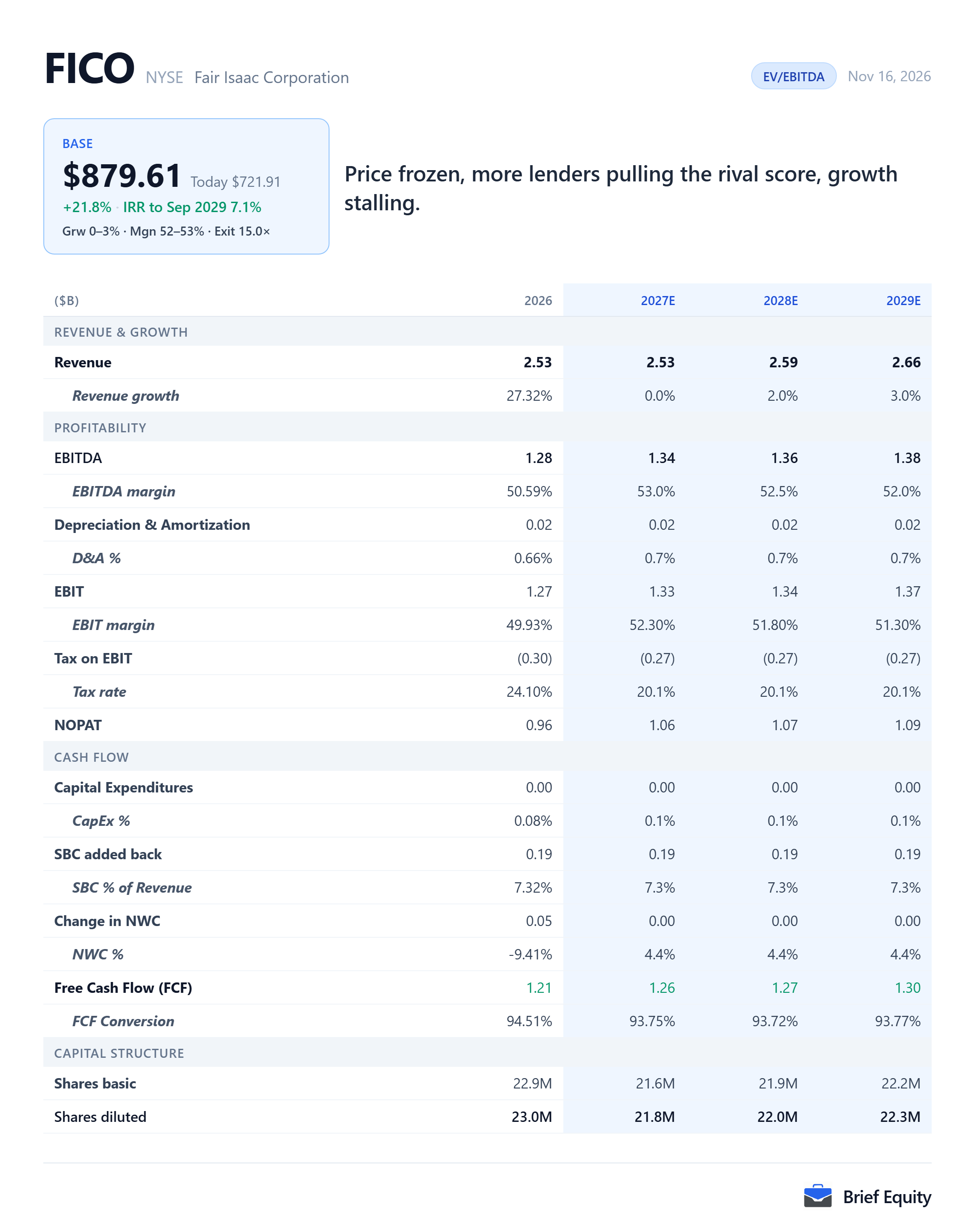
The model's assumptions for Fair Isaac
Fair Isaac's fiscal year ends on September 30, and the last year it has reported in full is fiscal 2026. The model runs three years, to fiscal 2029, and values the company on a multiple of its fiscal 2029 EBITDA. Every figure below is the model's own, except the analyst consensus row.
| 2027 | 2028 | 2029 | |
|---|---|---|---|
| Revenue, model | 2.53 | 2.59 | 2.66 |
| Revenue growth, model | 0.0% | 2.0% | 3.0% |
| EBITDA, model | 1.34 | 1.36 | 1.38 |
| EBITDA margin, model | 53.0% | 52.5% | 52.0% |
| Revenue, analyst consensus | 2.59 | 2.73 | 2.85 |
Why Fair Isaac looks undervalued
Fair Isaac charges $10 wholesale for a mortgage FICO Score sold through the tri-merge resellers, and the competition for that score has become intense. Equifax holds its price for VantageScore 4.0, the rival mortgage score, at $1, TransUnion holds its standalone price at 99 cents, and Rocket Mortgage said it would default to VantageScore 4.0 for eligible loans in the fourth quarter of 2026. At $721.91, Fair Isaac starts to look somewhat undervalued, though not by a wide margin.
Fair Isaac's response was to hold the $10 price for 2027 for lenders who enroll in its Preferred Program and keep pulling FICO scores, and lenders including PennyMac, loanDepot and Guild Mortgage have enrolled. It gave no guidance for fiscal 2027, and its chief executive said it will no longer share what its prices are.
“Obviously, we want to retain as much volume as we possibly can in the face of competition from Vantage.”
William Lansing, Chief Executive Officer, Fair Isaac fourth-quarter fiscal 2026 earnings call, November 4, 2026
For Fair Isaac, the Brief Equity model is a quick one. It has revenue flat in fiscal 2027, then growing 2% and 3% a year, well below the analyst consensus. At 15 times fiscal 2029 EBITDA, the model values Fair Isaac at about $880 a share, about 22% above the price of $721.91.
This view of Fair Isaac needs enough mortgage lenders to keep paying $10 for a FICO score while the rival score sells for $1 or less.
What has to be true, and what would break it
The view that Fair Isaac looks somewhat undervalued at $721.91 rests on mortgage lenders continuing to pay its price.
What has to be true
- Enough mortgage lenders keep paying $10 for a FICO score while VantageScore sells for $1 or less.
- Revenue is flat in fiscal 2027 and grows 2% and 3% in the two years after.
- The market pays about 15 times EBITDA for Fair Isaac in fiscal 2029.
What would break it
- More lenders make VantageScore their default, as Rocket Mortgage has said it will.
- Fair Isaac has to lower its $10 mortgage score price to keep its volume.
The parts of Fair Isaac's business
Fair Isaac reports its revenue in two segments, Scores and Software, and splits Scores between business-to-business and business-to-consumer. In fiscal 2026, business-to-business scores were more than half of Fair Isaac's revenue and brought most of the year's growth.
| Share of revenue | Share of revenue growth | |
|---|---|---|
| Scores, business-to-business | 56.1% | 87.1% |
| Scores, business-to-consumer | 9.1% | 1.8% |
| Software | 34.8% | 11.1% |
Fair Isaac beside its peers
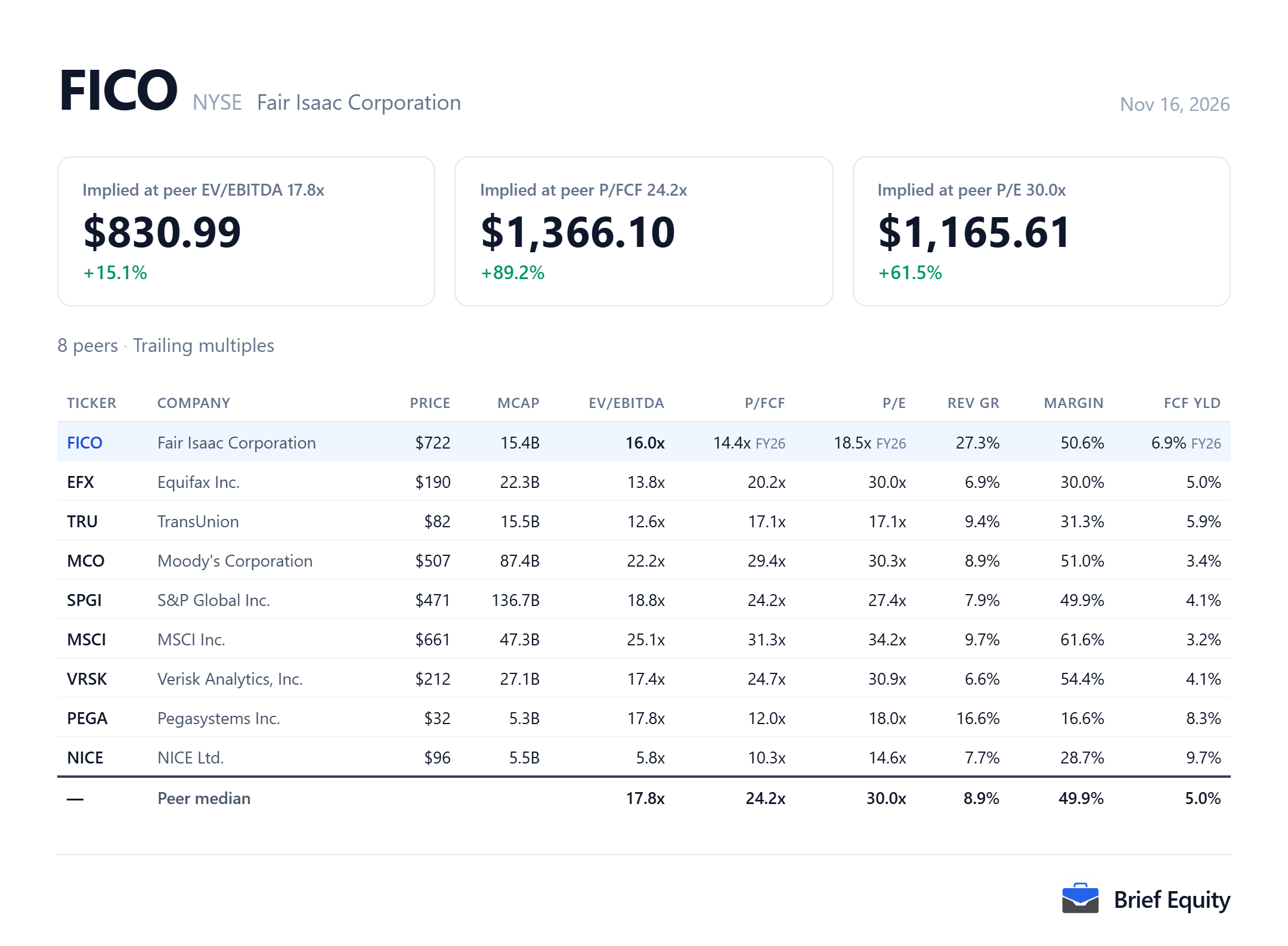
Fair Isaac is compared here with eight companies chosen for this post: the two credit bureaus that sell its scores and co-own VantageScore, four data, ratings and index companies, and two software companies.
- EFX: A credit bureau that sells FICO scores and co-owns VantageScore
- TRU: A credit bureau that sells FICO scores and co-owns VantageScore
- MCO: Credit ratings
- SPGI: Credit ratings and benchmarks
- MSCI: Index licensing
- VRSK: Data and analytics for insurers
- PEGA: Decisioning software, against the FICO Platform
- NICE: Fraud and compliance software
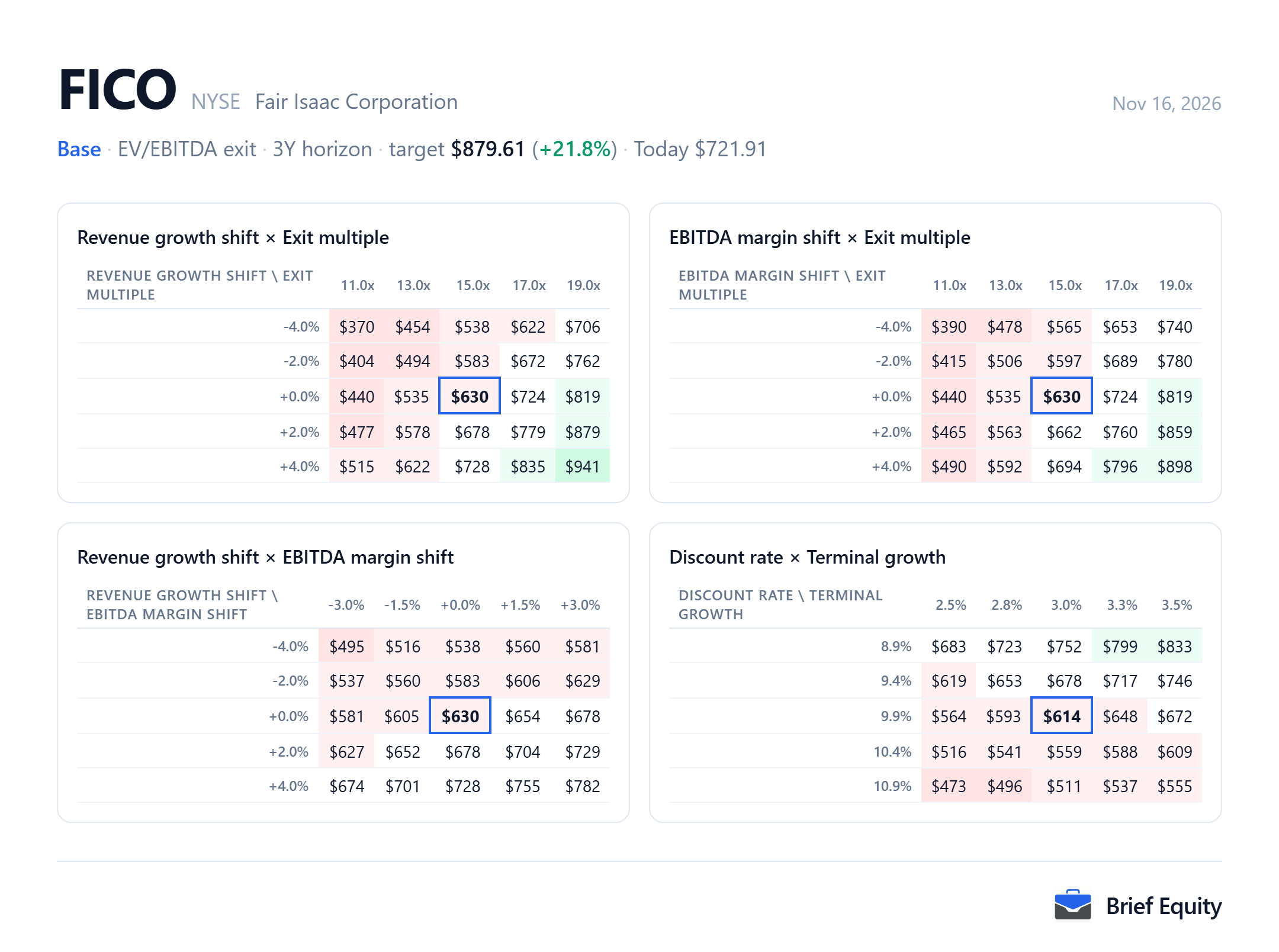
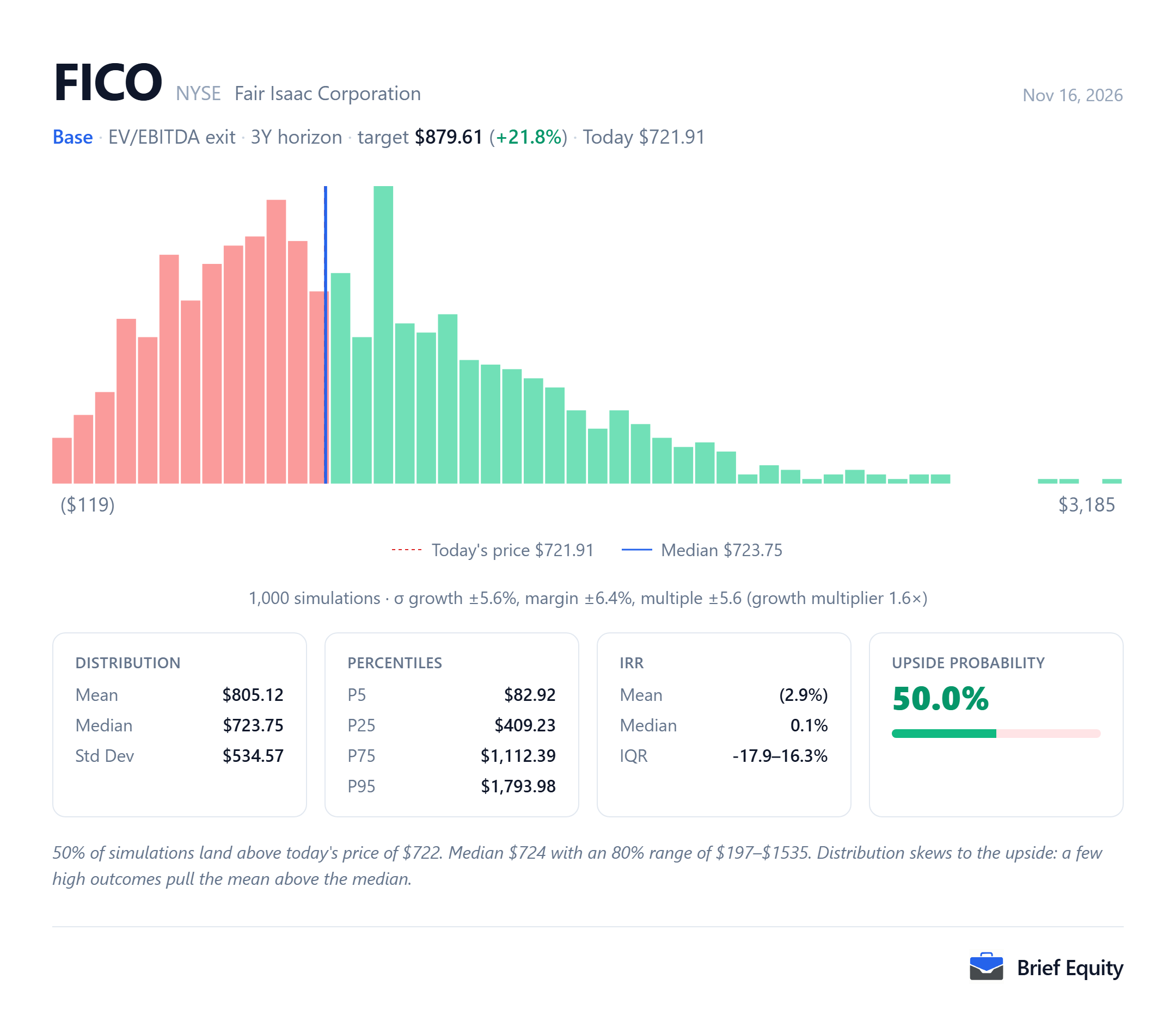
How the estimate moves with its assumptions
The two Fair Isaac cards below test the estimate: the sensitivity grids change two assumptions together, and the Monte Carlo card reruns the model many times with its main assumptions drawn at random.
Questions about Fair Isaac
These questions about Fair Isaac (FICO) are answered from the documents listed under Sources.
- How much of Fair Isaac's revenue comes from the three credit bureaus?
- Revenue from Fair Isaac's agreements with Experian, TransUnion and Equifax made up 60% of its total revenue in fiscal 2026, against 51% in fiscal 2025 and 45% in fiscal 2024, according to its annual report for fiscal 2026.
- Who owns VantageScore?
- VantageScore is a joint venture of TransUnion, Equifax and Experian, the three major consumer reporting agencies, according to Fair Isaac's annual report for fiscal 2026.
- When can FHA-insured mortgages use other credit scores?
- Beginning January 1, 2027, the Federal Housing Administration permits VantageScore and FICO Score 10T, in addition to the Classic FICO Score, for FHA-insured mortgages, according to Fair Isaac's annual report for fiscal 2026.
- How much stock did Fair Isaac buy back in fiscal 2026?
- Fair Isaac repurchased $3.028 billion of stock in fiscal 2026, 2.514 million shares at an average price of $1,204 a share, according to its call of November 4, 2026.
- What was Fair Isaac's free cash flow in fiscal 2026?
- Fair Isaac reported $1.034 billion of free cash flow for fiscal 2026, an increase of 40% over fiscal 2025, on its call of November 4, 2026.
- How much debt did Fair Isaac have at the end of fiscal 2026?
- Fair Isaac's total debt was $5.26 billion at the end of fiscal 2026, with a weighted average interest rate of 5.64%, according to its call of November 4, 2026.
- How fast is Fair Isaac's software recurring revenue growing?
- Annual recurring revenue for Fair Isaac's Software segment was $850.9 million at September 30, 2026, a 14% increase from September 30, 2025, according to its annual report for fiscal 2026.
Sources
The quotations and facts about Fair Isaac (FICO) on this page rest on the documents below.
- Fair Isaac fourth-quarter and fiscal 2026 results release, November 4, 2026
- Fair Isaac fourth-quarter fiscal 2026 earnings call, November 4, 2026
- Fair Isaac annual report on Form 10-K for fiscal 2026, November 6, 2026
- FICO announcement holding its wholesale mortgage score price at $10 for Preferred Program lenders, October 23, 2026
- FICO announcement of Guild Mortgage, New American Funding and PennyMac enrolling in its Preferred Program, November 2, 2026
- FICO announcement of DHI Mortgage, loanDepot, Paramount Residential Mortgage Group and CMG Financial enrolling in its Preferred Program, November 4, 2026
- Equifax announcement extending $1 VantageScore 4.0 mortgage score pricing through 2028, October 8, 2026
- National Mortgage Professional report on TransUnion's VantageScore 4.0 pricing through 2028, September 30, 2026
- Rocket Mortgage announcement making VantageScore 4.0 its preferred credit score, September 28, 2026
About this page
Brief Equity and its team hold no position in Fair Isaac (FICO) as of November 16, 2026.
This page is research, not investment advice. It describes one model and the assumptions behind it, and market data is delayed. Read how these models are built and our editorial policy.
Related guides: EV/EBITDA explained, What is enterprise value (EV), How to read a 10-K (SEC filing).