Valuation · EV/EBITDA model
Is Edgewell Personal Care (EPC) stock undervalued?
On November 14, 2026, with the shares at $27.28, a quick EV/EBITDA model by Brief Equity valued Edgewell Personal Care at about $46 for fiscal 2029, about 70% above the price. Edgewell looks undervalued on that model if the consolidation of four razor plants into one finishes on its new timeline and the restructuring charges stop.
By The Brief Equity Team · Model dated · Published
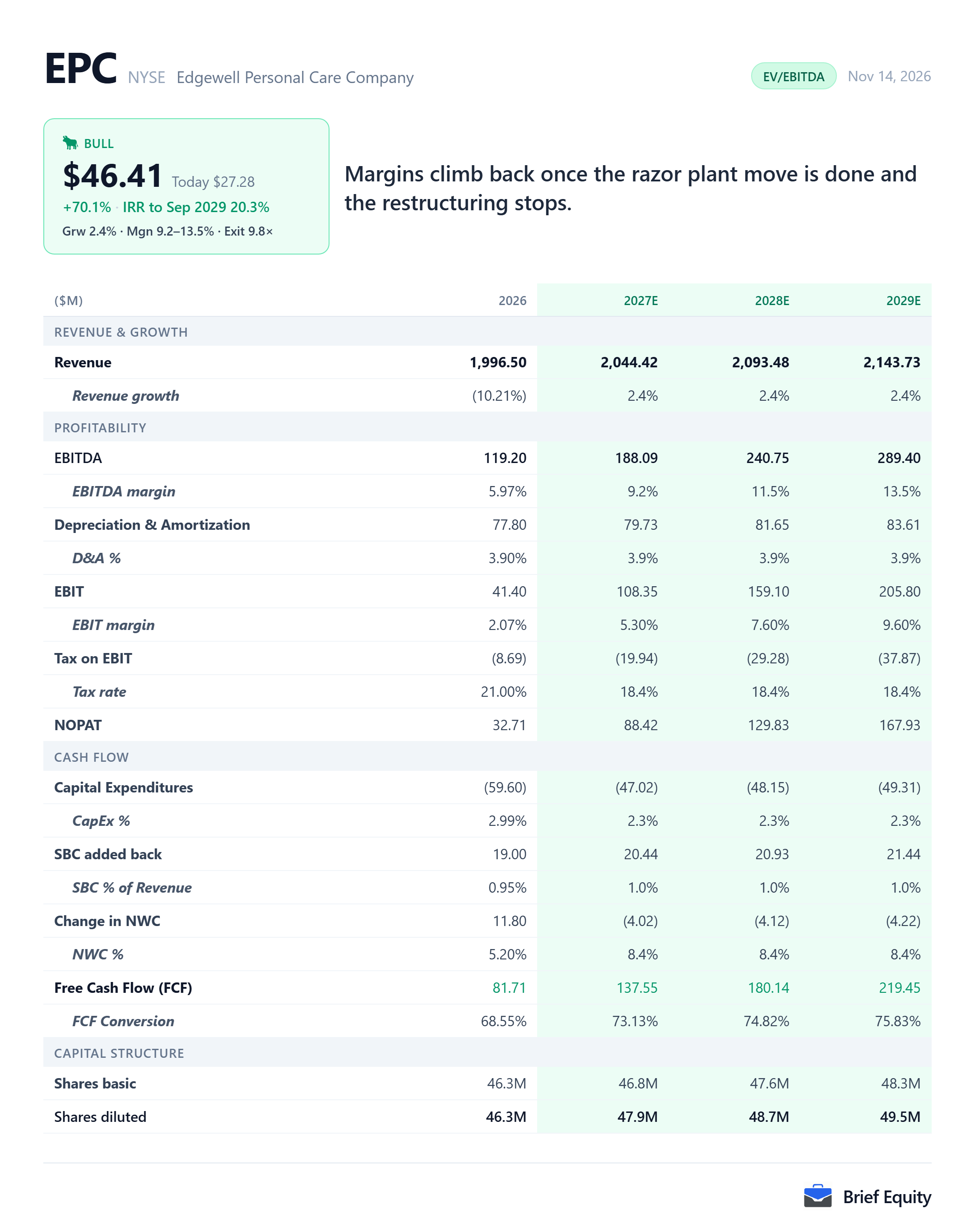
The model's assumptions for Edgewell Personal Care
Edgewell Personal Care's fiscal year ends on September 30, and the last year it has reported in full is fiscal 2026. The model runs three years, to fiscal 2029, and values the company on a multiple of its fiscal 2029 EBITDA. Every figure below is the model's own, except the analyst consensus row.
| 2027 | 2028 | 2029 | |
|---|---|---|---|
| Revenue, model | 2,044.42 | 2,093.48 | 2,143.73 |
| Revenue growth, model | 2.4% | 2.4% | 2.4% |
| EBITDA, model | 188.09 | 240.75 | 289.40 |
| EBITDA margin, model | 9.2% | 11.5% | 13.5% |
| Revenue, analyst consensus | 2,023.92 | 2,067.26 | 2,092.40 |
Why Edgewell Personal Care looks undervalued
Edgewell Personal Care recorded $101.8 million of restructuring and related costs in fiscal 2026 while it consolidates four razor plants into one new site, and in June 2026 Bloomberg reported that its board had turned down an offer of $30 a share as too low. At $27.28, Edgewell looks undervalued if the plant consolidation finishes this time.
Edgewell's chief executive said in November 2026 that the consolidation is roughly half done and running about six months behind the original plan, so its savings now begin in fiscal 2028 and the outlook for fiscal 2027 includes none of them. Wet Shave, the razor business, was 61.3% of revenue in fiscal 2026, and its segment profit fell 13.5% that year.
“As a result, the consolidation timeline has shifted by about six months compared with our original plan, and we now expect the associated savings to begin in fiscal '28.”
Rod Little, Chief Executive Officer, Edgewell Personal Care fourth-quarter fiscal 2026 earnings call, November 12, 2026
The reported offer for Edgewell came from Yellow Wood Partners, a private equity firm, according to people Bloomberg did not name, and the shares closed at $22.72 on the day of the report. Edgewell has not confirmed it.
“The board considered the offer, at $30 a share, too low, the people said, asking not to be identified because the details are private. The shares fell 1.7% to $22.72 in New York trading Monday.”
Report that Edgewell's board rejected a $30 a share takeover offer, June 22, 2026
For Edgewell, the Brief Equity model is a quick one. It has EBITDA of $188.09 million in fiscal 2027, in line with the company's own outlook of about $190 million to $210 million with restructuring charges included. The EBITDA margin then rises to 13.5% in fiscal 2029, or $289.40 million, against the $250 million to $270 million of adjusted EBITDA, before those charges, that Edgewell expects for fiscal 2027. With revenue growth of 2.4% a year and 9.8 times fiscal 2029 EBITDA, the model values Edgewell at about $46 a share in fiscal 2029, about 70% above the price of $27.28.
This view of Edgewell breaks if the consolidation slips again or the restructuring charges keep coming: they were $50.7 million in fiscal 2025, and about $55 million more is expected in fiscal 2027. Edgewell also has $750 million of notes due in 2028 and $500 million due in 2029, the years the savings are expected, with adjusted net debt leverage of 3.4x at the end of fiscal 2026.
What has to be true, and what would break it
The view that Edgewell Personal Care looks undervalued at $27.28 rests on its razor plant consolidation finishing and its restructuring charges stopping.
What has to be true
- The consolidation of four razor plants into one finishes on the new timeline, and its savings begin in fiscal 2028 as the chief executive said.
- The restructuring charges stop once the transformation program ends, which the company expects by the fourth quarter of fiscal 2028.
- The EBITDA margin reaches 13.5% by fiscal 2029, a level for which Edgewell has given no target.
What would break it
- The consolidation slips again, after moving about six months behind its original plan.
- Restructuring charges keep recurring, as they did at $50.7 million in fiscal 2025 and $101.8 million in fiscal 2026.
The parts of Edgewell Personal Care's business
Edgewell Personal Care reports its revenue in two segments. In fiscal 2026, Wet Shave was most of the revenue, while Sun and Skin Care brought most of the year's revenue growth.
| Share of revenue | Share of revenue growth | |
|---|---|---|
| Wet Shave | 61.3% | 14.8% |
| Sun and Skin Care | 38.7% | 85.2% |
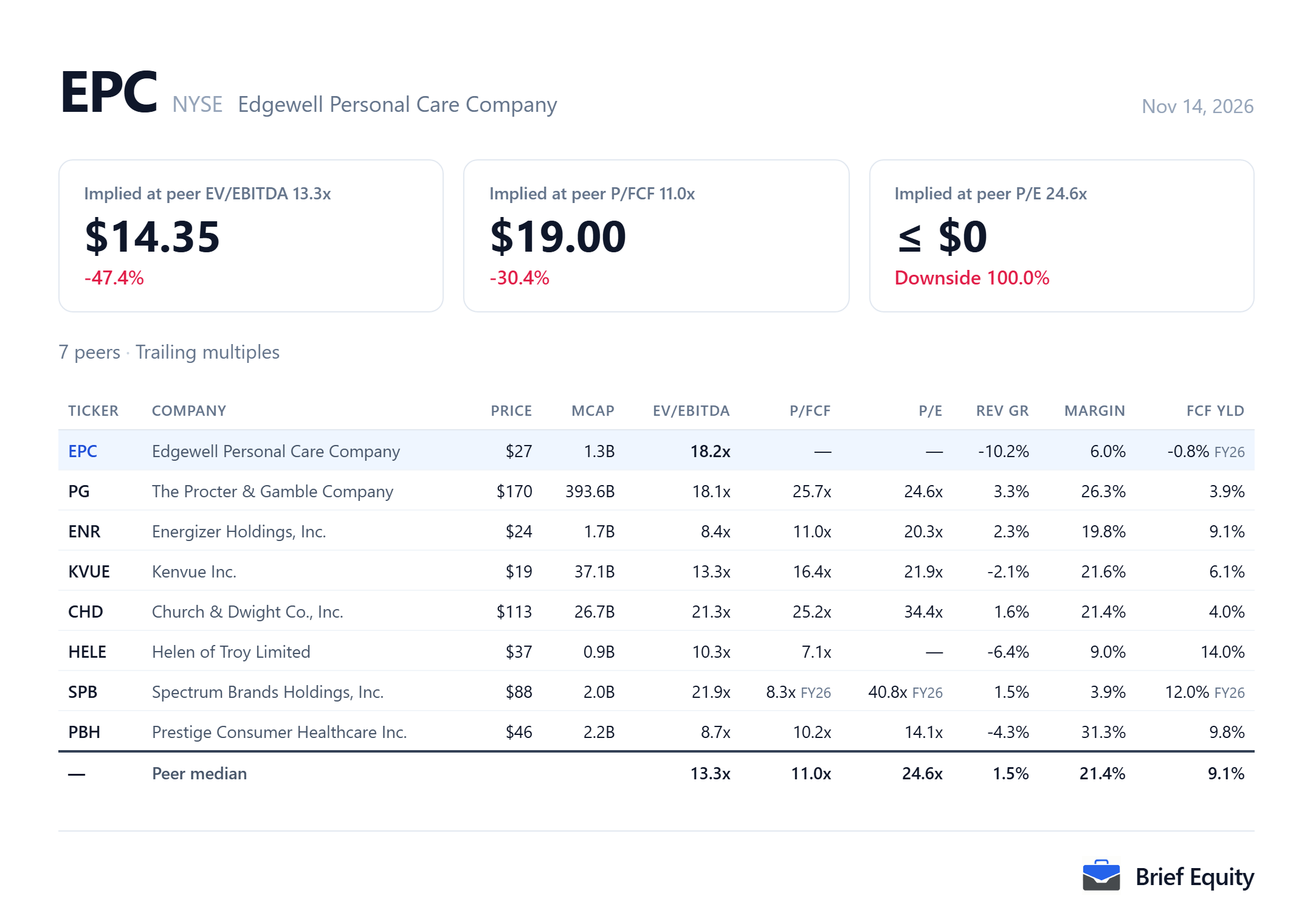
Edgewell Personal Care beside its peers
Edgewell Personal Care is compared here with seven companies chosen for this post: razor makers for Wet Shave, sun and skin care brands for Sun and Skin Care, and branded consumer companies of a similar size.
- PG: Gillette, the largest razor brand, against Edgewell's Wet Shave
- ENR: A branded consumer staples company near Edgewell's size
- KVUE: Neutrogena sun and skin care, against Edgewell's Sun and Skin Care
- CHD: Personal care brands, against Edgewell's Sun and Skin Care
- HELE: A smaller personal care company, against Edgewell's Grooming brands
- SPB: A smaller branded household products company
- PBH: A mid-sized branded consumer products company
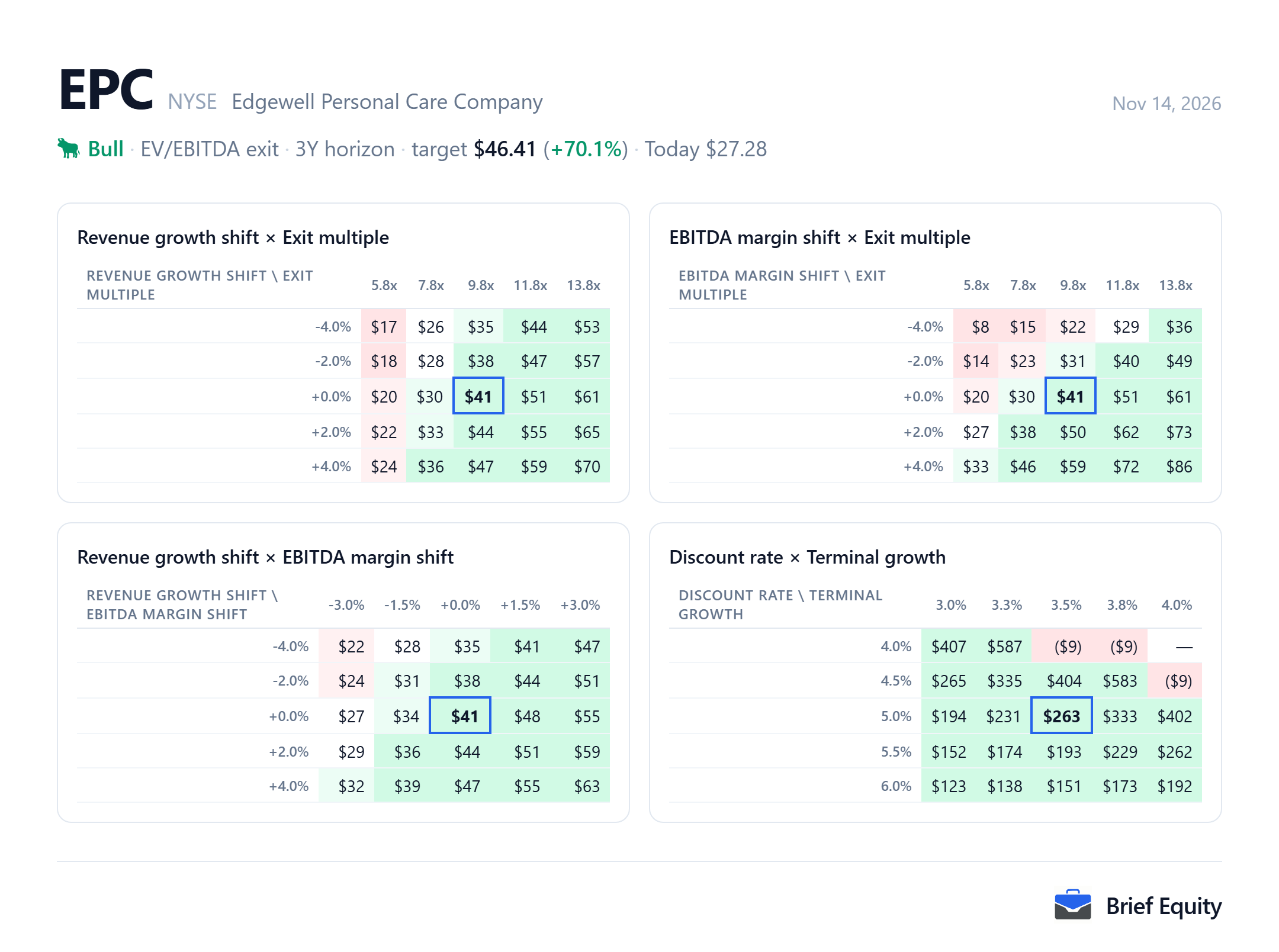
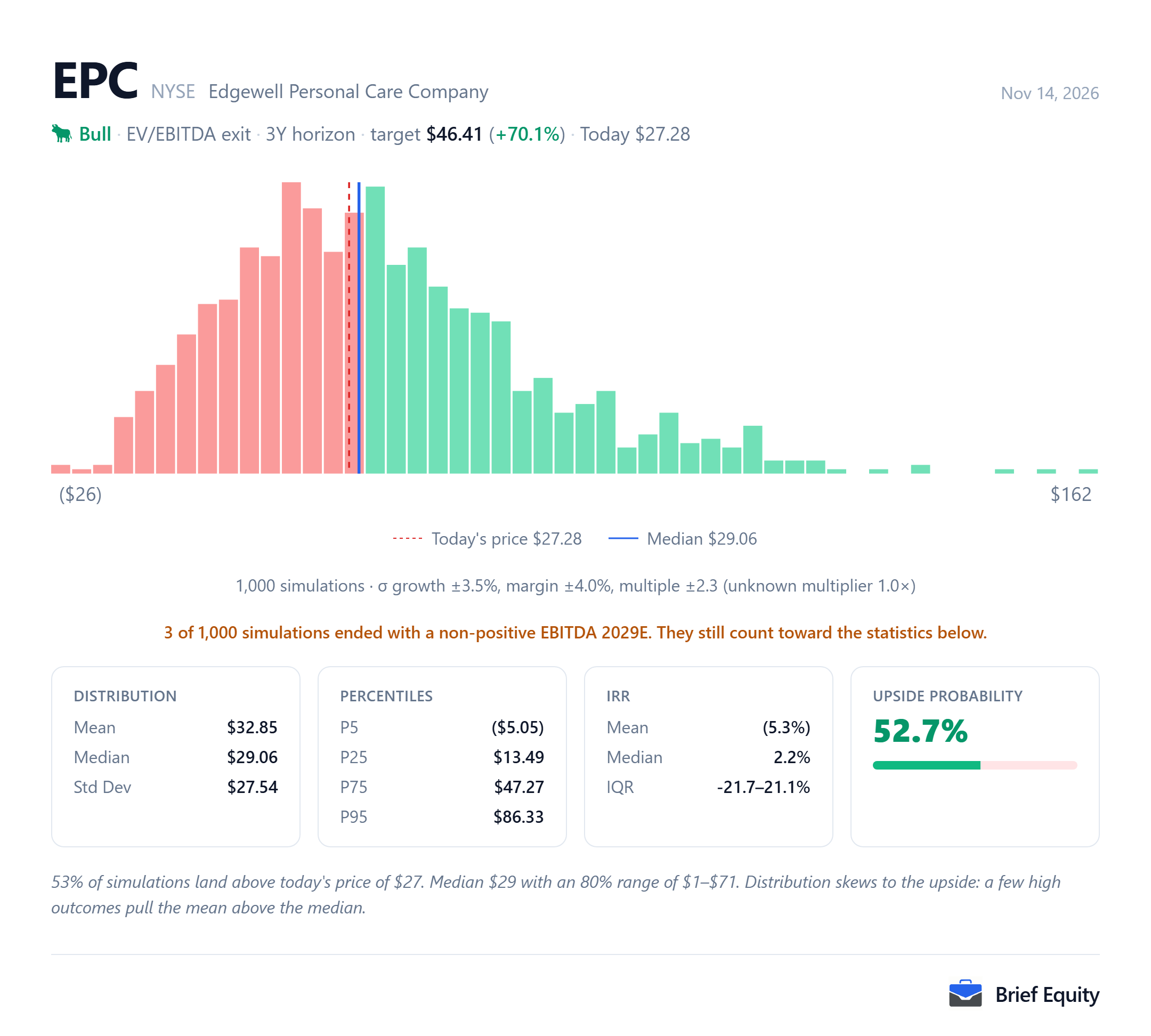
How the estimate moves with its assumptions
The two Edgewell Personal Care cards below test the estimate: the sensitivity grids move two assumptions at a time, and the Monte Carlo card reruns the model many times with growth, margin and the exit multiple drawn at random.
Questions about Edgewell Personal Care
These questions about Edgewell Personal Care (EPC) are answered from the documents listed under Sources.
- When did Edgewell sell its Feminine Care business?
- Edgewell closed the sale of its Feminine Care business to Essity on February 2, 2026, and received approximately $340 million on a cash-free and debt-free basis, according to its annual report for fiscal 2026.
- How much of Edgewell's sales come from Walmart?
- Walmart accounted for approximately 18.8% of Edgewell's net sales in fiscal 2026, according to its annual report for that year.
- How did Edgewell's sales grow in fiscal 2026?
- Edgewell's net sales for fiscal 2026, which ended September 30, 2026, were $1,996.5 million, an increase of 1.8%, with organic net sales up 0.3%, according to its results release.
Sources
The quotations and facts about Edgewell Personal Care (EPC) on this page rest on the documents below.
- Edgewell Personal Care fourth-quarter and fiscal 2026 results release, November 12, 2026
- Edgewell Personal Care fourth-quarter fiscal 2026 earnings call, November 12, 2026
- Edgewell Personal Care annual report on Form 10-K for fiscal 2026, November 13, 2026
- Report that Edgewell's board rejected a $30 a share takeover offer, June 22, 2026
About this page
Brief Equity and its team hold no position in Edgewell Personal Care (EPC) as of November 14, 2026.
This page is research, not investment advice. It describes one model and the assumptions behind it, and market data is delayed. Read how these models are built and our editorial policy.
Related guides: How to read a 10-K (SEC filing), How to research a stock before you buy, Where to read earnings transcripts and filings in one place.