Valuation · EV/EBITDA model
Is Costco (COST) stock overvalued?
Brief Equity's EV/EBITDA model of Costco (COST), dated October 18, 2026, puts the shares at $1,477 by fiscal 2029, about 49% above the $989.11 share price at that date. Costco looks expensive at that price, although its business behaves almost like a bond. The estimate assumes that the market comes to value Costco at 35 times its EBITDA, against 28.4 times at the end of fiscal 2026.
By The Brief Equity Team · Model dated · Published
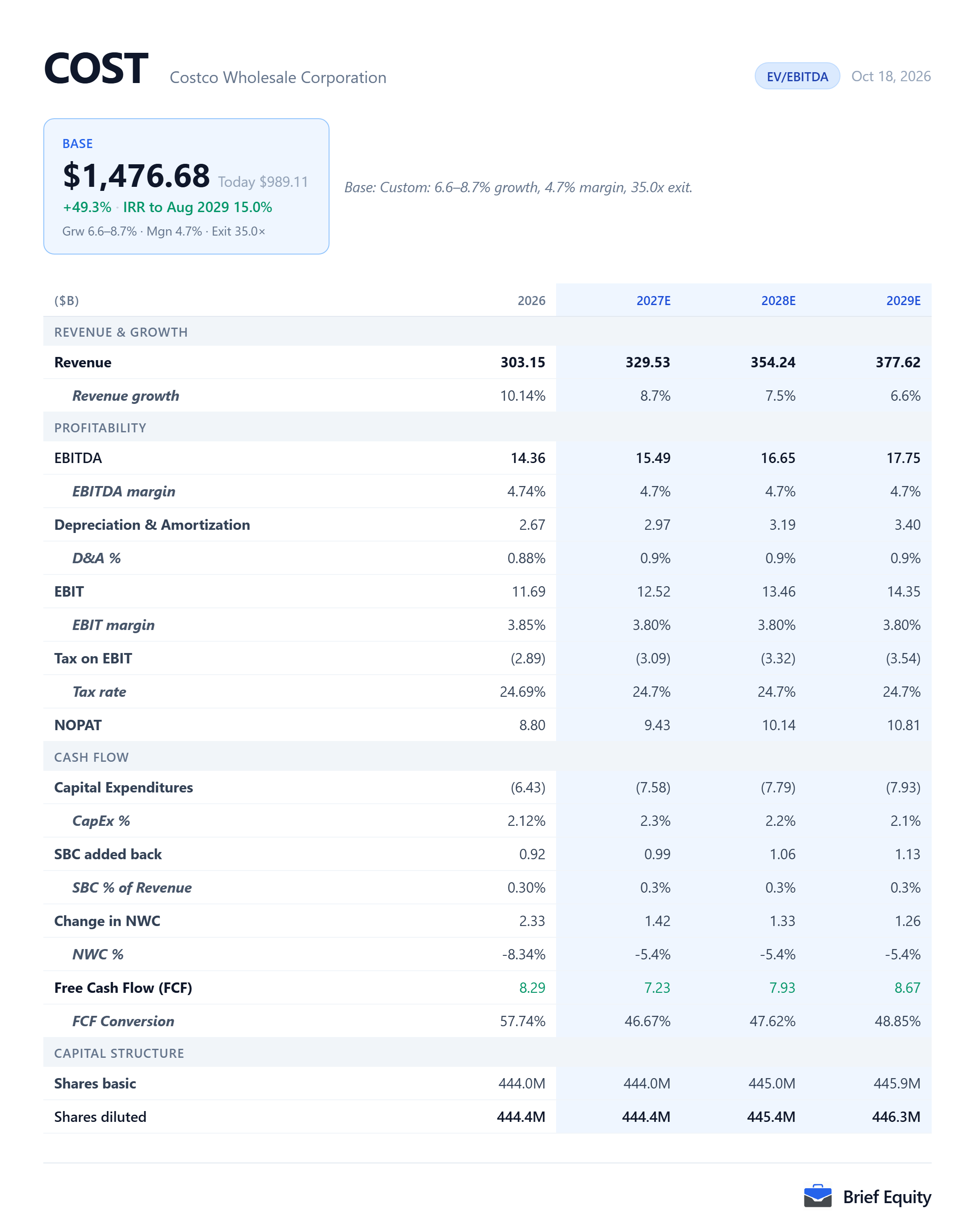
The model's assumptions for Costco
Costco's fiscal year ends around the end of August, so fiscal 2027 runs from September 2026 to August 2027. The figures come from a quick model, built on a small set of stated assumptions and projected over three years.
| Fiscal 2027 | Fiscal 2028 | Fiscal 2029 | |
|---|---|---|---|
| Revenue, model | 329.53 | 354.24 | 377.62 |
| Revenue growth, model | 8.7% | 7.5% | 6.6% |
| EBITDA, model | 15.49 | 16.65 | 17.75 |
| EBITDA margin, model | 4.7% | 4.7% | 4.7% |
| Revenue, analysts' consensus | 329.47 | 354.17 | 377.55 |
Why Costco looks overvalued
Costco looks expensive at $989.11, although its business is steady enough to be treated almost like a bond.
The model assumes that Costco's revenue grows 8.7% in fiscal 2027, 7.5% in fiscal 2028 and 6.6% in fiscal 2029, close to the analysts' consensus of 7.6% a year from fiscal 2026 to fiscal 2029. It holds the EBITDA margin at the 4.7% of fiscal 2026 and sets capital expenditure in line with the approximately $7.5 billion Costco plans for fiscal 2027. Valued at 35 times its fiscal 2029 EBITDA, Costco reaches $1,477 a share by fiscal 2029, about 49% above the share price at the model's date.
Costco's business changes little from year to year. Its comparable sales, excluding gasoline and currency, have grown in a range of 6% to 7% for about a year, according to its chief financial officer, and higher gasoline prices added 130 basis points to its net sales growth in fiscal 2026.
Costco's members renew: the renewal rate in the United States and Canada was 92.3% at the end of fiscal 2026.
Costco's enterprise value ended fiscal 2026 at 28.4 times its EBITDA. The estimate for Costco depends on the market coming to pay 35 times EBITDA for a business with a 4.7% EBITDA margin.
What has to be true, and what would break it
The estimate for Costco holds only if the conditions below are met, and each of them can fail.
What has to be true
- The market comes to value Costco at 35 times EBITDA by the end of fiscal 2029.
- Revenue grows 8.7% in fiscal 2027, 7.5% in fiscal 2028 and 6.6% in fiscal 2029.
- The EBITDA margin is 4.7% in each year from fiscal 2027 to fiscal 2029.
- GLP-1 drugs do not reduce what members spend on food.
What would break it
- The multiple stays at the 28.4 times EBITDA at which Costco ended fiscal 2026, or falls.
- Comparable sales, excluding gasoline and currency, fall below the range of 6% to 7%.
- GLP-1 drugs reduce what members spend on food.
The parts of Costco's business
Costco reports its net sales in four merchandise categories and its membership fees separately. The table gives each one's share of Costco's revenue, and of its revenue growth, for fiscal 2026.
| Share of revenue | Share of revenue growth | |
|---|---|---|
| Foods and Sundries | 38.5% | 25.9% |
| Non-Foods | 25.5% | 22.2% |
| Fresh Foods | 13.8% | 13.3% |
| Warehouse Ancillary and Other Businesses | 20.2% | 36.5% |
| Membership fees | 1.9% | 2.1% |
Costco beside its peers
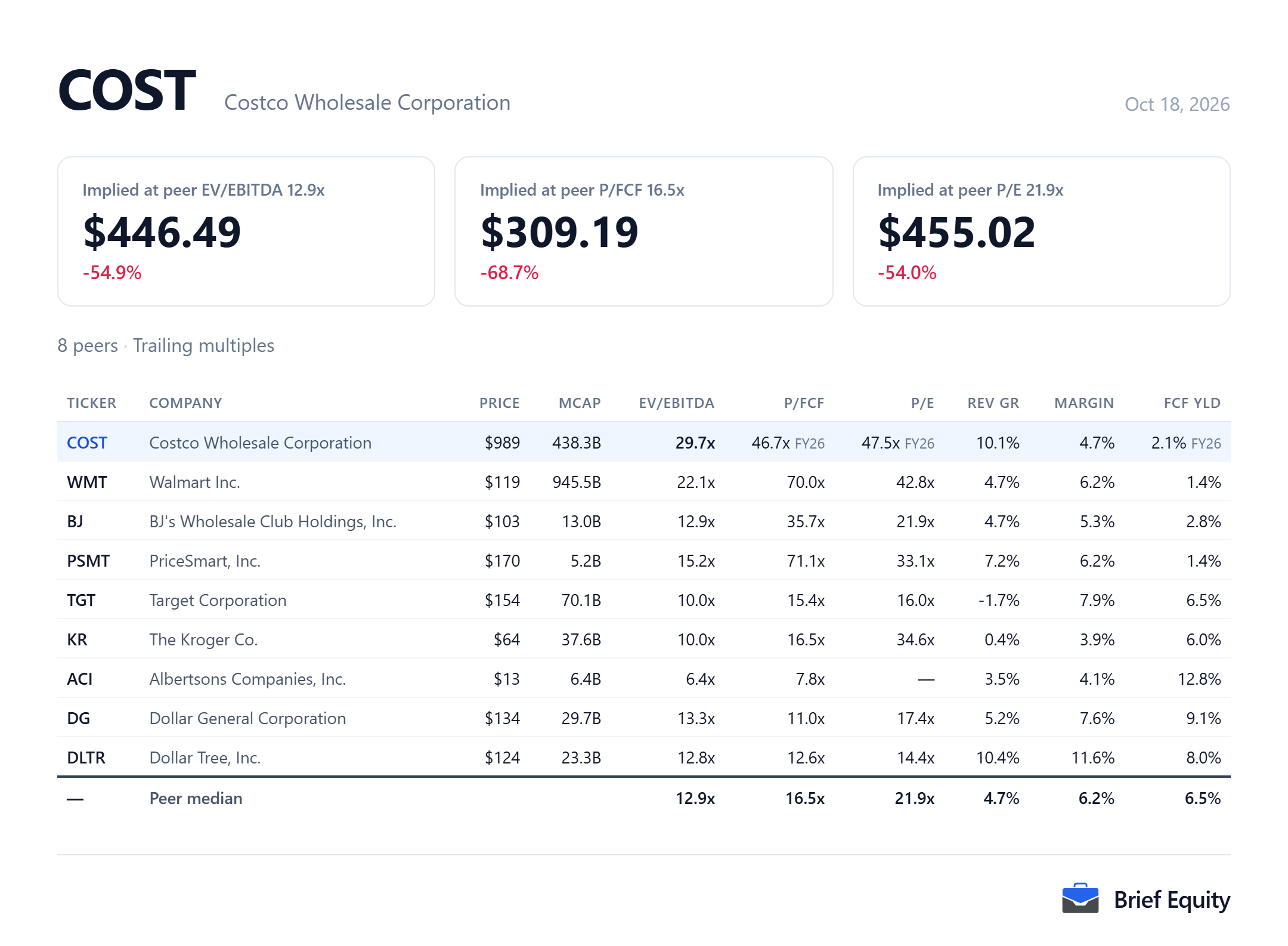
Costco is compared with eight retailers, chosen so that its warehouse clubs, its food business and its value pricing each have peers.
- WMT: mass retail, and warehouse clubs through Sam's Club
- BJ: warehouse club
- PSMT: warehouse club outside the United States
- TGT: general merchandise
- KR: grocery, with fuel and pharmacy
- ACI: grocery and pharmacy
- DG: value consumables
- DLTR: value retail
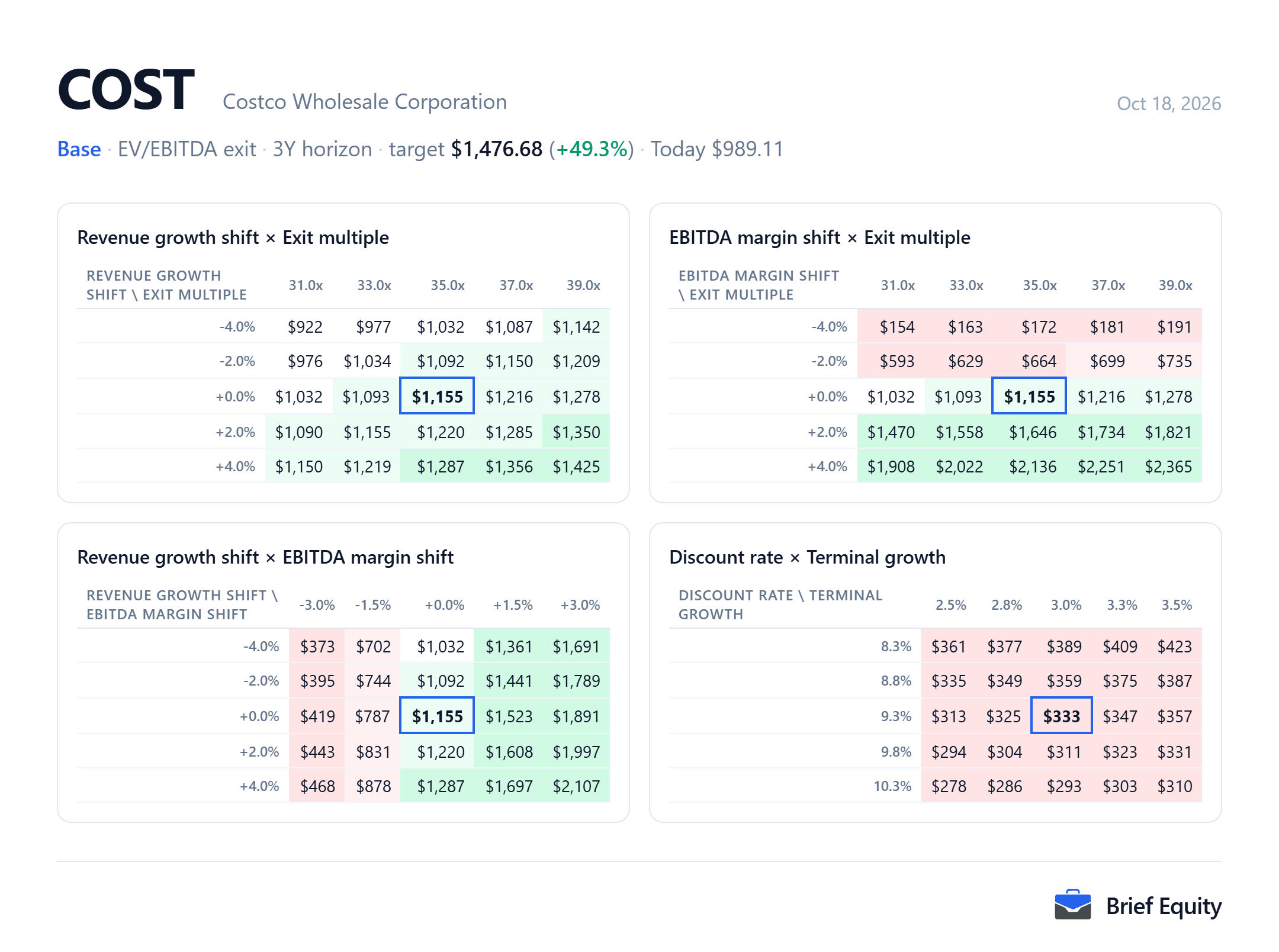
How the estimate moves with its assumptions
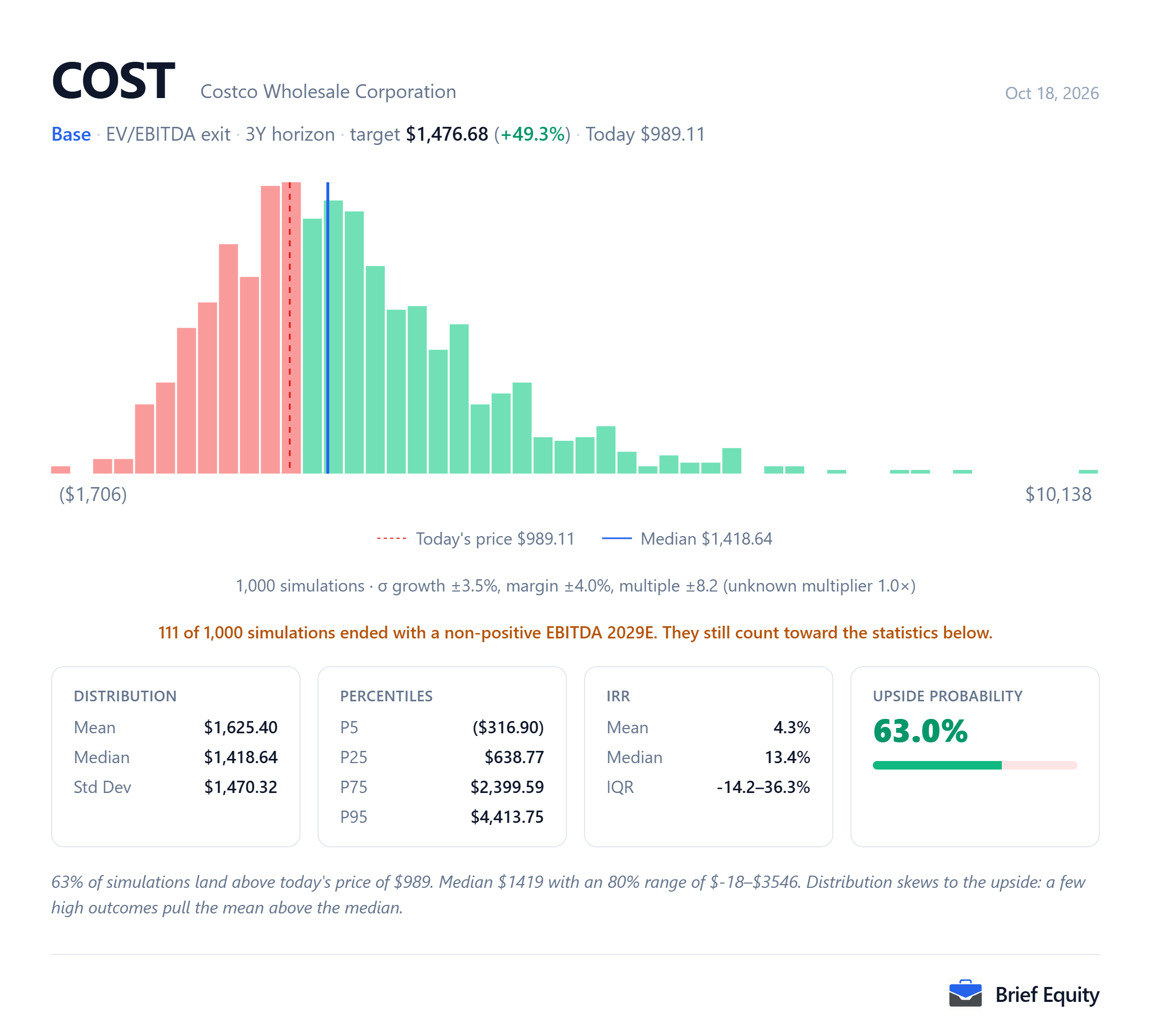
The estimate for Costco rests on a few assumptions, and the two pictures below show how far it moves when they change. The first changes two assumptions at a time, and the second runs the model many times with growth, margin and the exit multiple drawn at random.
Questions about Costco
These questions about Costco (COST) are answered from the documents listed under Sources.
- How many warehouses does Costco plan to open in fiscal 2027?
- Costco plans to open up to 33 new warehouses in fiscal 2027, including five relocations, according to its annual report for fiscal 2026. It opened 28 new warehouses, including three relocations, in fiscal 2026.
- What were Costco's membership renewal rates at the end of fiscal 2026?
- At the end of fiscal 2026, Costco's renewal rates were 92.3% in the United States and Canada and 89.8% worldwide.
- How many paid members does Costco have?
- Costco had 84.1 million total paid members at the end of fiscal 2026, up 3.8% from a year earlier, according to its earnings call of September 24, 2026.
- How large is Costco's gasoline business?
- Costco operated 774 gas stations at the end of fiscal 2026, and gasoline represented 11% of its total net sales in fiscal 2026.
- How much does Costco sell online?
- Costco's digitally enabled sales, which include third-party delivery, exceeded $33 billion in fiscal 2026, an increase of more than 20%.
- What dividend does Costco pay?
- In October 2026 Costco declared a quarterly cash dividend of $1.47 per share, payable on November 13, 2026.
Sources
The quotations and facts about Costco (COST) on this page rest on the documents below.
- Costco Annual Report on Form 10-K for fiscal 2026, October 7, 2026
- Costco press release on its fourth quarter and fiscal year 2026, September 24, 2026
- Costco fourth-quarter fiscal 2026 earnings call, September 24, 2026
- Costco third-quarter fiscal 2026 earnings call, May 28, 2026
- Costco's EV/EBITDA at each fiscal year-end since fiscal 2007, October 18, 2026
- Costco press release declaring its quarterly dividend, filed with the SEC, October 14, 2026
About this page
Brief Equity and its team hold no position in Costco (COST) as of October 18, 2026.
This page is research, not investment advice. It describes one model and the assumptions behind it, and market data is delayed. Read how these models are built and our editorial policy.
Related guides: EV/EBITDA explained, What is enterprise value (EV).