Valuation · EV/EBITDA model
Is Canada Goose (GOOS.TO) stock undervalued?
Brief Equity's EV/EBITDA model of Canada Goose (GOOS.TO), dated November 5, 2026, values the shares at CAD 18 by fiscal 2029, about 43% above the CAD 12.51 share price at that date. The stock looks undervalued if its margin recovers from a year that carried a one-time payment, and the company looks like a candidate for a sale, though the two shareholders who control about 92% of the votes decide whether one happens.
By The Brief Equity Team · Model dated · Published
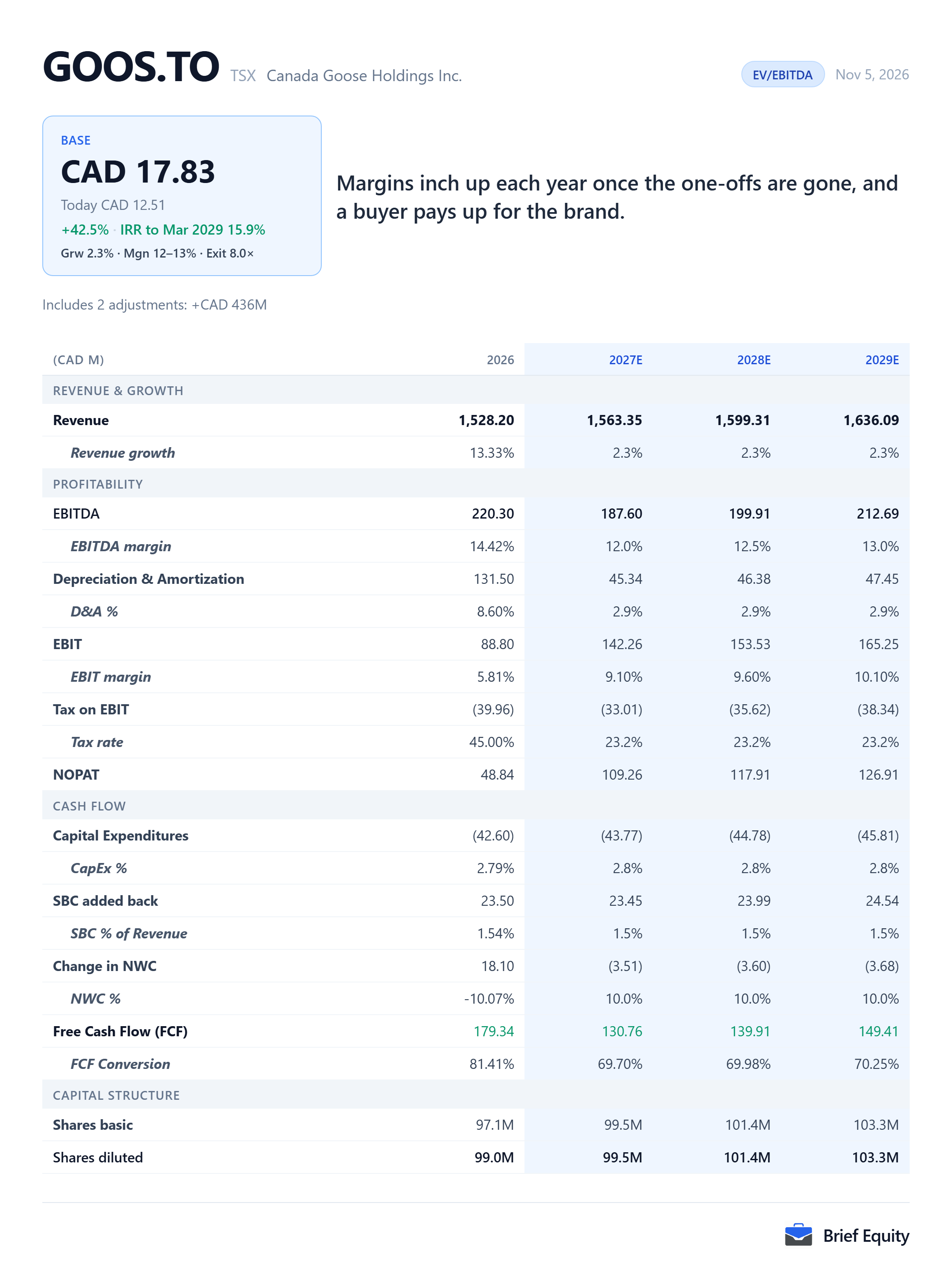
The model's assumptions for Canada Goose
Canada Goose's fiscal 2027 is the year ending in late March 2027, and the model's figures are in Canadian dollars. The figures below come from a quick model, built on a small set of stated assumptions and projected over three fiscal years. The model counts store rent as an operating cost, so its EBITDA is after rent. Analyst consensus revenue is shown beside the model's revenue for the same years.
| Fiscal 2027 | Fiscal 2028 | Fiscal 2029 | |
|---|---|---|---|
| Revenue, model | 1,563.35 | 1,599.31 | 1,636.09 |
| Revenue, analyst consensus | 1,576.80 | 1,640.11 | 1,636.27 |
| Revenue growth, model | 2.3% | 2.3% | 2.3% |
| EBITDA after rent, model | 187.60 | 199.91 | 212.69 |
| EBITDA margin after rent, model | 12.0% | 12.5% | 13.0% |
Why Canada Goose looks undervalued
Canada Goose's shares were 34.92% lower on November 5, 2026 than 52 weeks earlier, and at CAD 12.51 they look undervalued. Part of the case is that the company could be bought. In July 2025, Bain Capital was reported to be considering a sale of part or all of its controlling stake.
Canada Goose's sale reports went further in August 2025. CNBC reported that Boyu Capital had made a verbal offer and that Advent International had held discussions with Bain. CNBC later corrected its story to say the discussions were at an early stage and that no firm bids had been made.
Canada Goose's margin in fiscal 2026 included a one-time arbitration payment of CAD 43.8 million. On November 5, 2026, the company reiterated its outlook for an adjusted EBIT margin of 11% to 12% in fiscal 2027, an outlook that includes approximately 100 basis points of impact from United States tariffs. Its gross margin was 66.8% in the second quarter, against 64.0% a year earlier, and its president and chief operating officer described the gain as structural.
“Spanning 280 bps in Q2 and 210 year to date. And we do believe this is pretty much all structural.”
Elizabeth Danaher Clymer, President and Chief Operating Officer, Canada Goose fiscal 2027 second-quarter earnings call, November 5, 2026
Brief Equity's quick model of Canada Goose counts store rent as an operating cost, has the EBITDA margin after rent rising from 12.0% in fiscal 2027 to 13.0% in fiscal 2029, and applies an exit multiple of 8 times EBITDA. That produces a target of CAD 18 a share by fiscal 2029, about 43% above the share price. Holding the rest of the model constant, the CAD 12.51 price implies revenue falling 20.1% a year.
Canada Goose's chief executive bought 100,000 shares on the open market on September 9, 2026, at an average of about CAD 10.623. Under the share buyback that began on November 10, 2025, the company had repurchased 3,487,620 of its shares at a weighted average price of CAD 11.30 by October 31, 2026.
Canada Goose is controlled by two holders of multiple voting shares, Bain Capital and the chief executive, who held 92.0% of the votes at September 27, 2026. A sale therefore happens only if they agree, and in September 2025 the company said it was not planning any take-private move. If someone bids for their shares, a coattail agreement means public shareholders have to be offered a price at least as high.
Canada Goose's comparable sales are also still negative. Comparable sales in its own stores and online declined 7.5% in the second quarter of fiscal 2027, led by a decline of 26.9% in Europe, the Middle East and Africa, and the chief financial officer said they remained negative in October.
“DTC comparable sales remain negative in October as softer traffic persisted. With warmer weather delaying seasonal purchasing.”
Neil Bowden, Chief Financial Officer, Canada Goose fiscal 2027 second-quarter earnings call, November 5, 2026
What has to be true, and what would break it
The estimate for Canada Goose holds only if the conditions below are met, and each of them can fail.
What has to be true
- The EBITDA margin after rent rises from 12.0% in fiscal 2027 to 13.0% in fiscal 2029, with no repeat of the fiscal 2026 arbitration payment.
- The shares are valued at 8 times EBITDA after rent in fiscal 2029.
- For a sale of the company, Bain Capital and the chief executive, who hold 92.0% of the votes, agree to sell.
What would break it
- Comparable sales in the company's own stores and online keep falling, as they did in the second quarter of fiscal 2027 and in October 2026.
- The company misses its outlook for an adjusted EBIT margin of 11% to 12% in fiscal 2027.
- Bain Capital and the chief executive, who control the votes, choose not to sell.
The parts of Canada Goose's business
Canada Goose reports its revenue in three channels: its own stores and online (DTC), wholesale, and other. The table gives each channel's share of revenue and, for the two channels that grew, their share of the year's revenue growth.
| Share of revenue | Share of revenue growth | |
|---|---|---|
| DTC | 75.7% | 88.2% |
| Wholesale | 19.1% | 16.9% |
| Other | 5.2% |
Canada Goose beside its peers
Canada Goose is compared with eight companies: two premium outerwear brands, three premium brands that sell mostly through their own stores, a luxury group, and two outerwear companies that sell mostly through wholesale.
- MONC.MI: luxury outerwear, and the buyer of Stone Island
- AS: premium outerwear through Arc'teryx
- LULU: premium apparel sold mostly through its own stores
- RL: a premium brand sold through its own stores and wholesale
- TPR: a premium brand sold mostly through its own stores
- CPRI: a group of luxury brands
- COLM: outerwear sold mostly through wholesale
- VFC: outerwear through The North Face
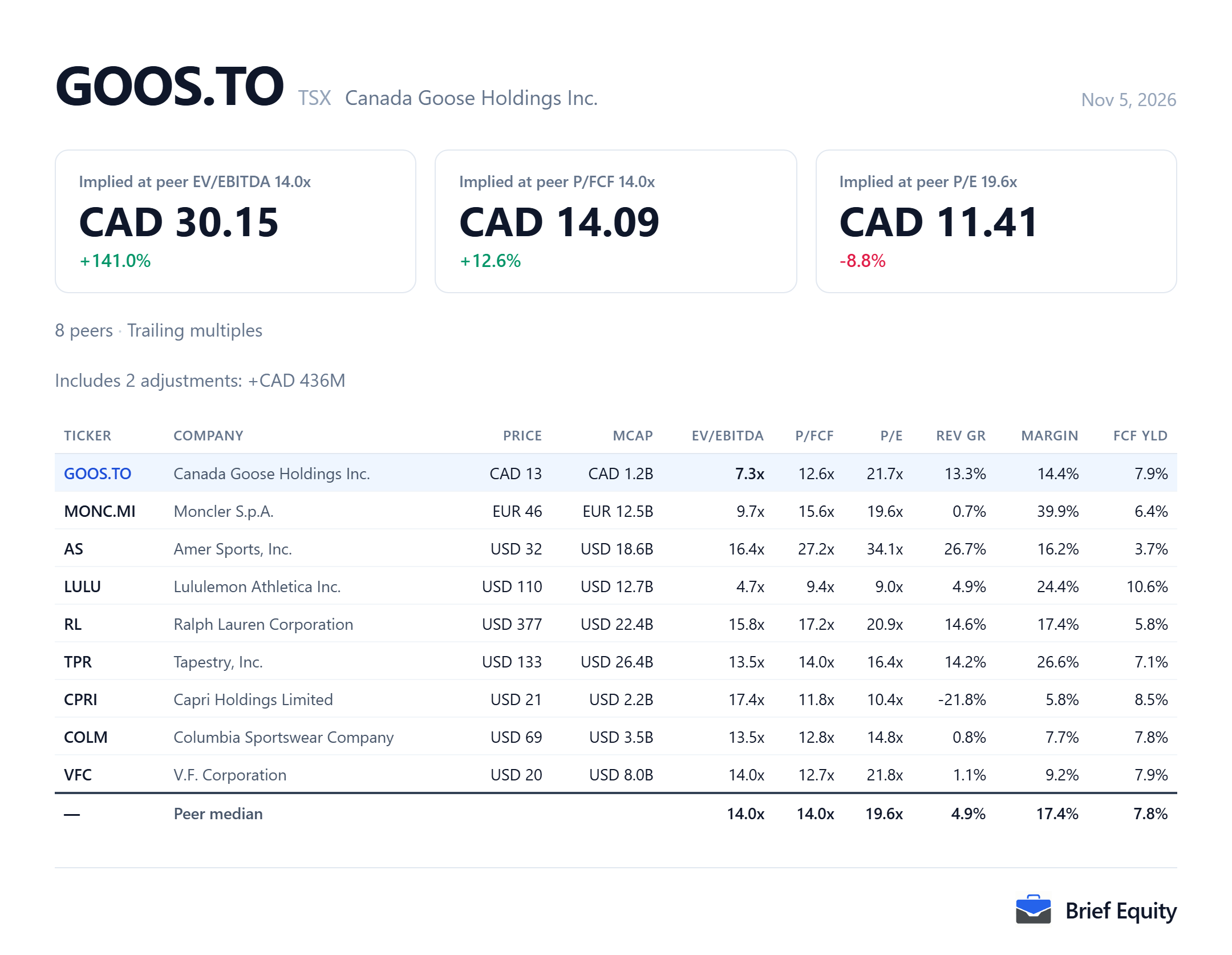
How the estimate moves with its assumptions
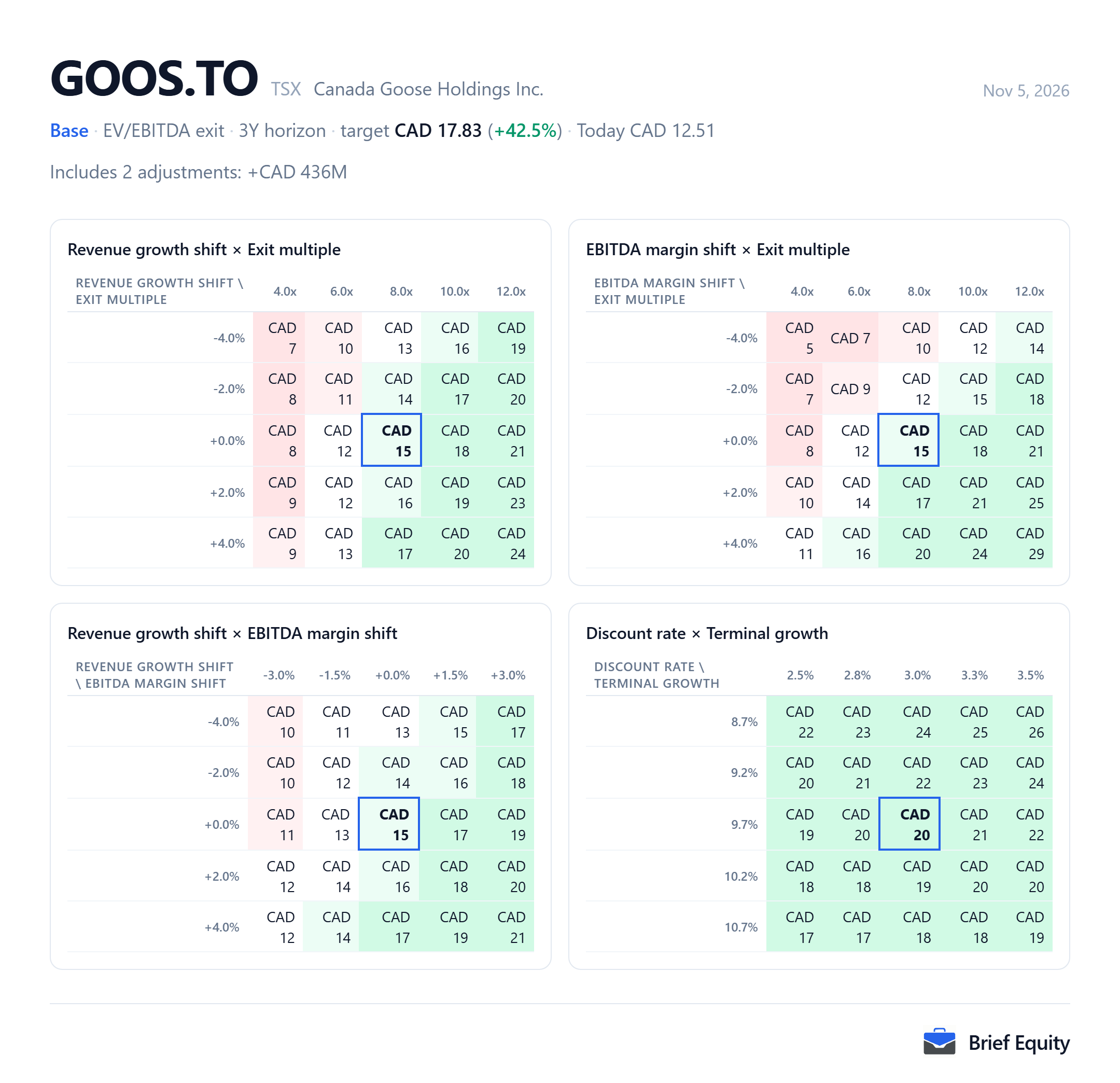
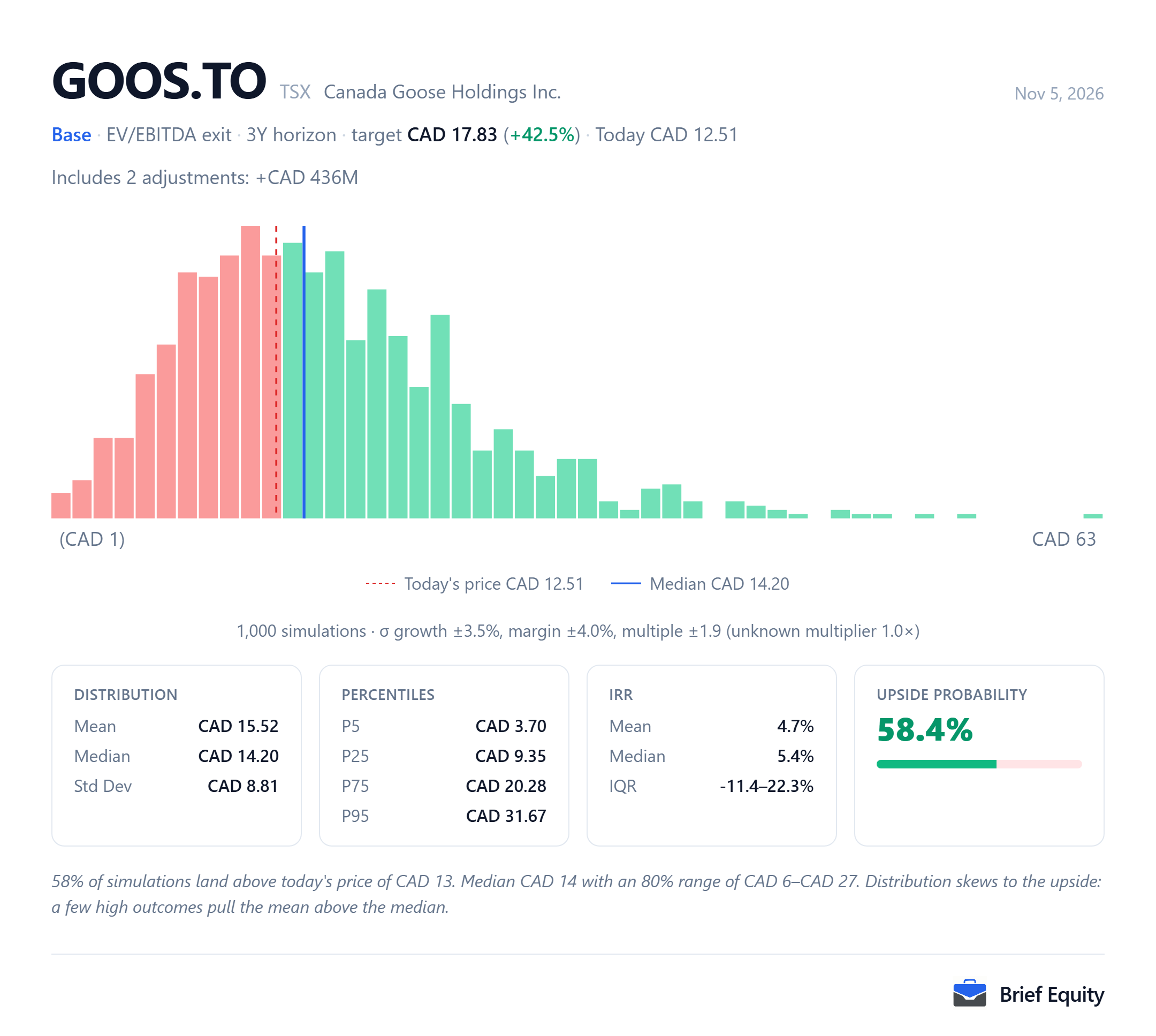
The estimate for Canada Goose depends on its assumptions, and the two pictures below show how far it moves when they change. The first varies two assumptions at a time. The second runs the model many times with growth, margin and the exit multiple varied at random.
Questions about Canada Goose
These questions about Canada Goose (GOOS.TO) are answered from the documents listed under Sources.
- Who controls Canada Goose?
- At September 27, 2026, Bain Capital and Canada Goose's chief executive held multiple voting shares representing 53.4% of the shares and 92.0% of the voting power.
- How many stores does Canada Goose have?
- Canada Goose had 94 permanent stores at the end of the second quarter of fiscal 2027, on September 27, 2026.
- Did Canada Goose sell Baffin?
- Yes. Canada Goose sold the Baffin footwear business to L.P. Royer Inc., and the sale closed on August 10, 2026.
Sources
The quotations and facts about Canada Goose (GOOS.TO) on this page rest on the documents below.
- Canada Goose second-quarter fiscal 2027 earnings release, November 5, 2026
- Canada Goose fiscal 2027 second-quarter earnings call, November 5, 2026
- Canada Goose management's discussion and analysis, second quarter of fiscal 2027, November 5, 2026
- Canada Goose interim financial statements, second quarter of fiscal 2027, November 5, 2026
- Canada Goose annual report on Form 20-F, fiscal 2026, May 15, 2026
- Canada Goose chief executive share purchase, September 10, 2026
- Report: Bain Capital mulls selling Canada Goose stake, July 10, 2025
- Canada Goose shares rise after report of take-private bids, August 27, 2025
- Canada Goose says it is not planning a take-private move, September 3, 2025
- 52-week share price change for Canada Goose on the TSX, November 5, 2026
About this page
Brief Equity and its team hold no position in Canada Goose (GOOS.TO) as of November 5, 2026.
This page is research, not investment advice. It describes one model and the assumptions behind it, and market data is delayed. Read how these models are built and our editorial policy.
Related guides: How to value a stock yourself (without Excel), How to build a DCF model (step by step).