Valuation · EV/EBITDA model
Is Boeing (BA) stock undervalued?
Brief Equity's quick EV/EBITDA model of Boeing, dated October 29, 2026, puts the shares at about $231 for 2028, against a price of $173.62 that day. Boeing looks cheap in the $170s, though not by a large amount, even if the 777X is certified by mid-2027, the 737 reaches 52 aircraft a month in the second half of 2027 and Boeing's free cash flow plan arrives on schedule.
By The Brief Equity Team · Model dated · Published
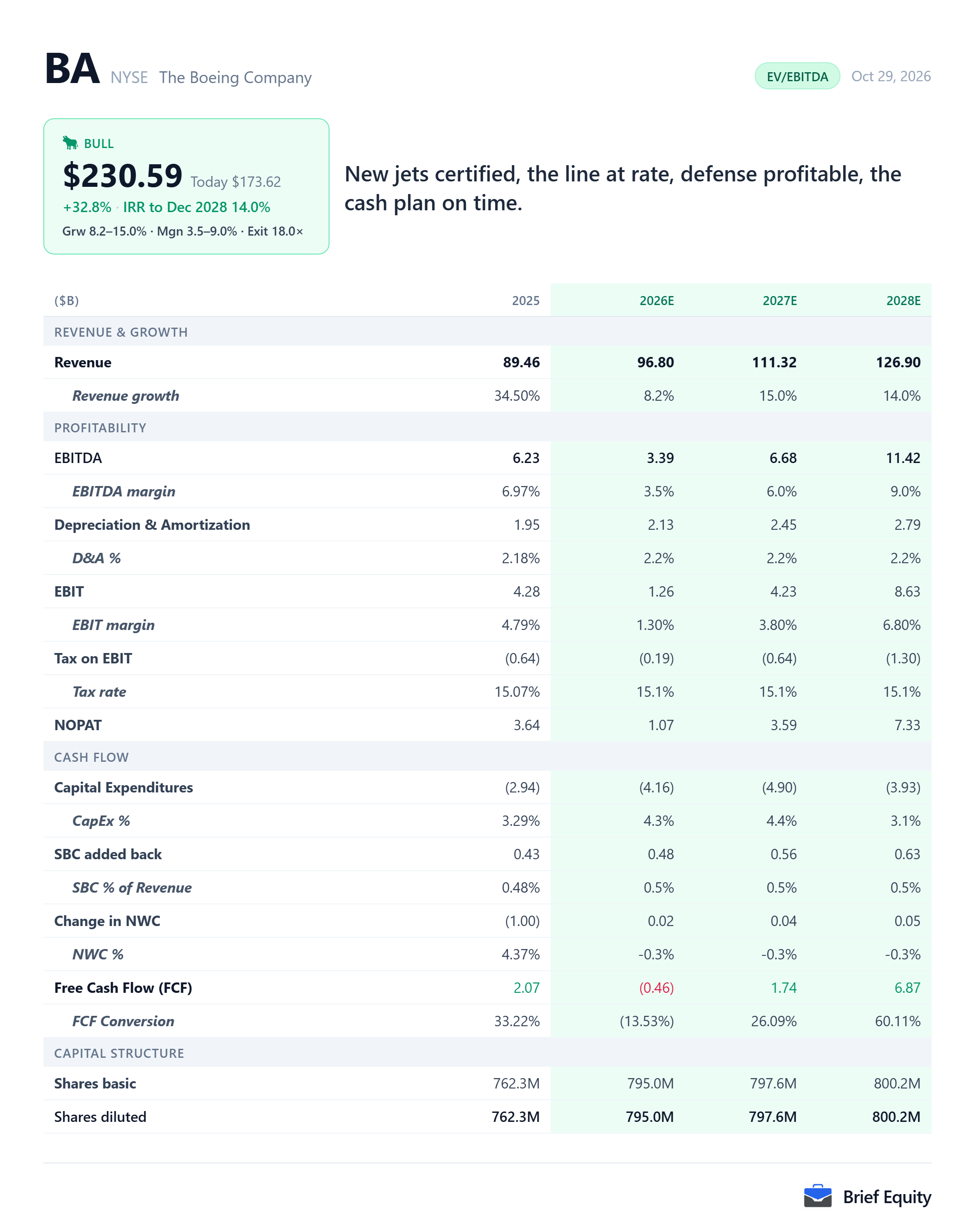
The model's assumptions for Boeing
Boeing's fiscal year is the calendar year, so each year in the table below is the company's own. The model runs three years, to 2028.
| 2026 | 2027 | 2028 | |
|---|---|---|---|
| Revenue, model | 96.80 | 111.32 | 126.90 |
| Revenue, analyst consensus | 96.84 | 109.58 | 121.33 |
| Revenue growth, model | 8.2% | 15.0% | 14.0% |
| EBITDA, model | 3.39 | 6.68 | 11.42 |
| EBITDA margin, model | 3.5% | 6.0% | 9.0% |
Why Boeing looks undervalued
Boeing looks cheap at $173.62 in Brief Equity's model, but not by a large amount, even if the 777X is certified by mid-2027, the 737 reaches a production rate of 52 aircraft a month in the second half of 2027, and Boeing's free cash flow plan arrives on schedule.
In this quick model, Boeing's revenue grows 15.0% in 2027, against analyst consensus of 13.1% for that year, and its EBITDA margin rises from 3.5% in 2026 to 9.0% in 2028, against analyst consensus of 8.5% for 2028. At 18 times 2028 EBITDA, the shares come to about $231 in 2028, about 33% above the price.
Boeing's free cash flow plan moved later in October 2026. With its third-quarter results on October 27, 2026, Boeing guided free cash flow of about $3 billion for 2027, against an analyst consensus of $5.5 billion according to LSEG data reported by Reuters, and named 2029 as the year it expects to reach $10 billion. Boeing's shares were down 9.6% that afternoon, and its chief executive described the new plan as a shift of about one year.
Boeing's chief executive said in September 2026 that 737 production was running at 47 aircraft a month but was not yet stable at that rate, and on October 27, 2026 Boeing's chief executive said full stability would take into 2027. Boeing's chief financial officer also said that 737 margins will not return to their 2018 level, after saying in July 2026 that they would approximate it by the end of the decade.
“We are making progress, but we still have more work to do And I am expecting it will take us into next year to get fully stable at this rate.”
Robert K. Ortberg, President and Chief Executive Officer, Boeing third-quarter 2026 earnings call, October 27, 2026
Boeing's 737-10 was certified by the FAA on October 20, 2026. In defense, the U.S. Navy selected Boeing for its F/A-XX fighter in September 2026, and Boeing's Defense, Space & Security backlog reached a record $101 billion at September 30, 2026.
What has to be true, and what would break it
Boeing looks cheap on this model, though not by a large amount, and the view weakens if its certification and production dates move later again.
What has to be true
- The FAA certifies the 777X by mid-2027, as Boeing's cash targets assume.
- The 737 becomes stable at 47 aircraft a month and reaches 52 a month in the second half of 2027.
- Boeing's free cash flow reaches about $3 billion in 2027 and about $6 billion in 2028, as guided in October 2026.
What would break it
- The 777X certification slips past mid-2027.
- 737 production stays unstable at 47 aircraft a month and rate 52 moves beyond 2027.
- Boeing's free cash flow plan moves later again, as it did in October 2026.
The parts of Boeing's business
Boeing reports three businesses, and in 2025 Commercial Airplanes was less than half of Boeing's revenue but most of its revenue growth.
| Share of revenue | Share of revenue growth | |
|---|---|---|
| Commercial Airplanes | 46.2% | 81.1% |
| Defense, Space & Security | 30.4% | 14.5% |
| Global Services | 22.9% | 4.2% |
Boeing beside its peers
Boeing is compared here with eight US-listed aerospace and defense companies: defense contractors, and makers of aircraft engines and parts.
- LMT: A defense contractor, against Defense, Space & Security
- GD: A defense contractor and business jet maker
- HWM: A maker of aircraft engine and structural parts
- NOC: A defense contractor and builder of military aircraft
- RTX: A maker of aircraft engines and systems, and a defense contractor
- TDG: A maker of aircraft components with a large aftermarket business, against Global Services
- GE: GE Aerospace, a maker of commercial and military jet engines
- LHX: A defense electronics and space contractor
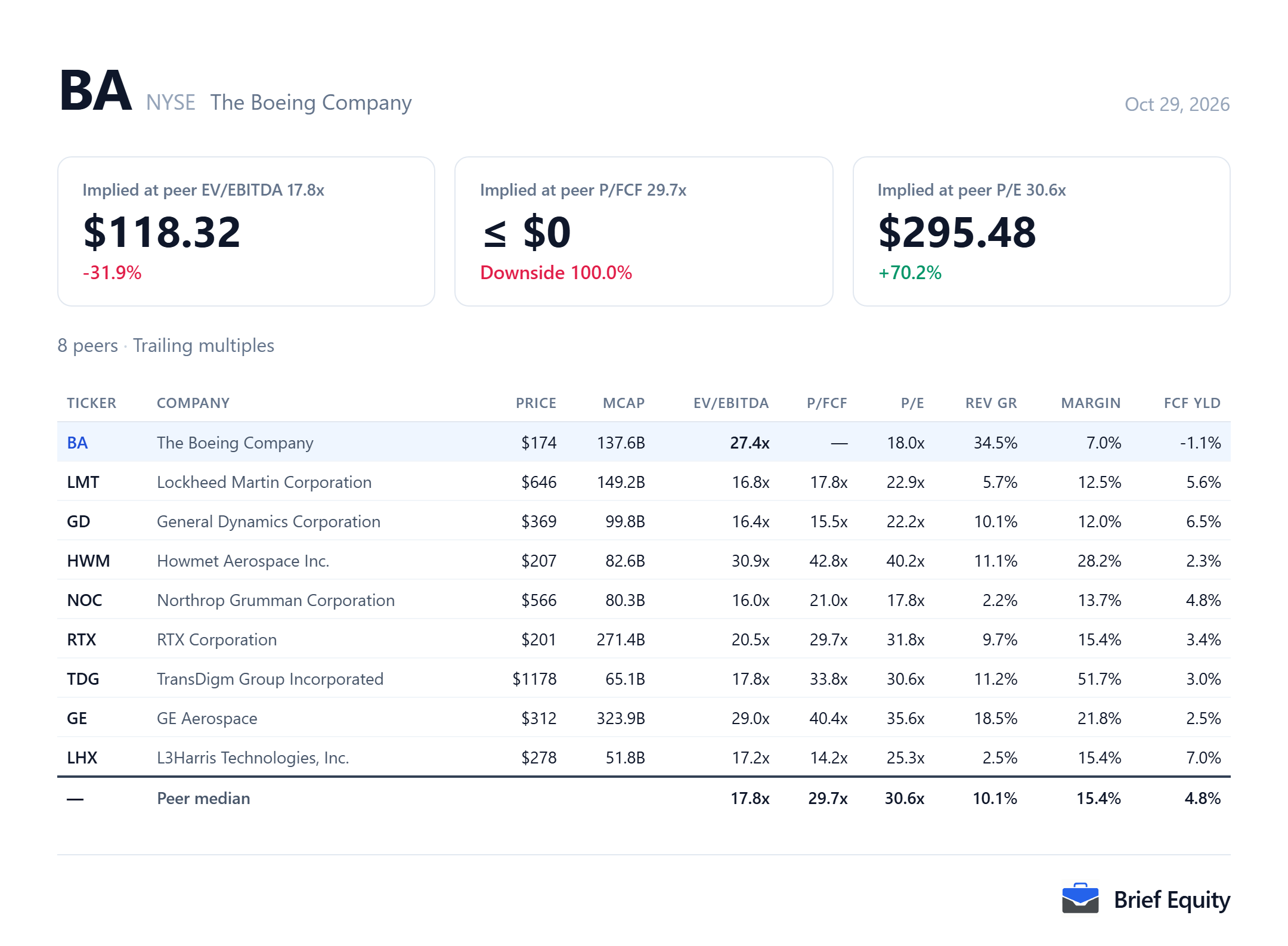
How the estimate moves with its assumptions
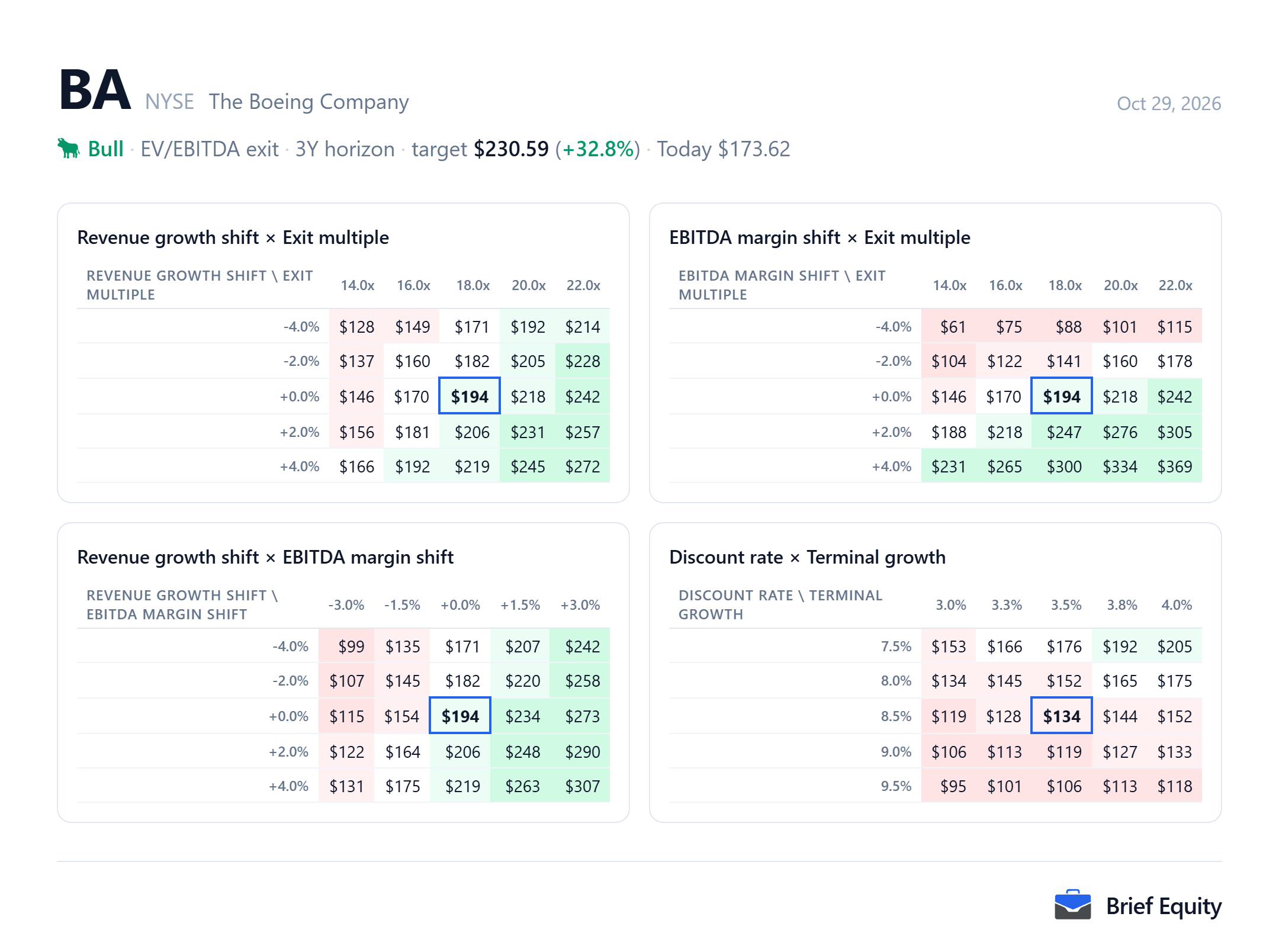
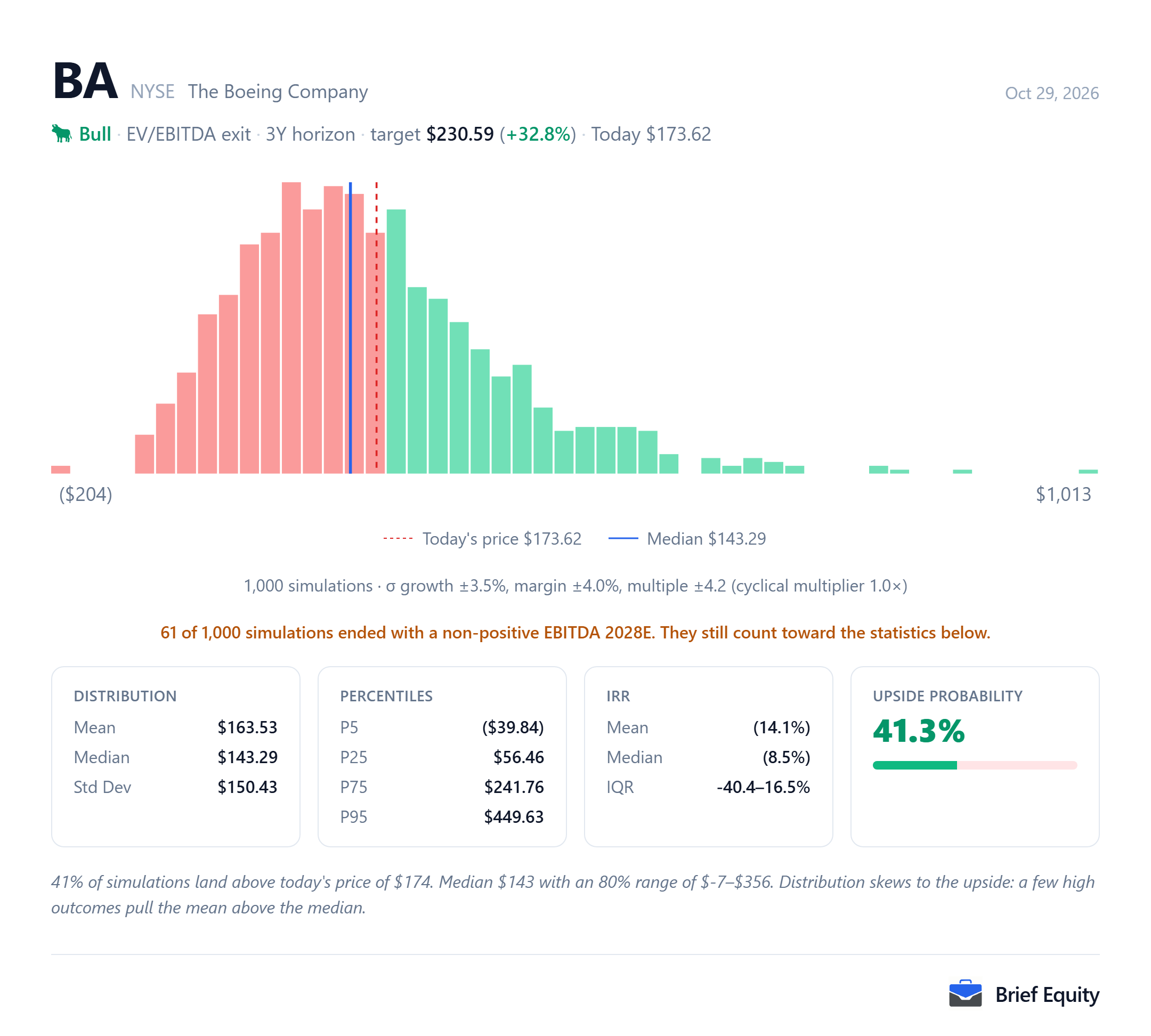
The two pictures below show how far the Boeing estimate moves when its assumptions change: one moves two assumptions at a time, and the other runs the model many times with growth, margin and the exit multiple drawn at random.
Questions about Boeing
These questions about Boeing (BA) are answered from the documents listed under Sources.
- What is Boeing's free cash flow guidance?
- On October 27, 2026, Boeing guided free cash flow of approximately $2 billion for 2026, about $3 billion for 2027, about $6 billion for 2028 and $10 billion for 2029.
- How much debt does Boeing have?
- At September 30, 2026, Boeing had consolidated debt of $45.9 billion and cash and investments in marketable securities of $20.7 billion, with $10.0 billion of undrawn credit facilities.
- When does Boeing's mandatory convertible preferred stock convert?
- Unless converted earlier, each share of Boeing's 6.00% Series A mandatory convertible preferred stock converts automatically on October 15, 2027, into between 5.8280 and 6.9940 shares of common stock, depending on the market value of the common stock.
- Did Boeing sell Jeppesen?
- On October 31, 2025, Boeing closed the sale of portions of its Digital Aviation Solutions business, including Jeppesen, ForeFlight, AerData and OzRunways, to Thoma Bravo for proceeds of $10,550 million, recording a gain of $9,566 million.
- How large is Boeing's commercial backlog?
- At September 30, 2026, Boeing's Commercial Airplanes backlog included over 6,300 airplanes valued at a record $612 billion.
Sources
The quotations and facts about Boeing (BA) on this page rest on the documents below.
- Boeing third-quarter 2026 results release, October 27, 2026
- Boeing third-quarter 2026 earnings call, October 27, 2026
- Boeing second-quarter 2026 earnings call, July 28, 2026
- Boeing quarterly report (Form 10-Q) for the third quarter of 2026, October 27, 2026
- Boeing annual report (Form 10-K) for 2025, January 30, 2026
- Reuters report, as published by The Standard, on Boeing's shares after its third-quarter results, October 28, 2026
- Boeing CEO on 737-10 certification and 737 production, at an investor conference, September 16, 2026
- U.S. FAA certifies Boeing 737-10, October 20, 2026
- U.S. Navy selects Boeing for F/A-XX program, September 29, 2026
About this page
Brief Equity and its team hold no position in Boeing (BA) as of October 29, 2026.
This page is research, not investment advice. It describes one model and the assumptions behind it, and market data is delayed. Read how these models are built and our editorial policy.
Related guides: EV/EBITDA explained, What is enterprise value (EV), What is free cash flow.