Valuation · EV/EBITDA model
Is Block (XYZ) stock undervalued?
On November 4, 2026, with the shares at $87.92, a quick EV/EBITDA model by Brief Equity valued Block at about $140 for 2028. Block looks undervalued on that model if Square keeps gaining share and the company's margin keeps rising, rather than the extra profit going into new projects.
By The Brief Equity Team · Model dated · Published
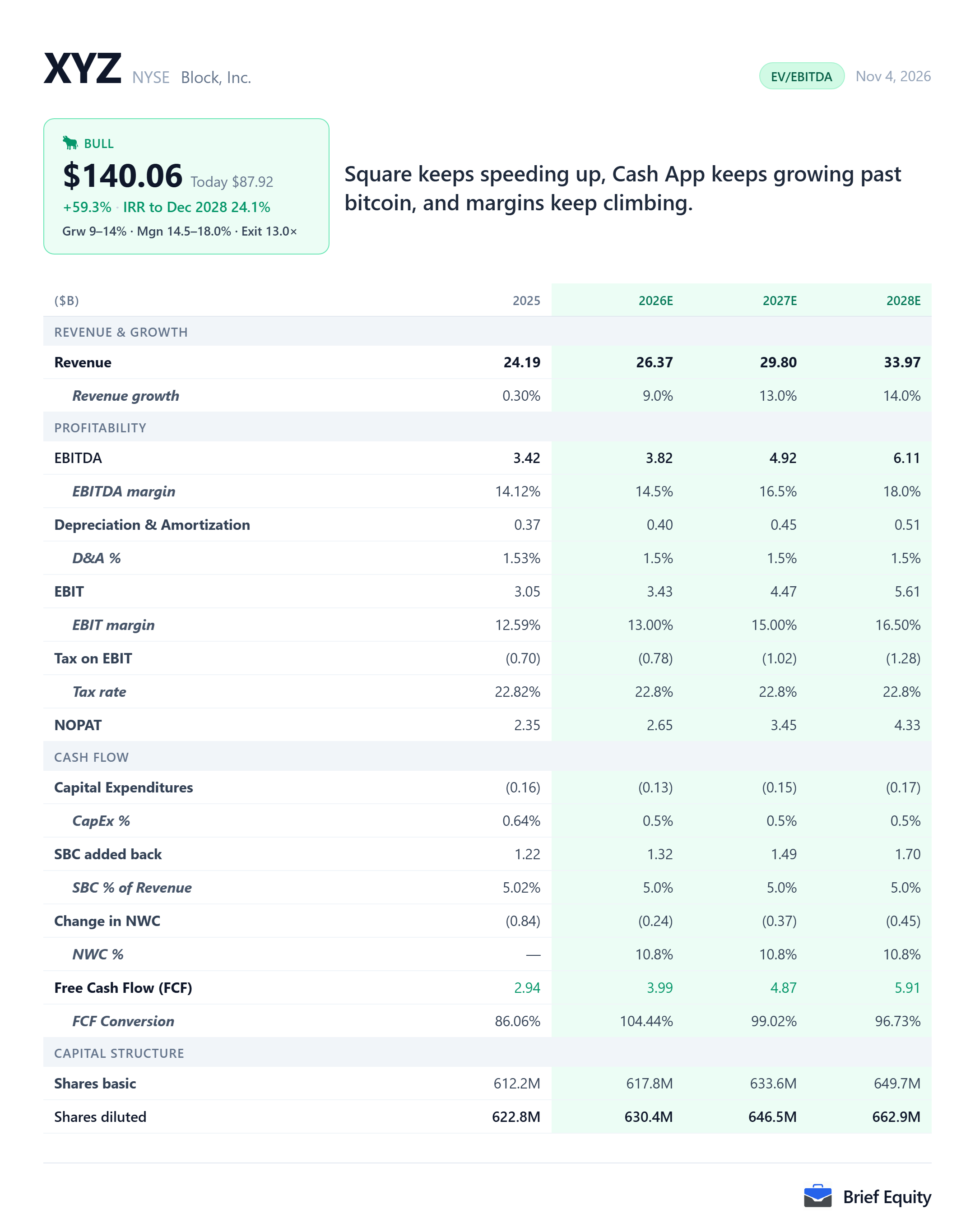
The model's assumptions for Block
Block's fiscal year is the calendar year, and the last year it has reported in full is 2025. The model runs three years, to 2028. Every row below is the model's own except the analyst consensus revenue. Block's revenue includes bitcoin sales booked at the full sale amount.
| 2026 | 2027 | 2028 | |
|---|---|---|---|
| Revenue, model | 26.37 | 29.80 | 33.97 |
| Revenue growth, model | 9.0% | 13.0% | 14.0% |
| EBITDA, model | 3.82 | 4.92 | 6.11 |
| EBITDA margin, model | 14.5% | 16.5% | 18.0% |
| Revenue, analyst consensus | 26.14 | 29.18 | 32.47 |
Why Block looks undervalued
Block beat its own guidance in the third quarter of 2026 and raised its outlook for the year. Gross profit grew 22% against the 18% the company had guided, and Square's gross payment volume grew 14%, which Block called its strongest growth rate since the first quarter of 2023.
Within Square, U.S. gross payment volume grew 10.4% and international gross payment volume grew 26% in the quarter. Block expects to accelerate Square's gross payment volume growth for the third consecutive year in 2027, and as of September only 16% of its U.S. sellers used its monetized software.
Block's rival Fiserv has lowered its expectations for Clover, its point-of-sale business. In August 2026 Fiserv lowered its 2026 outlook and said it expects Clover revenue growth in the mid-single digits for 2026, and its chief executive changed in June. Fiserv's new chief executive, Takis Georgakopoulos, said on the company's third-quarter 2026 call:
“And the last thing, which is really important, which is part of the constraint that Clover had in the past is it could not scale up when clients were becoming large, sophisticated, multi-location and so on and so forth, they would either leave us to a competitor or we would have to migrate them to one of our other platforms.”
Fiserv third-quarter 2026 earnings call, November 3, 2026
Not every competitor of Block is struggling: Toast ended the third quarter of 2026 with approximately 189,000 locations, up 21%.
Block's governance concentrates control with its co-founder. Jack Dorsey, whose title is Block Head and Chairperson, held 42.2% of the total voting power as of March 31, 2026, mostly through Class B shares that carry ten votes each, and he was also chief executive of Twitter from July 2015 until November 2021.
Block has also settled several anti-money laundering matters. In January 2025 it agreed to pay an $80 million fine to 48 state financial regulators, and in April 2025 New York fined it $40 million. In October 2026 it reached an agreement in principle with the Department of Justice on a deferred prosecution agreement over a charge that it failed to maintain an effective anti-money laundering program, and it accrued $764 million for the matter, after credit for prior regulatory resolutions. The resolution still needs a final agreement and court approval.
Block has made large acquisitions and run several projects outside its two segments. Afterpay was announced in August 2021 at approximately $29 billion in stock and closed in January 2022 for total consideration of $13.8 billion. Block bought 86.8% of TIDAL in April 2021 for $223.1 million in cash and $10.1 million of stock, and in the fourth quarter of 2024 Block recognized $73.5 million of goodwill impairment and $60.3 million of other impairment charges related to TIDAL.
In November 2024 Block said it was scaling back its investment in TIDAL and winding down TBD, giving it room to invest in bitcoin mining and Bitkey, its self-custody bitcoin wallet. Proto sells bitcoin mining systems containing Block's own chips, primarily to one customer, and Block held approximately 9,237 bitcoins at September 30, 2026.
Bitcoin also makes Block's revenue harder to read. It was 35% of Block's 2025 revenue but 4% of its gross profit, and excluding bitcoin, Cash App revenue grew 32% in the first nine months of 2026.
The model has Block's revenue growing 9.0% in 2026, 13.0% in 2027 and 14.0% in 2028, above the analyst consensus for 2027 and 2028, with the EBITDA margin rising from 14.5% to 18.0%. With an exit multiple of 13.0 times EBITDA, the model values Block at about $140 a share for 2028, about 59% above the share price.
Block's chief financial officer said on the third-quarter 2026 call that profit above plan will go back into new initiatives:
“Given the strong incremental margins and high-return investment opportunities we see, we plan to reinvest profit upside in long-term strategic growth initiatives like Neighborhoods and Builderlab, where we -- which we believe will shape Block for the next decade.”
Amrita Ahuja, Chief Financial Officer and Chief Operating Officer, Block third-quarter 2026 earnings call, November 3, 2026
Consumer lending carries the other risk. In the third quarter of 2026 Block's transaction, loan and consumer receivable losses increased 66%, while consumer lending origination volume grew 40%.
What has to be true, and what would break it
Block looks undervalued on this model if Square keeps gaining share and Block's margin keeps rising.
What has to be true
- Square's gross payment volume growth keeps accelerating, as Block expects for 2027.
- Block's revenue grows 13.0% in 2027 and 14.0% in 2028.
- Block's EBITDA margin rises from 14.5% in 2026 to 18.0% in 2028.
- Consumer lending losses stop growing faster than originations.
- The market pays about 13.0 times Block's EBITDA at the end of 2028.
What would break it
- Square's gross payment volume growth stops accelerating.
- Profit above plan goes into new initiatives such as Neighborhoods and Builderlab instead of lifting the margin.
- Consumer lending losses keep growing faster than originations, as they did in the third quarter of 2026.
- The market pays less than 13.0 times Block's EBITDA at the end of 2028.
The parts of Block's business
Block reports two segments, Cash App and Square, plus a Corporate and Other category for products and services not assigned to either segment.
| Share of revenue | |
|---|---|
| Cash App | 63.8% |
| Square | 34.9% |
| Corporate and Other | 1.3% |
Block beside its peers
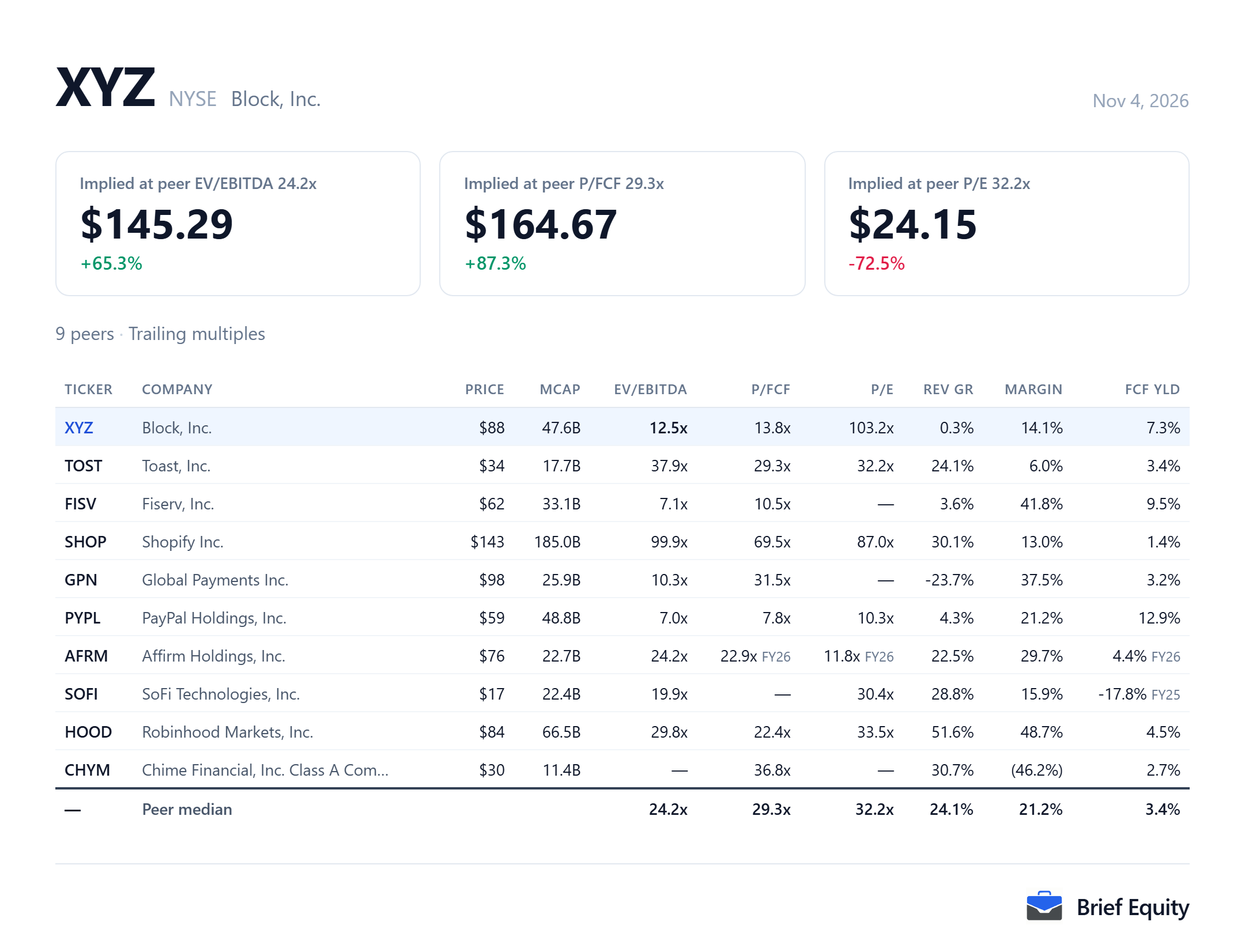
Block is compared here with nine US-listed companies, chosen to cover Square's seller business, Cash App's payments, banking, lending and investing, and Afterpay.
- TOST: Restaurant point of sale, against Square
- FISV: Owner of Clover, a Square rival
- SHOP: Merchant point of sale and software, against Square
- GPN: Merchant acquiring, against Square
- PYPL: Peer-to-peer payments and Venmo, against Cash App
- AFRM: Installment lending at checkout, against Afterpay
- SOFI: Consumer banking and lending, against Cash App
- HOOD: Retail investing and bitcoin, against Cash App
- CHYM: Neobank, against Cash App
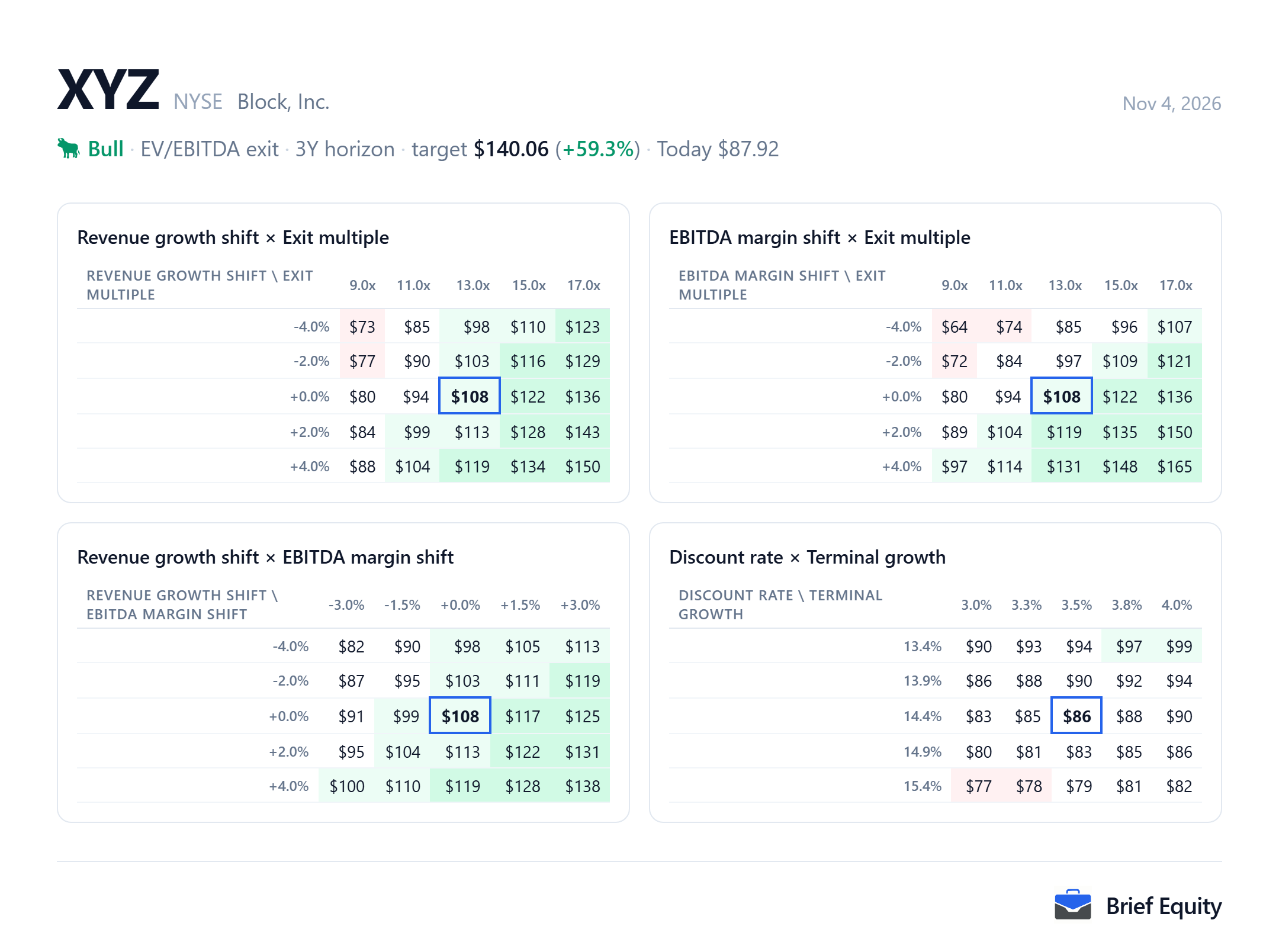
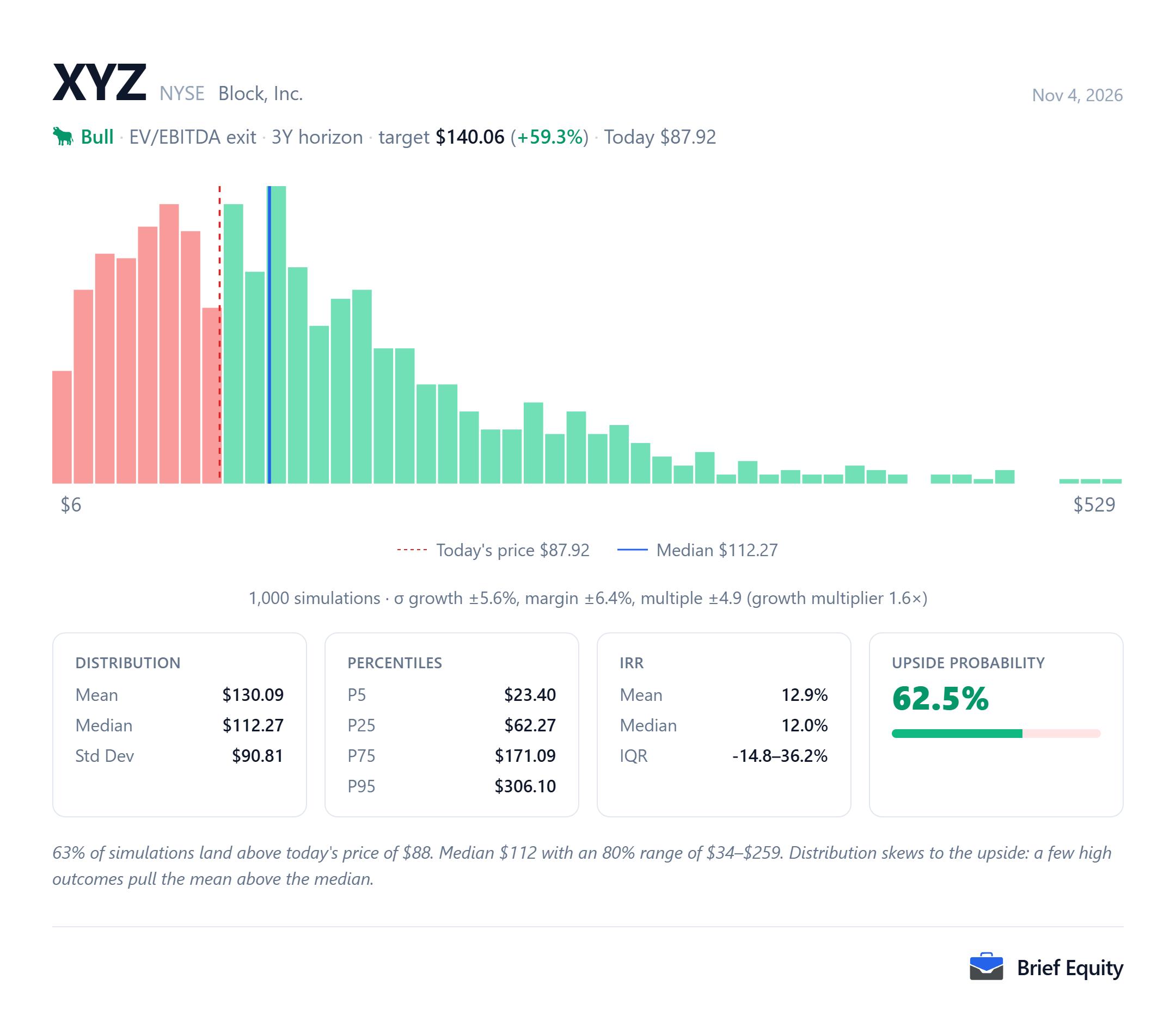
How the estimate moves with its assumptions
The two Block cards below test the estimate: the sensitivity grids move two assumptions at a time, and the Monte Carlo card reruns the model many times with growth, margin and the exit multiple drawn at random.
Questions about Block
These questions about Block (XYZ) are answered from the documents listed under Sources.
- How much of Block's voting power does Jack Dorsey hold?
- As of March 31, 2026, Jack Dorsey held 42.2% of Block's total voting power, through 1,000,000 Class A shares and 47,844,566 Class B shares.
- What did Block pay for Afterpay?
- Block completed the Afterpay acquisition on January 31, 2022, issuing 113,617,352 Class A shares with an aggregate fair value of $13.8 billion. Goodwill from the deal was allocated equally to Square and Cash App, according to Block's 2022 annual report.
- How much bitcoin does Block hold?
- As of September 30, 2026, Block held approximately 9,237 bitcoins for long-term investment purposes, with a fair value of $771.9 million.
- How many shares has Block repurchased in 2026?
- Block repurchased 11.6 million Class A shares for $700.9 million in the first nine months of 2026. It repurchased none in the third quarter, and about $4.6 billion remained authorized at September 30, 2026.
Sources
The quotations and facts about Block (XYZ) on this page rest on the documents below.
- Block annual report on Form 10-K for 2025, February 26, 2026
- Block quarterly report on Form 10-Q for the third quarter of 2026, November 3, 2026
- Block third-quarter 2026 shareholder letter, November 3, 2026
- Block third-quarter 2026 earnings call, November 3, 2026
- Block 2026 proxy statement, April 24, 2026
- Block annual report on Form 10-K for 2022, February 23, 2023
- Square announces plan to acquire Afterpay, August 2, 2021
- Block third-quarter 2024 shareholder letter, November 7, 2024
- Fiserv third-quarter 2026 earnings call, November 3, 2026
- Fiserv second-quarter 2026 earnings call, August 6, 2026
- Fiserv second-quarter 2026 results release, August 6, 2026
- Fiserv names Takis Georgakopoulos chief executive officer, June 15, 2026
- Toast third-quarter 2026 earnings call, November 3, 2026
- State regulators fine Block $80 million over Bank Secrecy Act and anti-money laundering violations, January 15, 2025
- Report on New York's $40 million fine against Block, April 10, 2025
About this page
Brief Equity and its team hold no position in Block (XYZ) as of November 4, 2026.
This page is research, not investment advice. It describes one model and the assumptions behind it, and market data is delayed. Read how these models are built and our editorial policy.
Related guides: How to read a 10-K (SEC filing), Where to read earnings transcripts and filings in one place, How to value a stock yourself (without Excel).