Valuation · EV/EBITDA model
Is Accenture (ACN) stock overvalued?
Brief Equity's EV/EBITDA model of Accenture (ACN), dated October 17, 2026, puts the shares at $248 by fiscal 2029, about 8% above the $229.68 share price at that date. Accenture looks less cheap than its earnings multiple suggests, and the estimate leaves little room above the share price. The estimate assumes that clients keep paying less for the same work as AI does more of it.
By The Brief Equity Team · Model dated · Published
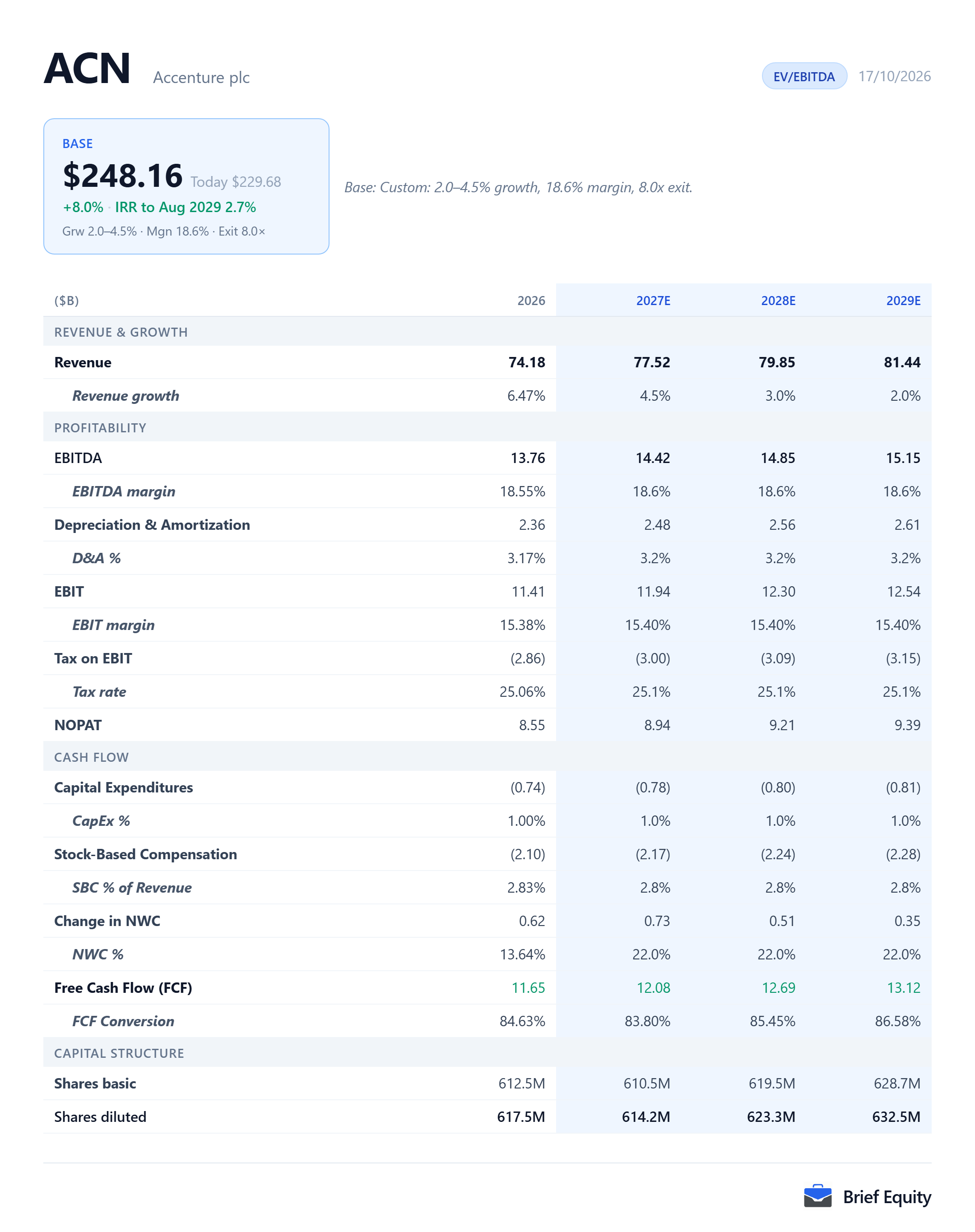
The model's assumptions for Accenture
Accenture's fiscal year ends on August 31, so fiscal 2027 runs from September 2026 to August 2027. The figures come from a quick model, built on a small set of stated assumptions and projected over three years.
| Fiscal 2027 | Fiscal 2028 | Fiscal 2029 | |
|---|---|---|---|
| Revenue, model | 77.52 | 79.85 | 81.44 |
| Revenue growth, model | 4.5% | 3.0% | 2.0% |
| EBITDA, model | 14.42 | 14.85 | 15.15 |
| EBITDA margin, model | 18.6% | 18.6% | 18.6% |
| Revenue, analysts' consensus | 77.45 | 81.34 | 85.84 |
Why Accenture looks overvalued
Accenture states in its annual report for fiscal 2026 that new technology has already replaced some of the services it sells, and that this will continue.
“Some of these technological developments have reduced and replaced, in whole or in part, some of our historical solutions and services and will continue to do so in the future.”
Accenture Annual Report on Form 10-K for fiscal 2026, October 16, 2026
Accenture's shares have risen a long way since June 2026, when the company bought back its own shares at an average price of $127.63. At $229.68 the shares look less cheap than they first appear.
For now, Accenture is benefiting from AI. Bookings with its eight emerging AI and data partners, which include Anthropic and OpenAI, more than tripled in fiscal 2026 compared with fiscal 2025, and revenue from that work more than doubled. Revenue per person grew 5% over the year, which the company's chief executive attributed partly to AI.
“So you are seeing an increase in revenue per person, which is what you would expect in part due to AI, but we're also in growth mode.”
Julie T. Sweet, Chair and Chief Executive Officer, Accenture fourth-quarter fiscal 2026 earnings call, October 1, 2026
On the call for the fourth quarter of fiscal 2026, Accenture's chief executive said pricing was lower in many areas of the business. Accenture's guidance for fiscal 2027 is revenue growth of 3% to 6% in local currency, of which 2% to 2.5% is expected to come from acquisitions, and its organic growth in fiscal 2026 was approximately 3%.
The estimate for Accenture depends on clients continuing to pay less for the same work as AI performs more of it.
Accenture traded at 14.57 times its normalized earnings expected for the next twelve months in October 2026, against an average of 23.90 times over the previous five years. The model values the company at 8 times its fiscal 2029 EBITDA, which puts the shares at $248 by fiscal 2029, about 8% above the share price at the model's date.
The model assumes that Accenture's revenue grows 4.5% in fiscal 2027, 3% in fiscal 2028 and 2% in fiscal 2029, against the analysts' consensus of 5.0% a year from fiscal 2026 to fiscal 2029.
What has to be true, and what would break it
The estimate for Accenture holds only if the conditions below are met, and each of them can fail.
What has to be true
- Clients keep paying less for the same work as AI performs more of it.
- Revenue grows 4.5% in fiscal 2027, 3% in fiscal 2028 and 2% in fiscal 2029.
- The EBITDA margin is 18.6% in each year from fiscal 2027 to fiscal 2029.
- The market values Accenture at 8 times EBITDA at the end of fiscal 2029.
What would break it
- The opportunities from AI keep outweighing the AI-related efficiencies in Accenture's business, as its management expects.
- Revenue grows in line with the analysts' consensus of 5.0% a year.
- The market values Accenture at a higher multiple of its EBITDA.
The parts of Accenture's business
Accenture divides its revenue into two types of work, consulting and managed services. The table gives each one's share of Accenture's revenue, and of its revenue growth in US dollars, for fiscal 2026.
| Share of revenue | Share of revenue growth | |
|---|---|---|
| Consulting | 49.7% | 39.4% |
| Managed Services | 50.3% | 60.6% |
Accenture beside its peers
Accenture is compared with eight IT services companies, chosen so that each of its two types of work has several peers.
- IBM: consulting
- EPAM: consulting, through engineering and digital projects
- GLOB: consulting, through digital projects
- CTSH: managed services, through application outsourcing
- INFY: managed services, through offshore delivery
- WIT: managed services, through offshore delivery
- KD: managed services, through infrastructure services
- G: managed services, through business operations
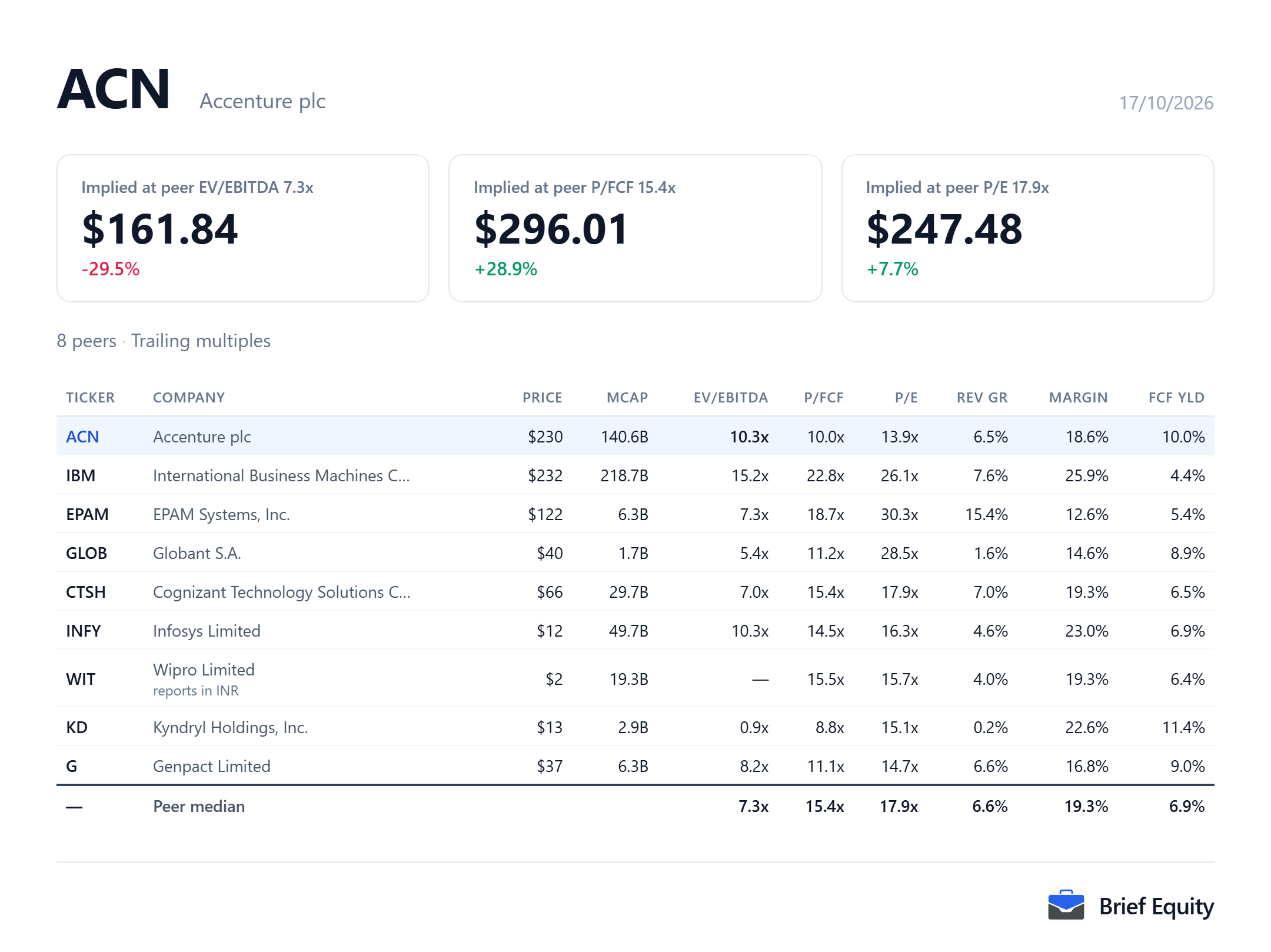
How the estimate moves with its assumptions
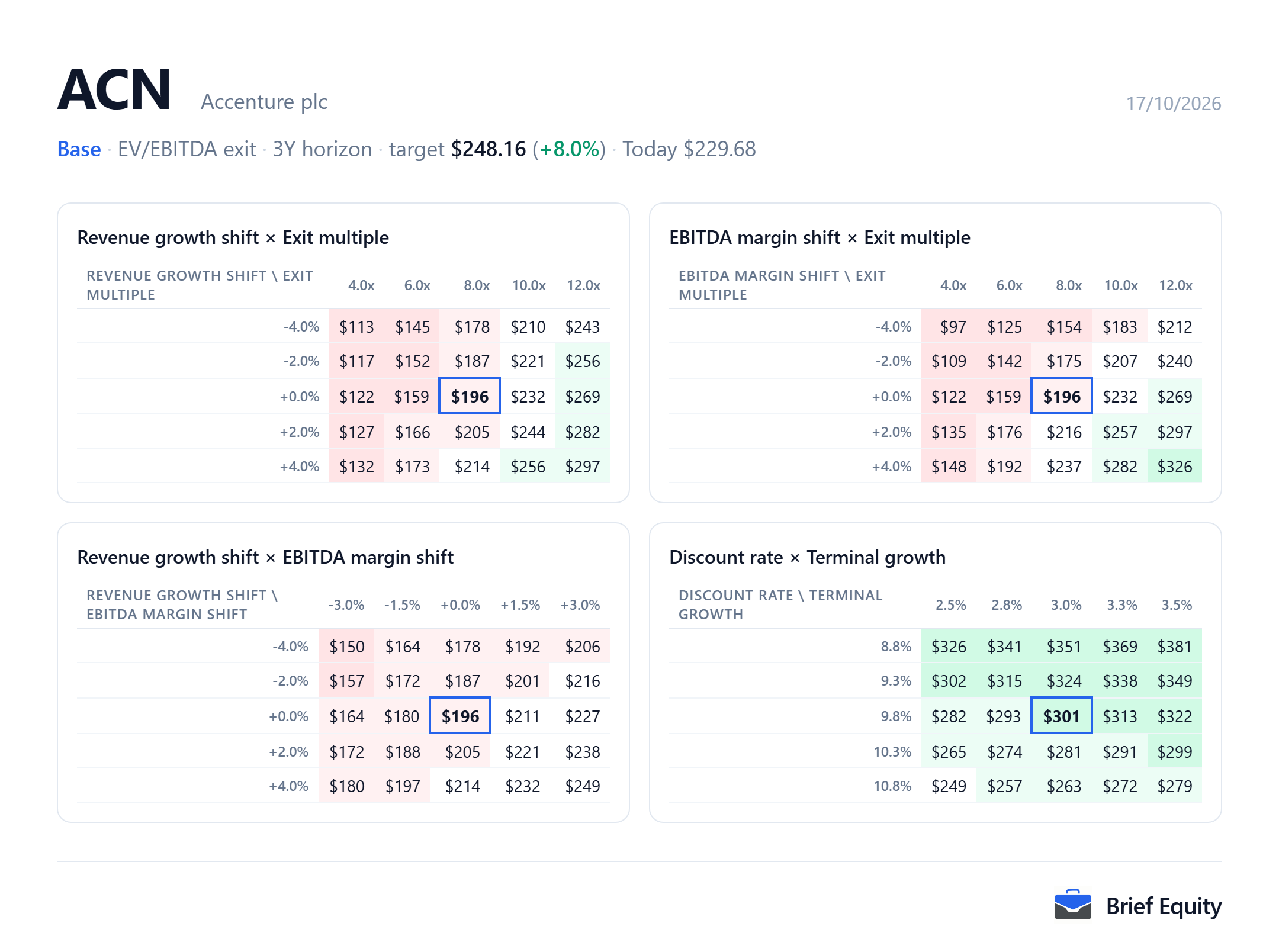
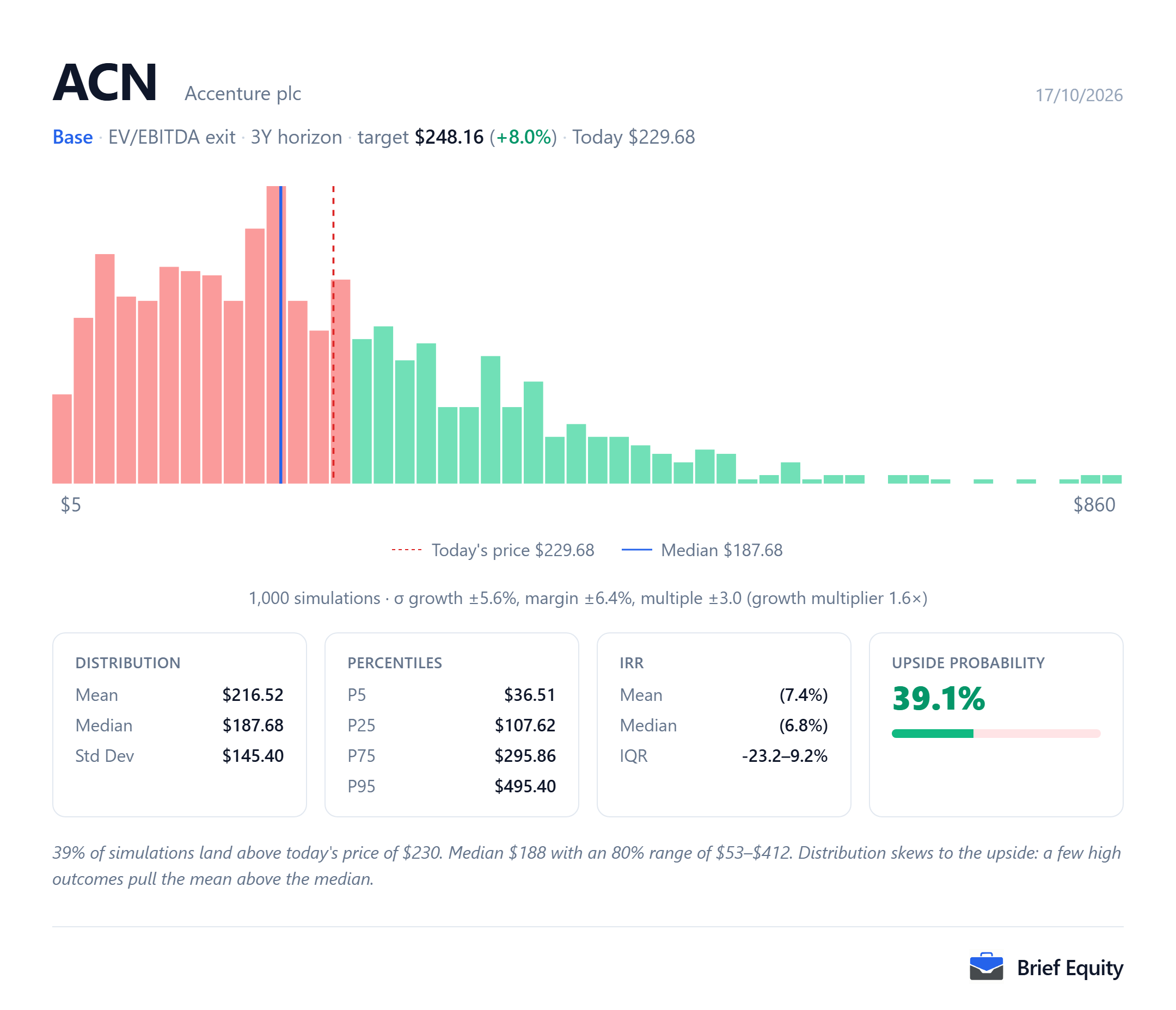
The estimate for Accenture rests on a few assumptions, and the two pictures below show how much it changes when they move. The first changes two assumptions at a time. The second repeats the model many times with growth, margin and the exit multiple drawn at random.
Questions about Accenture
These questions about Accenture (ACN) are answered from the documents listed under Sources.
- How much did Accenture return to shareholders in fiscal 2026?
- Accenture returned $11.5 billion to shareholders in fiscal 2026, including $7.5 billion in share repurchases or redemptions.
- What were Accenture's new bookings in fiscal 2026?
- Accenture's new bookings were $84.54 billion in fiscal 2026, with a book-to-bill of 1.1.
- What are Accenture's remaining performance obligations?
- Accenture had remaining performance obligations of approximately $37 billion at August 31, 2026, against $34 billion a year earlier.
- How much did Accenture spend on acquisitions in fiscal 2026?
- Accenture deployed $4.9 billion across 17 acquisitions in fiscal 2026, according to its earnings call of October 1, 2026.
- How many people does Accenture employ?
- Accenture had 814,391 employees at August 31, 2026, according to its Investor Day presentation of October 14, 2026.
Sources
The quotations and facts about Accenture (ACN) on this page rest on the documents below.
- Accenture Annual Report on Form 10-K for fiscal 2026, October 16, 2026
- Accenture press release on its fourth quarter and full fiscal year 2026, October 1, 2026
- Accenture fourth-quarter fiscal 2026 earnings call, October 1, 2026
- Accenture third-quarter fiscal 2026 earnings call, June 18, 2026
- Accenture Investor Day presentation, filed with the SEC, October 14, 2026
- Accenture's forward earnings multiple against its five-year average, October 14, 2026
About this page
Brief Equity and its team hold no position in Accenture (ACN) as of October 17, 2026.
This page is research, not investment advice. It describes one model and the assumptions behind it, and market data is delayed. Read how these models are built and our editorial policy.
Related guides: EV/EBITDA explained, What is enterprise value (EV), What is the P/E ratio.